
Mindmap
Nat 5 Physics Waves and Radiation
Inhalt der Mindmap
Nat 5 Physics Waves and Radiation
Nuclear Radiation
- Atoms are made up of protons, neutrons and electrons
- Ionisation is when an atoms loses or gains an electron and becomes charged. If it loses an electron is becomes positive and if is gains it becomes negative
- Atoms can be ionised in many ways. There are three main types of ionising radiation
- Alpha
- made up of 2 protons and two neutrons
- Helium Nucleus
- very slow and heavy compared to beta and gamma
- most ionising out of the three
- stopped by a sheet of paper
- positively charged
- made up of 2 protons and two neutrons
- Beta
- fast moving electron
- smaller and faster than alpha
- produced when a neutron decays into a proton
- negative
- not as ionising as alpha
- stopped by sheet of aluminium
- Gamma
- electromagnetic wave
- travel at the speed of light 3x10^8 m/s
- no mass
- no charge
- very weakly ionising
- can only be stopped with a block of lead
- Isotopes are atoms with the same number of protons but a different number of neutrons
- Radiation will turn photographic film black
- Gamma can be detected with a geiger muller tube
- Safety
- Limit time exposed
- Wear protective clothing
- Hold radiation away from face
- Wear protective clothing
- Limit time exposed
- Uses of Radiation
- Radiotherapy
- Medical tracers
- alpha radiation is used in smoke dectectors
- monitor thickness of paper- beta
- Dosimetry is the measurement of the amount of radiation
- Activity
- The number of nuclei decaying every second
- Measure in Becquerels (Bq)
- activity =number of decays/time
- Absorbed Dose
- The amount which is absorbed per 1kg of material
- Measured in Grays (Gy)
- Absorbed Dose = Energy/ mass
- Equivalent Dose
- Harming effect radiation has on the body
- Measured in sieverts (Sv)
- Equivalent Dose = Absorbed Dose x Weighting Factor
- Weighting factor is how dangerous the radiation is
- Higher the Weighting factor the more dangerous
- Found in Data Sheet
- Higher the Weighting factor the more dangerous
- Weighting factor is how dangerous the radiation is
- Activity
- Half Life is the amount of time it takes for the radioactivity of a substance to half
- Nuclear Fission/ Fusion
- Fission
- When the nucleus of a large atom is split creating two smaller nuclei, neutrons and a large amount of energy
- Can cause chain reaction
- When the nucleus of a large atom is split creating two smaller nuclei, neutrons and a large amount of energy
- Fusion
- Occurs at very high temperatures. Process of joining two samll nuclei together and releasing a lot of energy
- Nuclear fusion is better than fission as it is safer, produces less harmful waste, easy to get fuel. However it needs very high temperatures which is very difficult
- Occurs at very high temperatures. Process of joining two samll nuclei together and releasing a lot of energy
- Fission
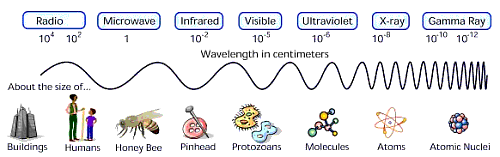
The Electromagnetic Spectrum
- The elctromagnetic spectrum is a family of waves which are all transverse waves
- All EM spectrum waves travel at 3x10^8 m/s or 3,000,00,000 m/s
- Gamma waves are used to kill cancer and are detected by a geiger-muller tube
- X-rays are used to take photos of your body and are dectected by photographic film
- Turn photographic film black
- Ultraviolet can be used to treat acne and too much can cause skin damage
- Visible light is separated in seven different colours Red, Orange, Yellow, Grean, Blue, Indigo and Violet. (ROYGBIV)
- Red has a longer wave length than violet
- Visible light is detected by our eyes and can be used as a laser
- Infrared us heat radiation and can be dectected by a thermometer
- Used in medicine as heat treatment and in industry to dry paint
- Microwaves are detected by an aerial and is used for mobile phones
- Radio/TV waves are dected by an aerial and carry programmes
- Gamma has the highest frequency and the shortest wavelength and radio waves have the lowest frequency and the longest wavelength
Waves
- All waves transfer energy
- Longitudinal waves vibrate in the same direction as the direction the wave is travelling
- Sound waves
- In transverse waves the vibration is at a right angle to the direction the wave is travelling in
- Radio waves, Light waves, water waves
- Wavelength is the distance from peak to peak or trough to trough
- measured in metres
- Symbol- lambda
- measured in metres
- The amplitude of a wave is the height of the wave from the middle point to the peak
- units vary
- Frequency is the measure of the number of waves passing a point each second or the number of waves per second
- frequency= no. of waves/ time
- measured in hertz (Hz)
- Symbol is f
- frequency= no. of waves/ time
- The period of a wave is the time taken for one wave to pass a point.
- period = 1/ frequency
- Symbol is T
- measured in seconds (s)
- period = 1/ frequency
- Wave equation
- speed= frequency x wavelength
- Diffraction is the bending of waves round an object
- The longer the wavelength/ lower the frequency the better a wave diffracts
- The shorter the wavelength/ the higher the frequency the less the wave diffracts
Light
- When the speed of light changes when it travels from one substance to another it is called refraction
- If the light travels at an angle to the normal the direction and the speed changes
- If a ray is travelling from air to glass it bends towards the normal and when it travels from glass back to air it bends away from the normal
- Long sightedness can be corrected using a convex lense and short with a concave lense
- Convex lense focuses light to one point
- Concave lenses spread light out
Bilder und Dateien der Mindmap
Informationen
- Beschreibung
- High School Physics (Unit 1) Mindmap am Nat 5 Physics Waves and Radiation, erstellt von CC410 am 28/04/2015.
- Erstellt von
- CC410
- Aufrufe
- 153
- Tags
- Bewertung