
Mindmap
Inglês estudos
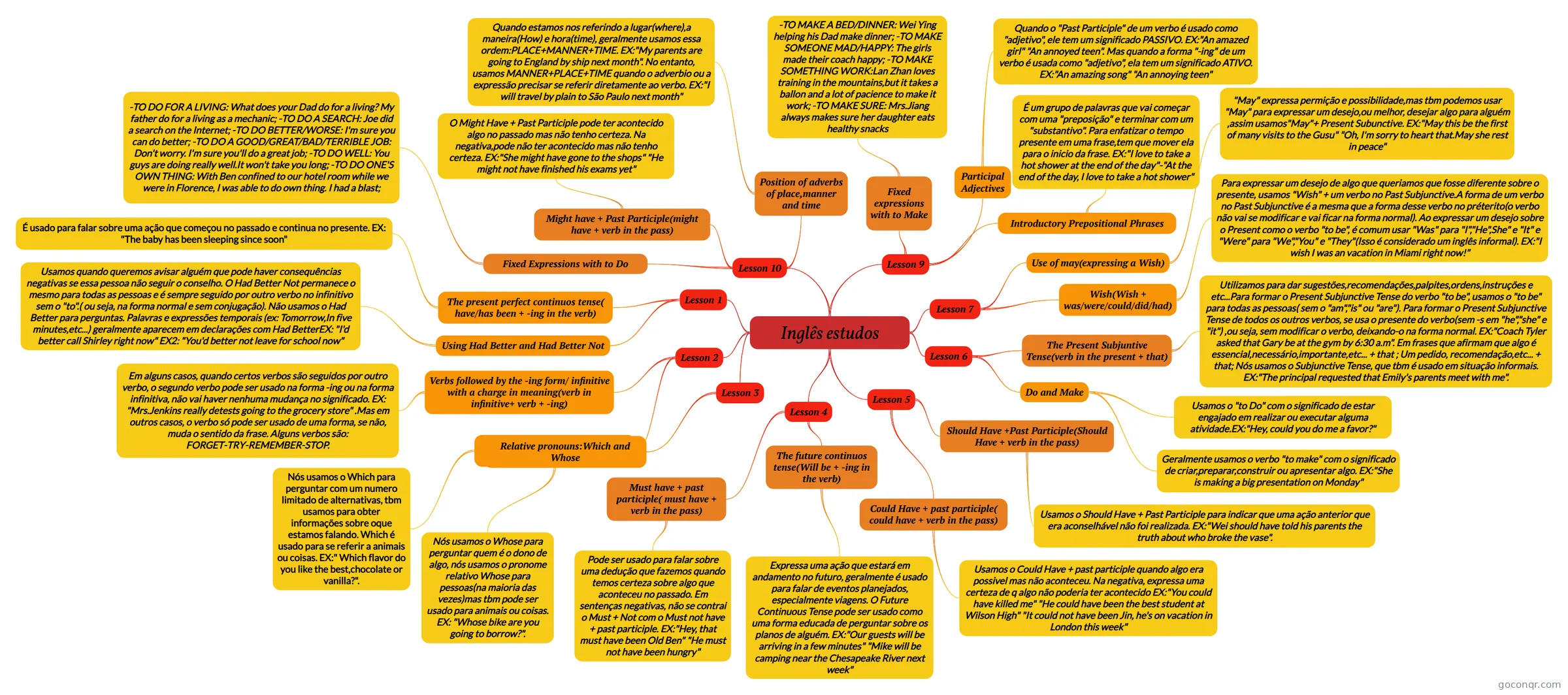
Mapa mental: Inglês estudos
Inhalt der Mindmap
Inglês estudos
Lesson 1
- The present perfect continuos tense( have/has been + -ing in the verb)
- É usado para falar sobre uma ação que começou no passado e continua no presente. EX: "The baby has been sleeping since soon"
- Using Had Better and Had Better Not
- Usamos quando queremos avisar alguém que pode haver consequências negativas se essa pessoa não seguir o conselho. O Had Better Not permanece o mesmo para todas as pessoas e é sempre seguido por outro verbo no infinitivo sem o "to".( ou seja, na forma normal e sem conjugação). Não usamos o Had Better para perguntas. Palavras e expressões temporais (ex: Tomorrow,In five minutes,etc...) geralmente aparecem em declarações com Had BetterEX: "I'd better call Shirley right now" EX2: "You'd better not leave for school now"
- The present perfect continuos tense( have/has been + -ing in the verb)
Lesson 2
- Verbs followed by the -ing form/ infinitive with a charge in meaning(verb in infinitive+ verb + -ing)
- Em alguns casos, quando certos verbos são seguidos por outro verbo, o segundo verbo pode ser usado na forma -ing ou na forma infinitiva, não vai haver nenhuma mudança no significado. EX: "Mrs.Jenkins really detests going to the grocery store" .Mas em outros casos, o verbo só pode ser usado de uma forma, se não, muda o sentido da frase. Alguns verbos são: FORGET-TRY-REMEMBER-STOP.
- Relative pronouns: Which and Whose
- Nós usamos o Which para perguntar com um numero limitado de alternativas, tbm usamos para obter informações sobre oque estamos falando. Which é usado para se referir a animais ou coisas. EX:" Which flavor do you like the best,chocolate or vanilla?".
- Nós usamos o Whose para perguntar quem é o dono de algo, nós usamos o pronome relativo Whose para pessoas(na maioria das vezes)mas tbm pode ser usado para animais ou coisas. EX: "Whose bike are you going to borrow?".
- Verbs followed by the -ing form/ infinitive with a charge in meaning(verb in infinitive+ verb + -ing)
Lesson 3
- Relative pronouns:Which and Whose
Lesson 4
- Must have + past participle( must have + verb in the pass)
- Pode ser usado para falar sobre uma dedução que fazemos quando temos certeza sobre algo que aconteceu no passado. Em sentenças negativas, não se contrai o Must + Not com o Must not have + past participle. EX:"Hey, that must have been Old Ben" "He must not have been hungry"
- The future continuos tense(Will be + -ing in the verb)
- Expressa uma ação que estará em andamento no futuro, geralmente é usado para falar de eventos planejados, especialmente viagens. O Future Continuous Tense pode ser usado como uma forma educada de perguntar sobre os planos de alguém. EX:"Our guests will be arriving in a few minutes" "Mike will be camping near the Chesapeake River next week"
- Must have + past participle( must have + verb in the pass)
Lesson 5
- Could Have + past participle( could have + verb in the pass)
- Usamos o Could Have + past participle quando algo era possivel mas não aconteceu. Na negativa, expressa uma certeza de q algo não poderia ter acontecido EX:"You could have killed me" "He could have been the best student at Wilson High" "It could not have been Jin, he's on vacation in London this week"
- Should Have +Past Participle(Should Have + verb in the pass)
- Usamos o Should Have + Past Participle para indicar que uma ação anterior que era aconselhável não foi realizada. EX:"Wei should have told his parents the truth about who broke the vase".
- Could Have + past participle( could have + verb in the pass)
Lesson 6
- Do and Make
- Usamos o "to Do" com o significado de estar engajado em realizar ou executar alguma atividade.EX:"Hey, could you do me a favor?"
- Geralmente usamos o verbo "to make" com o significado de criar,preparar,construir ou apresentar algo. EX:"She is making a big presentation on Monday"
- The Present Subjuntive Tense(verb in the present + that)
- Utilizamos para dar sugestões,recomendações,palpites,ordens,instruções e etc...Para formar o Present Subjunctive Tense do verbo "to be", usamos o "to be" para todas as pessoas( sem o "am","is" ou "are"). Para formar o Present Subjunctive Tense de todos os outros verbos, se usa o presente do verbo(sem -s em "he","she" e "it") ,ou seja, sem modificar o verbo, deixando-o na forma normal. EX:"Coach Tyler asked that Gary be at the gym by 6:30 a.m". Em frases que afirmam que algo é essencial,necessário,importante,etc... + that ; Um pedido, recomendação,etc... + that; Nós usamos o Subjunctive Tense, que tbm é usado em situação informais. EX:"The principal requested that Emily's parents meet with me".
- Do and Make
Lesson 7
- Wish(Wish + was/were/could/did/had)
- Para expressar um desejo de algo que queriamos que fosse diferente sobre o presente, usamos "Wish" + um verbo no Past Subjunctive.A forma de um verbo no Past Subjunctive é a mesma que a forma desse verbo no préterito(o verbo não vai se modificar e vai ficar na forma normal). Ao expressar um desejo sobre o Present como o verbo "to be", é comum usar "Was" para "I","He",She" e "It" e "Were" para "We","You" e "They"(Isso é considerado um inglês informal). EX:"I wish I was an vacation in Miami right now!"
- Use of may(expressing a Wish)
- "May" expressa permição e possibilidade,mas tbm podemos usar "May" para expressar um desejo,ou melhor, desejar algo para alguém ,assim usamos"May"+ Present Subunctive. EX:"May this be the first of many visits to the Gusu" "Oh, I'm sorry to heart that.May she rest in peace"
- Wish(Wish + was/were/could/did/had)
Lesson 9
- Introductory Prepositional Phrases
- É um grupo de palavras que vai começar com uma "preposição" e terminar com um "substantivo". Para enfatizar o tempo presente em uma frase,tem que mover ela para o inicio da frase. EX:"I love to take a hot shower at the end of the day"-"At the end of the day, I love to take a hot shower"
- Participal Adjectives
- Quando o "Past Participle" de um verbo é usado como "adjetivo", ele tem um significado PASSIVO. EX:"An amazed girl" "An annoyed teen". Mas quando a forma "-ing" de um verbo é usada como "adjetivo", ela tem um significado ATIVO. EX:"An amazing song" "An annoying teen"
- Fixed expressions with to Make
- -TO MAKE A BED/DINNER: Wei Ying helping his Dad make dinner; -TO MAKE SOMEONE MAD/HAPPY: The girls made their coach happy; -TO MAKE SOMETHING WORK:Lan Zhan loves training in the mountains,but it takes a ballon and a lot of pacience to make it work; -TO MAKE SURE: Mrs.Jiang always makes sure her daughter eats healthy snacks
- Introductory Prepositional Phrases
Lesson 10
- Position of adverbs of place,manner and time
- Quando estamos nos referindo a lugar(where),a maneira(How) e hora(time), geralmente usamos essa ordem:PLACE+MANNER+TIME. EX:"My parents are going to England by ship next month". No entanto, usamos MANNER+PLACE+TIME quando o adverbio ou a expressão precisar se referir diretamente ao verbo. EX:"I will travel by plain to São Paulo next month"
- Fixed Expressions with to Do
- -TO DO FOR A LIVING: What does your Dad do for a living? My father do for a living as a mechanic; -TO DO A SEARCH: Joe did a search on the Internet; -TO DO BETTER/WORSE: I'm sure you can do better; -TO DO A GOOD/GREAT/BAD/TERRIBLE JOB: Don't worry. I'm sure you'll do a great job; -TO DO WELL: You guys are doing really well.It won't take you long; -TO DO ONE'S OWN THING: With Ben confined to our hotel room while we were in Florence, I was able to do own thing. I had a blast;
- Might have + Past Participle(might have + verb in the pass)
- O Might Have + Past Participle pode ter acontecido algo no passado mas não tenho certeza. Na negativa,pode não ter acontecido mas não tenho certeza. EX:"She might have gone to the shops" "He might not have finished his exams yet"
- Position of adverbs of place,manner and time
Informationen
- Beschreibung
- 1º ano Inglês Mindmap am Inglês estudos, erstellt von Ana Luisa Teixeira am 09/12/2020.
- Erstellt von
- Ana Luisa Teixeira
- Aufrufe
- 6
- Bewertung
Mehr zu Present perfect e present perfect continuous