
Mindmap
VICTORIAN AGE
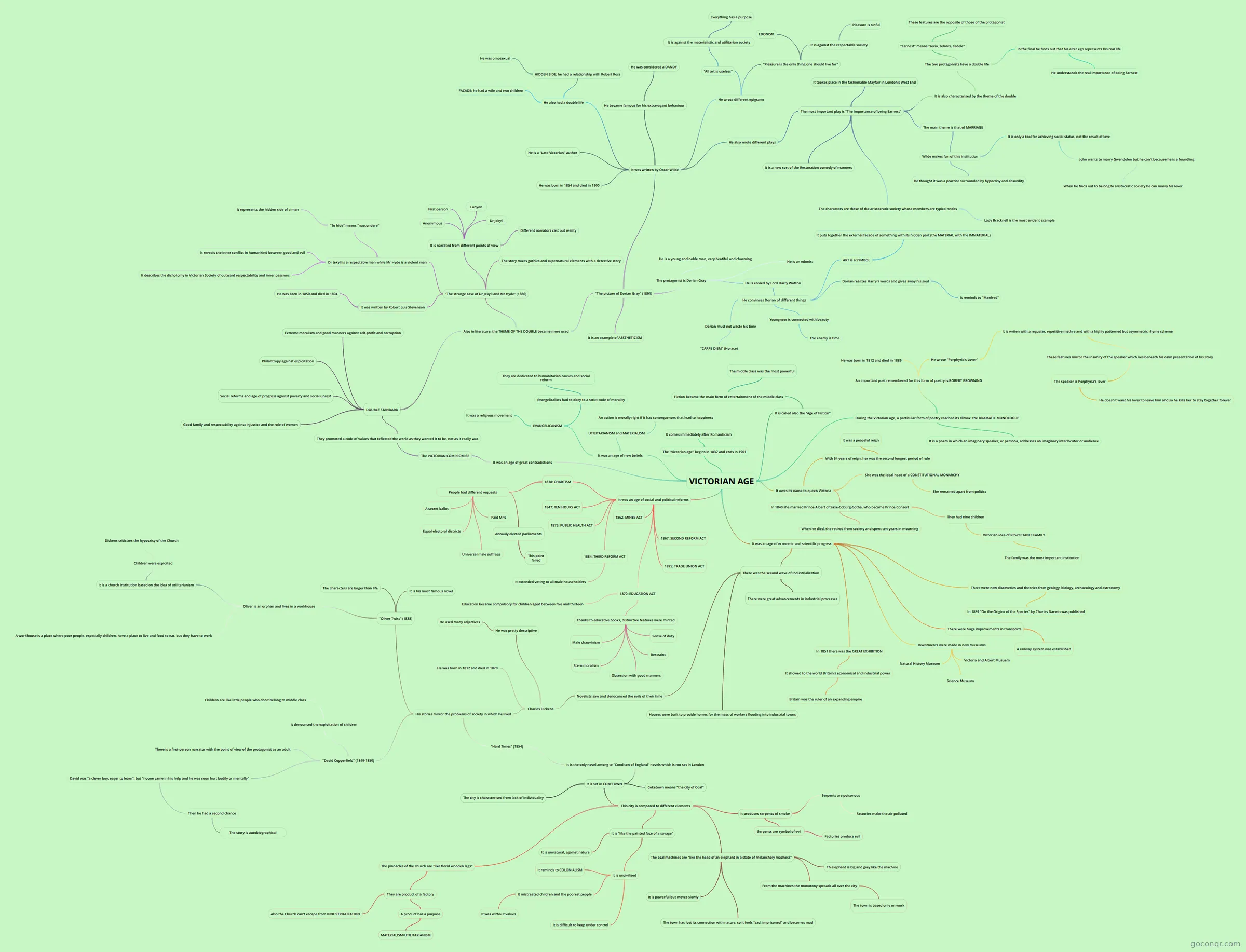
Mind map: Victorian Age
Inhalt der Mindmap
VICTORIAN AGE
The "Victorian age" begins in 1837 and ends in 1901
- It comes immediately after Romanticism
It owes its name to queen Victoria
- With 64 years of reign, her was the second longest period of rule
- It was a peaceful reign
- She was the ideal head of a CONSTITUTIONAL MONARCHY
- She remained apart from politics
- In 1840 she married Prince Albert of Saxe-Coburg-Gotha, who became Prince Consort
- They had nine children
- Victorian idea of RESPECTABLE FAMILY
- The family was the most important institution
- Victorian idea of RESPECTABLE FAMILY
- When he died, she retired from society and spent ten years in mourning
- They had nine children
- With 64 years of reign, her was the second longest period of rule
It was an age of economic and scientific progress
- There was the second wave of Industrialization
- There were great advancements in industrial processes
- Houses were built to provide homes for the mass of workers flooding into industrial towns
- Novelists saw and denocunced the evils of their time
- Charles Dickens
- He was born in 1812 and died in 1870
- His stories mirror the problems of society in which he lived
- "David Copperfield" (1849-1850)
- It denounced the exploitation of children
- Children are like little people who don't belong to middle class
- David was "a clever boy, eager to learn", but "noone came in his help and he was soon hurt bodily or mentally"
- Then he had a second chance
- The story is autobiographical
- Then he had a second chance
- There is a first-person narrator with the point of view of the protagonist as an adult
- It denounced the exploitation of children
- "Hard Times" (1854)
- It is the only novel among te "Conditon of England" novels which is not set in London
- It is set in COKETOWN
- Coketown means "the city of Coal"
- This city is compared to different elements
- It is "like the painted face of a savage"
- It is unnatural, against nature
- It is uncivilised
- It mistreated children and the poorest people
- It was without values
- It is difficult to keep under control
- It reminds to COLONIALISM
- It mistreated children and the poorest people
- It produces serpents of smoke
- Serpents are symbol of evil
- Factories produce evil
- Serpents are poisonous
- Factories make the air polluted
- Serpents are symbol of evil
- The coal machines are "like the head of an elephant in a state of melancholy madness"
- Th elephant is big and grey like the machine
- It is powerful but moves slowly
- From the machines the monotony spreads all over the city
- The town is based only on work
- The town has lost its connection with nature, so it feels "sad, imprisoned" and becomes mad
- The pinnacles of the church are "like florid wooden legs"
- They are product of a factory
- Also the Church can't escape from INDUSTRIALIZATION
- A product has a purpose
- MATERIALISM/UTILITARIANISM
- They are product of a factory
- It is "like the painted face of a savage"
- The city is characterised from lack of individuality
- It is set in COKETOWN
- It is the only novel among te "Conditon of England" novels which is not set in London
- "Oliver Twist" (1838)
- It is his most famous novel
- The characters are larger than life
- Oliver is an orphan and lives in a workhouse
- A workhouse is a place where poor people, especially children, have a place to live and food to eat, but they have to work
- It is a church institution based on the idea of utilitarianism
- Children were exploited
- Dickens criticizes the hypocrisy of the Church
- Children were exploited
- "David Copperfield" (1849-1850)
- He was pretty descriptive
- He used many adjectives
- Charles Dickens
- In 1851 there was the GREAT EXHIBITION
- It showed to the world Britain's economical and industrial power
- Britain was the ruler of an expanding empire
- It showed to the world Britain's economical and industrial power
- There were huge improvements in transports
- A railway system was established
- Investments were made in new museums
- Natural History Museum
- Science Museum
- Victoria and Albert Musuem
- There were new discoveries and theories from geology, biology, archaeology and astronomy
- In 1859 "On the Origins of the Species" by Charles Darwin was published
- There was the second wave of Industrialization
It was an age of new beliefs
- EVANGELICANISM
- It was a religious movement
- Evangelicalists had to obey to a strict code of morality
- They are dedicated to humanitarian causes and social reform
- UTILITARIANISM and MATERIALISM
- An action is morally right if it has consequences that lead to happiness
- EVANGELICANISM
It was an age of social and political reforms
- 1838: CHARTISM
- People had different requests
- Equal electoral districts
- Universal male suffrage
- A secret ballot
- Paid MPs
- Annauly elected parliaments
- This point failed
- People had different requests
- 1847: TEN HOURS ACT
- 1862: MINES ACT
- 1867: SECOND REFORM ACT
- 1875: TRADE UNION ACT
- 1875: PUBLIC HEALTH ACT
- 1884: THIRD REFORM ACT
- It extended voting to all male householders
- 1870: EDUCATION ACT
- Education became compulsory for children aged between five and thirteen
- Thanks to educative books, distinctive features were minted
- Stern moralism
- Restraint
- Sense of duty
- Male chauvinism
- Obsession with good manners
- 1838: CHARTISM
It was an age of great contradictions
- The VICTORIAN COMPROMISE
- They promoted a code of values that reflected the world as they wanted it to be, not as it really was
- DOUBLE STANDARD
- Social reforms and age of progress against poverty and social unrest
- Philantropy against exploitation
- Extreme moralism and good manners against self-profit and corruption
- Good family and respectability against injustice and the role of women
- Also in literature, the THEME OF THE DOUBLE became more used
- "The strange case of Dr Jekyll and Mr Hyde" (1886)
- It was written by Robert Luis Stevenson
- He was born in 1850 and died in 1894
- It is narrated from different points of view
- Anonymous
- First-person
- Lanyon
- Dr Jekyll
- Different narrators cast out reality
- The story mixes gothics and supernatural elements with a detective story
- Dr Jekyll is a respectable man while Mr Hyde is a violent man
- "To hide" means "nascondere"
- It represents the hidden side of a man
- It reveals the inner conflict in humankind between good and evil
- It describes the dichotomy in Victorian Society of outward respectability and inner passions
- "To hide" means "nascondere"
- It was written by Robert Luis Stevenson
- "The picture of Dorian Gray" (1891)
- It was written by Oscar Wilde
- He was born in 1854 and died in 1900
- He is a "Late Victorian" author
- He also had a double life
- FACADE: he had a wife and two children
- HIDDEN SIDE: he had a relationship with Robert Ross
- He was omosexual
- He became famous for his extravagant behaviour
- He was considered a DANDY
- He wrote different epigrams
- "All art is useless"
- It is against the materialistic and utilitarian society
- Everything has a purpose
- It is against the materialistic and utilitarian society
- "Pleasure is the only thing one should live for"
- EDONISM
- It is against the respectable society
- Pleasure is sinful
- "All art is useless"
- He also wrote different plays
- The most important play is "The importance of being Earnest"
- It tookes place in the fashionable Mayfair in London's West End
- It is also characterised by the theme of the double
- The two protagonists have a double life
- In the final he finds out that his alter ego represents his real life
- He understands the real importance of being Earnest
- "Earnest" means "serio, zelante, fedele"
- These features are the opposite of those of the protagonist
- In the final he finds out that his alter ego represents his real life
- The two protagonists have a double life
- It is a new sort of the Restoration comedy of manners
- The characters are those of the aristocratic society whose members are typical snobs
- Lady Bracknell is the most evident example
- The main theme is that of MARRIAGE
- Wilde makes fun of this institution
- He thought it was a practice surrounded by hypocrisy and absurdity
- It is only a tool for achieving social status, not the result of love
- John wants to marry Gwendolen but he can't because he is a foundling
- When he finds out to belong to aristocratic society he can marry his lover
- John wants to marry Gwendolen but he can't because he is a foundling
- Wilde makes fun of this institution
- The most important play is "The importance of being Earnest"
- The protagonist is Dorian Gray
- He is a young and noble man, very beatiful and charming
- He is an edonist
- He is envied by Lord Harry Wotton
- He convinces Dorian of different things
- Dorian must not waste his time
- "CARPE DIEM" (Horace)
- Youngness is connected with beauty
- The enemy is time
- ART is a SYMBOL
- It puts together the external facade of something with its hidden part (the MATERIAL with the IMMATERIAL)
- Dorian realizes Harry's words and gives away his soul
- It reminds to "Manfred"
- Dorian must not waste his time
- He convinces Dorian of different things
- It is an example of AESTHETICISM
- It was written by Oscar Wilde
- "The strange case of Dr Jekyll and Mr Hyde" (1886)
- DOUBLE STANDARD
- They promoted a code of values that reflected the world as they wanted it to be, not as it really was
- The VICTORIAN COMPROMISE
It is called also the "Age of Fiction"
- Fiction became the main form of entertainment of the middle class
- The middle class was the most powerful
- Fiction became the main form of entertainment of the middle class
During the Victorian Age, a particular form of poetry reached its climax: the DRAMATIC MONOLOGUE
- An important poet remembered for this form of poetry is ROBERT BROWNING
- He was born in 1812 and died in 1889
- He wrote "Porphyria's Lover"
- It is writen with a regualar, repetitive methre and with a highly patterned but asymmetric rhyme scheme
- These features mirror the insanity of the speaker which lies beneath his calm presentation of his story
- The speaker is Porphyria's lover
- He doesn't want his lover to leave him and so he kills her to stay together forever
- The speaker is Porphyria's lover
- These features mirror the insanity of the speaker which lies beneath his calm presentation of his story
- It is writen with a regualar, repetitive methre and with a highly patterned but asymmetric rhyme scheme
- It is a poem in which an imaginary speaker, or persona, addresses an imaginary interlocutor or audience
- An important poet remembered for this form of poetry is ROBERT BROWNING
Informationen
- Beschreibung
- Languages Mindmap am VICTORIAN AGE, erstellt von Elisa Corcione am 04/01/2021.
- Erstellt von
- Elisa Corcione
- Aufrufe
- 1
- Verlauf
-
- Erstellt von Elisa Corcione · 4 Jan 2021
- Kopiert von Elisa Corcione · 4 Jan 2021
- Bewertung