
Mindmap
DISTRIBUTED SYSTEMS - NAMING
Inhalt der Mindmap
DISTRIBUTED SYSTEMS - NAMING
NAMES - IDENTIFIERS - ADDRESSES
- A name in a distributed system is a string of bits or characters that is used to refer to an entity. An entity in a distributed system can be practically anything.
- To operate on an entity, it is necessary to access it, for which we need an access point. An access point is yet another, but special, kind of entity in a distributed system. The name of an access point is called an address.
- A true identifier is a name that has the following properties
- An identifier refers to at most one entity.
- Each entity is referred to by at most one identifier.
- An identifier always refers to the same entity
FLAT NAMING
- identifiers are simply random bit strings, which we conveniently refer to as unstructured, or flat names
- SIMPLE SOLUTIONS
- Broadcasting
- Consider a distributed system built on a computer network that offers efficient broadcasting facilities
- Forwarding pointers
- Another popular approach to locating mobile entities is to make use of forwarding pointers
- when an entity moves from A to B, it leaves behind in A a reference to its new location at B.
- Another popular approach to locating mobile entities is to make use of forwarding pointers
- Broadcasting
- Home-based approaches
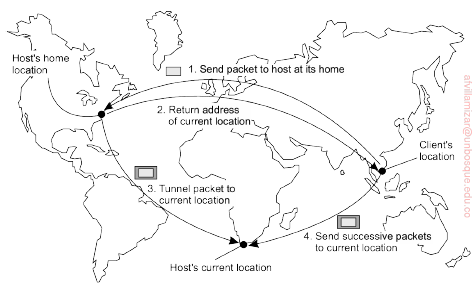
- A popular approach to supporting mobile entities in large-scale networks is to introduce a home location, which keeps track of the current location of an entity.
- The home-based approach is used as a fall-back mechanism for location services based on forwarding pointers. Another example where the homebased approach is followed is in Mobile IP
- The home-based approach is used as a fall-back mechanism for location services based on forwarding pointers. Another example where the homebased approach is followed is in Mobile IP
- A popular approach to supporting mobile entities in large-scale networks is to introduce a home location, which keeps track of the current location of an entity.
- SIMPLE SOLUTIONS
- identifiers are simply random bit strings, which we conveniently refer to as unstructured, or flat names
STRUCTURED NAMING
- naming systems generally support structured names that are composed from simple, human-readable names.
- NAME SPACES
- Name spaces for structured names can be represented as a labeled, directed graph with two types of nodes.
- NAME RESOLUTION
- More generally, given a path name, it should be possible to look up any information stored in the node referred to by that name. The process of looking up a name is called name resolution
- THE DNS NAME SPACE
- The DNS name space is hierarchically organized as a rooted tree. A label is a case-insensitive string made up of alphanumeric characters. A label has a maximum length of 63 characters; the length of a complete path name is restricted to 255 characters
- NAME SPACES
- naming systems generally support structured names that are composed from simple, human-readable names.
Attribute-based naming
- There are many ways in which descriptions can be provided, but a popular one in distributed systems is to describe an entity in terms of (attribute, value) pairs, generally referred to as attribute-based naming.
- DIRECTORY SERVICES
- Attribute-based naming systems are also known as directory services, whereas systems that support structured naming are generally called naming systems.
- Hierarchical implementations: LDAP
- This approach has been widely adopted, for example, in Microsoft’s Active Directory service and other systems
- Many of these systems use, or rely on the lightweight directory access protocol commonly referred simply as LDAP. The LDAP directory service has been derived from OSI’s X.500 directory service.
- DIRECTORY SERVICES
- There are many ways in which descriptions can be provided, but a popular one in distributed systems is to describe an entity in terms of (attribute, value) pairs, generally referred to as attribute-based naming.
Bilder und Dateien der Mindmap
Informationen
- Beschreibung
- Mindmap am DISTRIBUTED SYSTEMS - NAMING, erstellt von ANDERSON FABIAN VILLAMIZAR GALLARDO am 19/04/2021.
- Erstellt von
- ANDERSON FABIAN VILLAMIZAR GALLARDO
- Aufrufe
- 0
- Bewertung