
Mindmap
Sophisticated Literary Aspects
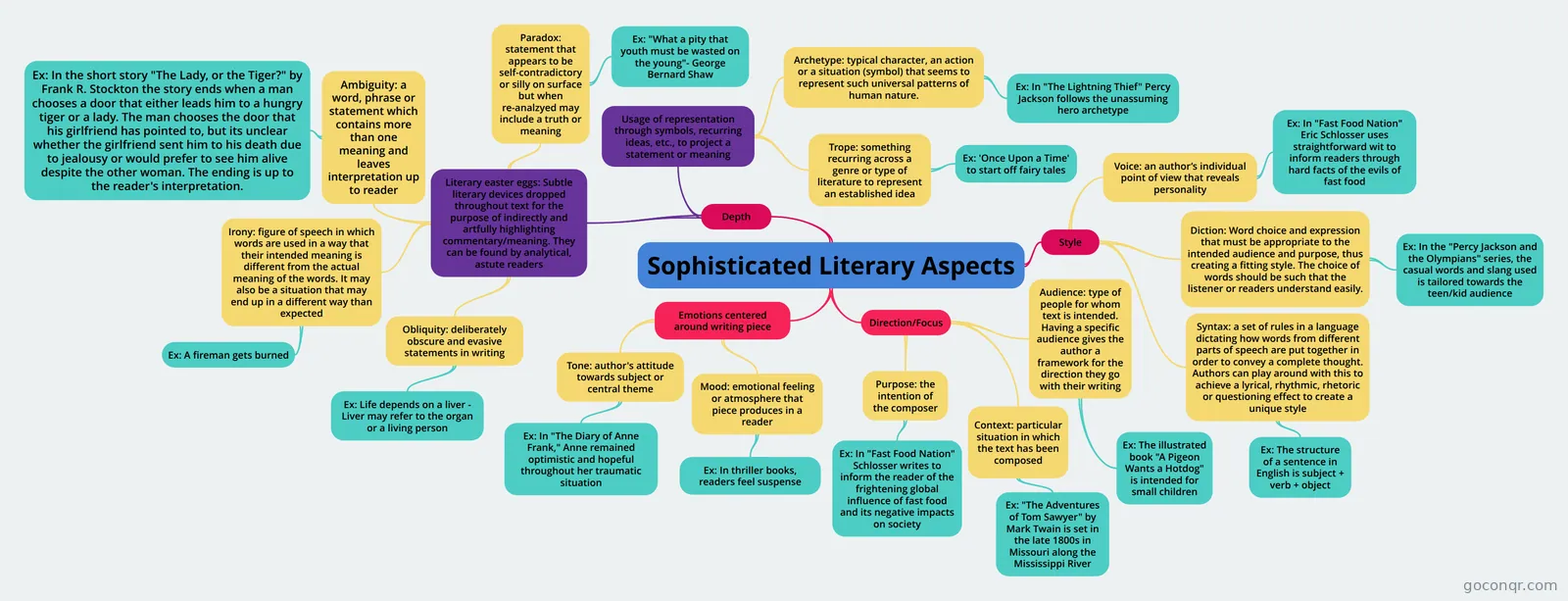
Mind map: Sophisticated literary aspects
Inhalt der Mindmap
Sophisticated Literary Aspects
Emotions centered around writing piece
- Mood: emotional feeling or atmosphere that piece produces in a reader
- Ex: In thriller books, readers feel suspense
- Tone: author's attitude towards subject or central theme
- Ex: In "The Diary of Anne Frank," Anne remained optimistic and hopeful throughout her traumatic situation
- Mood: emotional feeling or atmosphere that piece produces in a reader
Direction/Focus
- Audience: type of people for whom text is intended. Having a specific audience gives the author a framework for the direction they go with their writing
- Ex: The illustrated book "A Pigeon Wants a Hotdog" is intended for small children
- Context: particular situation in which the text has been composed
- Ex: "The Adventures of Tom Sawyer" by Mark Twain is set in the late 1800s in Missouri along the Mississippi River
- Purpose: the intention of the composer
- Ex: In "Fast Food Nation" Schlosser writes to inform the reader of the frightening global influence of fast food and its negative impacts on society
- Audience: type of people for whom text is intended. Having a specific audience gives the author a framework for the direction they go with their writing
Depth
- Literary easter eggs: Subtle literary devices dropped throughout text for the purpose of indirectly and artfully highlighting commentary/meaning. They can be found by analytical, astute readers
- Irony: figure of speech in which words are used in a way that their intended meaning is different from the actual meaning of the words. It may also be a situation that may end up in a different way than expected
- Ex: A fireman gets burned
- Ambiguity: a word, phrase or statement which contains more than one meaning and leaves interpretation up to reader
- Ex: In the short story "The Lady, or the Tiger?" by Frank R. Stockton the story ends when a man chooses a door that either leads him to a hungry tiger or a lady. The man chooses the door that his girlfriend has pointed to, but its unclear whether the girlfriend sent him to his death due to jealousy or would prefer to see him alive despite the other woman. The ending is up to the reader's interpretation.
- Paradox: statement that appears to be self-contradictory or silly on surface but when re-analzyed may include a truth or meaning
- Ex: "What a pity that youth must be wasted on the young"- George Bernard Shaw
- Obliquity: deliberately obscure and evasive statements in writing
- Ex: Life depends on a liver - Liver may refer to the organ or a living person
- Irony: figure of speech in which words are used in a way that their intended meaning is different from the actual meaning of the words. It may also be a situation that may end up in a different way than expected
- Usage of representation through symbols, recurring ideas, etc., to project a statement or meaning
- Archetype: typical character, an action or a situation (symbol) that seems to represent such universal patterns of human nature.
- Ex: In "The Lightning Thief" Percy Jackson follows the unassuming hero archetype
- Trope: something recurring across a genre or type of literature to represent an established idea
- Ex: 'Once Upon a Time' to start off fairy tales
- Archetype: typical character, an action or a situation (symbol) that seems to represent such universal patterns of human nature.
- Literary easter eggs: Subtle literary devices dropped throughout text for the purpose of indirectly and artfully highlighting commentary/meaning. They can be found by analytical, astute readers
Style
- Voice: an author’s individual point of view that reveals personality
- Ex: In "Fast Food Nation" Eric Schlosser uses straightforward wit to inform readers through hard facts of the evils of fast food
- Syntax: a set of rules in a language dictating how words from different parts of speech are put together in order to convey a complete thought. Authors can play around with this to achieve a lyrical, rhythmic, rhetoric or questioning effect to create a unique style
- Ex: The structure of a sentence in English is subject + verb + object
- Diction: Word choice and expression that must be appropriate to the intended audience and purpose, thus creating a fitting style. The choice of words should be such that the listener or readers understand easily.
- Ex: In the "Percy Jackson and the Olympians" series, the casual words and slang used is tailored towards the teen/kid audience
- Voice: an author’s individual point of view that reveals personality
Informationen
- Beschreibung
- Mindmap am Sophisticated Literary Aspects, erstellt von Haley Chen am 01/08/2015.
- Erstellt von
- Haley Chen
- Aufrufe
- 0
- Bewertung