
Mindmap
PBL 2 - an unimmunized child
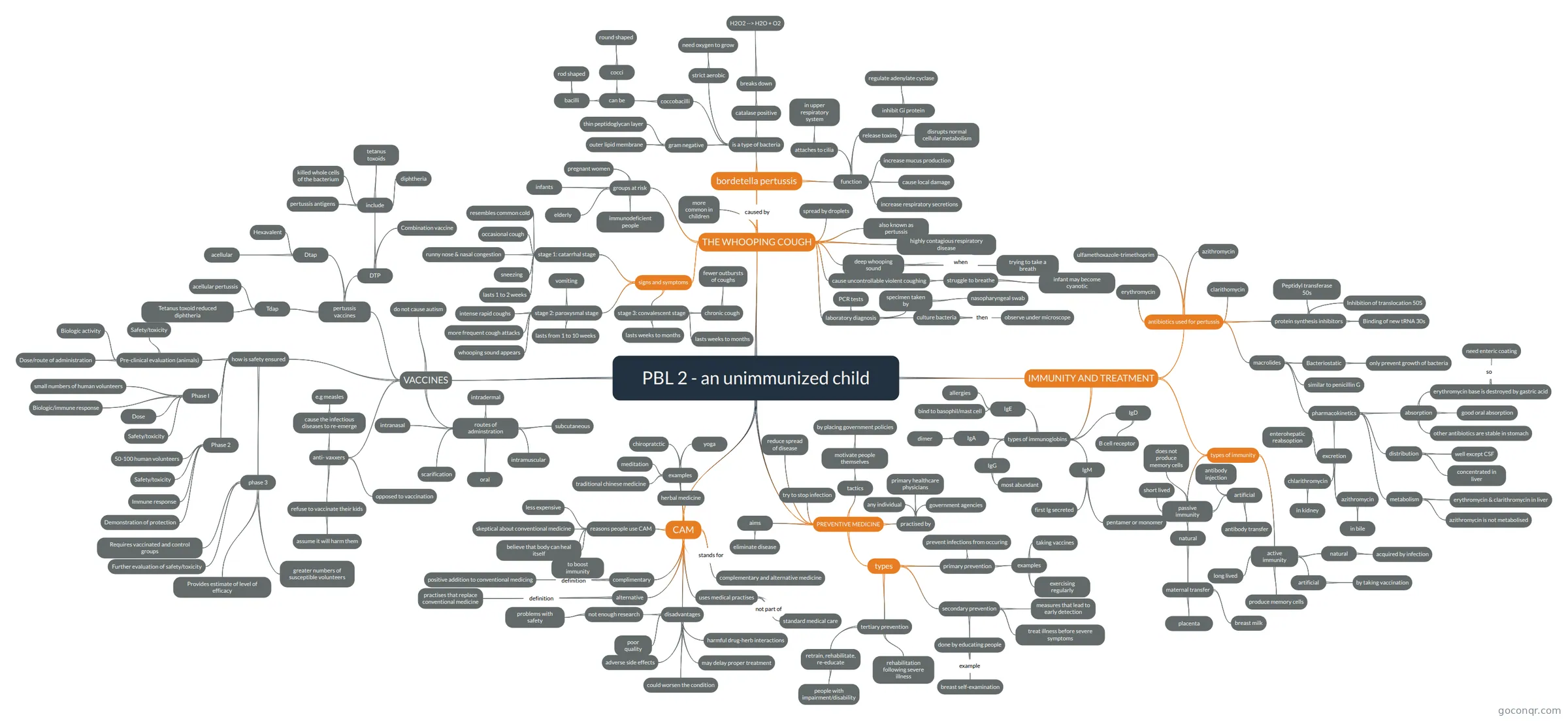
Mind map: PBL 2 an unimmunized child
Inhalt der Mindmap
PBL 2 - an unimmunized child
CAM
- complementary and alternative medicine
- stands for
- alternative
- practises that replace conventional medicine
- definition
- complimentary
- positive addition to conventional medicing
- definition
- uses medical practises
- standard medical care
- not part of
- reasons people use CAM
- to boost immunity
- skeptical about conventional medicine
- believe that body can heal itself
- less expensive
- examples
- herbal medicine
- traditional chinese medicine
- meditation
- chiropratctic
- yoga
- disadvantages
- not enough research
- problems with safety
- poor quality
- adverse side effects
- harmful drug-herb interactions
- may delay proper treatment
- could worsen the condition
- not enough research
PREVENTIVE MEDICINE
- aims
- eliminate disease
- reduce spread of disease
- try to stop infection
- practised by
- any individual
- primary healthcare physicians
- government agencies
- tactics
- motivate people themselves
- by placing government policies
- motivate people themselves
- types
- primary prevention
- prevent infections from occuring
- examples
- taking vaccines
- exercising regularly
- secondary prevention
- measures that lead to early detection
- treat illness before severe symptoms
- done by educating people
- breast self-examination
- example
- tertiary prevention
- rehabilitation following severe illness
- retrain, rehabilitate, re-educate
- people with impairment/disability
- primary prevention
- aims
THE WHOOPING COUGH
- bordetella pertussis
- is a type of bacteria
- gram negative
- thin peptidoglycan layer
- outer lipid membrane
- coccobacilli
- can be
- cocci
- round shaped
- bacilli
- rod shaped
- cocci
- can be
- strict aerobic
- need oxygen to grow
- catalase positive
- breaks down
- H2O2 --> H2O + O2
- breaks down
- gram negative
- function
- attaches to cilia
- in upper respiratory system
- cause local damage
- release toxins
- inhibit Gi protein
- regulate adenylate cyclase
- disrupts normal cellular metabolism
- inhibit Gi protein
- increase mucus production
- increase respiratory secretions
- attaches to cilia
- is a type of bacteria
- caused by
- also known as pertussis
- highly contagious respiratory disease
- more common in children
- cause uncontrollable violent coughing
- struggle to breathe
- infant may become cyanotic
- struggle to breathe
- deep whooping sound
- trying to take a breath
- when
- spread by droplets
- groups at risk
- pregnant women
- infants
- elderly
- immunodeficient people
- signs and symptoms
- stage 1: catarrhal stage
- resembles common cold
- runny nose & nasal congestion
- sneezing
- occasional cough
- lasts 1 to 2 weeks
- stage 2: paroxysmal stage
- intense rapid coughs
- more frequent cough attacks
- whooping sound appears
- vomiting
- lasts from 1 to 10 weeks
- stage 3: convalescent stage
- chronic cough
- fewer outbursts of coughs
- lasts weeks to months
- lasts weeks to months
- chronic cough
- stage 1: catarrhal stage
- laboratory diagnosis
- PCR tests
- culture bacteria
- observe under microscope
- then
- specimen taken by
- nasopharyngeal swab
- bordetella pertussis
VACCINES
- routes of adminstration
- subcutaneous
- intramuscular
- oral
- intradermal
- scarification
- intranasal
- anti- vaxxers
- opposed to vaccination
- refuse to vaccinate their kids
- assume it will harm them
- cause the infectious diseases to re-emerge
- e.g measles
- pertussis vaccines
- DTP
- Combination vaccine
- include
- diphtheria
- tetanus toxoids
- killed whole cells of the bacterium
- pertussis antigens
- Dtap
- Hexavalent
- acellular
- Tdap
- Tetanus toxoid reduced diphtheria
- acellular pertussis
- DTP
- do not cause autism
- how is safety ensured
- Pre-clinical evaluation (animals)
- Safety/toxicity
- Biologic activity
- Dose/route of administration
- Phase I
- small numbers of human volunteers
- Dose
- Safety/toxicity
- Biologic/immune response
- Phase 2
- 50-100 human volunteers
- Safety/toxicity
- Immune response
- Demonstration of protection
- phase 3
- greater numbers of susceptible volunteers
- Requires vaccinated and control groups
- Further evaluation of safety/toxicity
- Provides estimate of level of efficacy
- Pre-clinical evaluation (animals)
- routes of adminstration
IMMUNITY AND TREATMENT
- antibiotics used for pertussis
- erythromycin
- azithromycin
- clarithomycin
- ulfamethoxazole-trimethoprim
- protein synthesis inhibitors
- Peptidyl transferase 50s
- Inhibition of translocation 50S
- Binding of new tRNA 30s
- macrolides
- Bacteriostatic
- only prevent growth of bacteria
- similar to penicillin G
- pharmacokinetics
- absorption
- erythromycin base is destroyed by gastric acid
- need enteric coating
- so
- other antibiotics are stable in stomach
- good oral absorption
- erythromycin base is destroyed by gastric acid
- distribution
- well except CSF
- concentrated in liver
- metabolism
- erythromycin & clarithromycin in liver
- azithromycin is not metabolised
- excretion
- azithromycin
- in bile
- chlarithromycin
- in kidney
- enterohepatic reabsoption
- azithromycin
- absorption
- Bacteriostatic
- types of immunity
- active immunity
- natural
- acquired by infection
- artificial
- by taking vaccination
- produce memory cells
- long lived
- natural
- passive immunity
- natural
- maternal transfer
- breast milk
- placenta
- maternal transfer
- artificial
- antibody injection
- antibody transfer
- short lived
- does not produce memory cells
- natural
- active immunity
- types of immunoglobins
- IgM
- pentamer or monomer
- first Ig secreted
- IgA
- dimer
- IgD
- B cell receptor
- IgG
- most abundant
- IgE
- allergies
- bind to basophil/mast cell
- IgM
- antibiotics used for pertussis
Informationen
- Beschreibung
- Mindmap am PBL 2 - an unimmunized child, erstellt von Rama shanawani am 05/09/2021.
- Erstellt von
- Rama shanawani
- Aufrufe
- 10
- Bewertung