
Mindmap
Classification of biodiversity
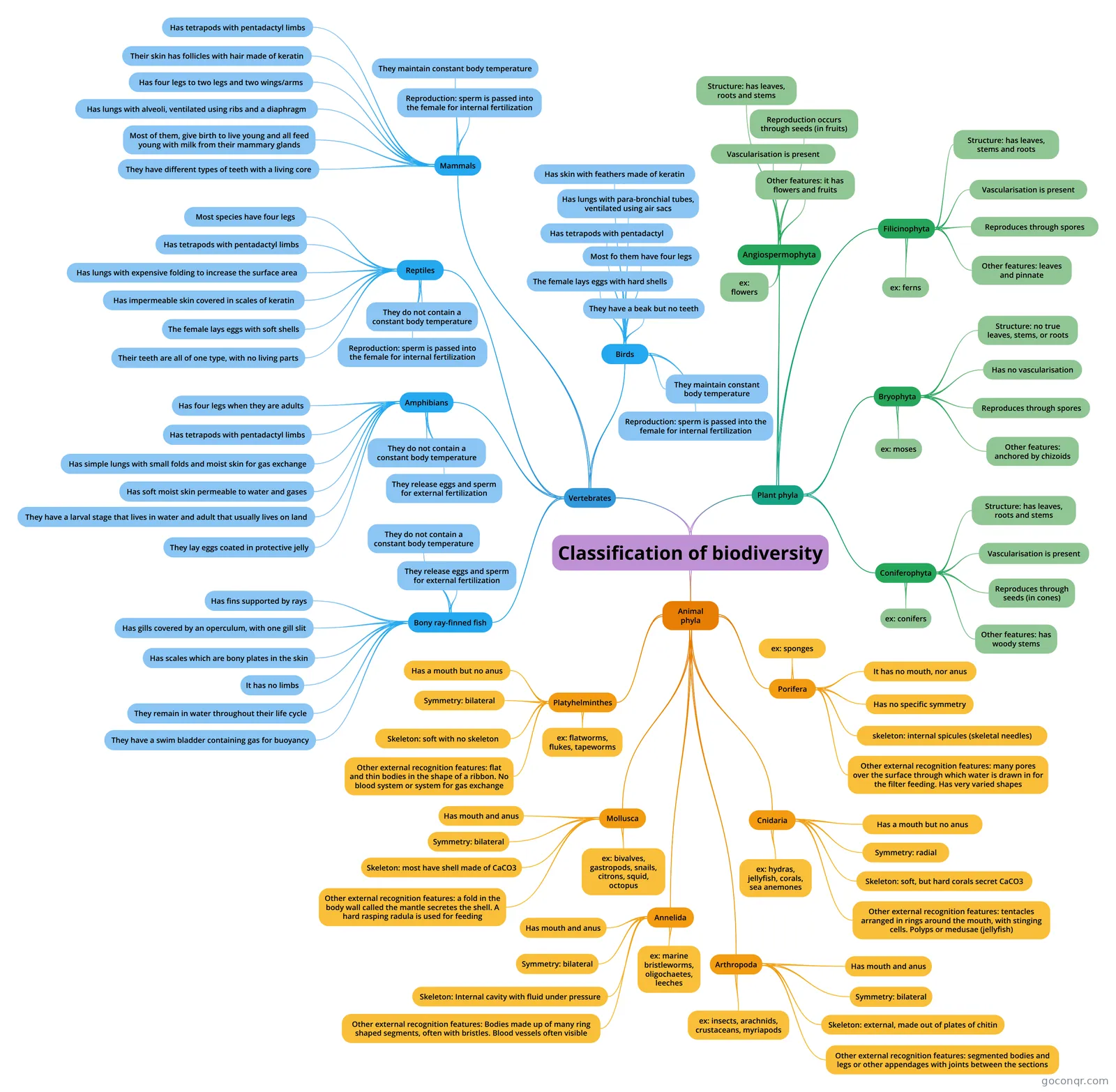
Mind map: classification of biodiversity
Inhalt der Mindmap
Classification of biodiversity
Plant phyla
- Bryophyta
- Structure: no true leaves, stems, or roots
- Has no vascularisation
- Reproduces through spores
- Other features: anchored by chizoids
- ex: moses
- Filicinophyta
- Structure: has leaves, stems and roots
- Vascularisation is present
- Reproduces through spores
- Other features: leaves and pinnate
- ex: ferns
- Coniferophyta
- Structure: has leaves, roots and stems
- Vascularisation is present
- Reproduces through seeds (in cones)
- Other features: has woody stems
- ex: conifers
- Angiospermophyta
- ex: flowers
- Structure: has leaves, roots and stems
- Vascularisation is present
- Reproduction occurs through seeds (in fruits)
- Other features: it has flowers and fruits
- Bryophyta
Animal phyla
- Porifera
- ex: sponges
- It has no mouth, nor anus
- Has no specific symmetry
- skeleton: internal spicules (skeletal needles)
- Other external recognition features: many pores over the surface through which water is drawn in for the filter feeding. Has very varied shapes
- Cnidaria
- ex: hydras, jellyfish, corals, sea anemones
- Has a mouth but no anus
- Symmetry: radial
- Skeleton: soft, but hard corals secret CaCO3
- Other external recognition features: tentacles arranged in rings around the mouth, with stinging cells. Polyps or medusae (jellyfish)
- Platyhelminthes
- ex: flatworms, flukes, tapeworms
- Has a mouth but no anus
- Symmetry: bilateral
- Skeleton: soft with no skeleton
- Other external recognition features: flat and thin bodies in the shape of a ribbon. No blood system or system for gas exchange
- Mollusca
- ex: bivalves, gastropods, snails, citrons, squid, octopus
- Has mouth and anus
- Symmetry: bilateral
- Skeleton: most have shell made of CaCO3
- Other external recognition features: a fold in the body wall called the mantle secretes the shell. A hard rasping radula is used for feeding
- Arthropoda
- ex: insects, arachnids, crustaceans, myriapods
- Has mouth and anus
- Symmetry: bilateral
- Skeleton: external, made out of plates of chitin
- Other external recognition features: segmented bodies and legs or other appendages with joints between the sections
- Annelida
- ex: marine bristleworms, oligochaetes, leeches
- Has mouth and anus
- Symmetry: bilateral
- Skeleton: Internal cavity with fluid under pressure
- Other external recognition features: Bodies made up of many ring shaped segments, often with bristles. Blood vessels often visible
- Porifera
Vertebrates
- Bony ray-finned fish
- Has scales which are bony plates in the skin
- Has gills covered by an operculum, with one gill slit
- It has no limbs
- Has fins supported by rays
- They release eggs and sperm for external fertilization
- They remain in water throughout their life cycle
- They have a swim bladder containing gas for buoyancy
- They do not contain a constant body temperature
- Amphibians
- Has soft moist skin permeable to water and gases
- Has simple lungs with small folds and moist skin for gas exchange
- Has tetrapods with pentadactyl limbs
- Has four legs when they are adults
- They release eggs and sperm for external fertilization
- They do not contain a constant body temperature
- They have a larval stage that lives in water and adult that usually lives on land
- They lay eggs coated in protective jelly
- Reptiles
- Has impermeable skin covered in scales of keratin
- Has lungs with expensive folding to increase the surface area
- Has tetrapods with pentadactyl limbs
- Most species have four legs
- Reproduction: sperm is passed into the female for internal fertilization
- They do not contain a constant body temperature
- The female lays eggs with soft shells
- Their teeth are all of one type, with no living parts
- Birds
- Has skin with feathers made of keratin
- Has lungs with para-bronchial tubes, ventilated using air sacs
- Has tetrapods with pentadactyl
- Most fo them have four legs
- Reproduction: sperm is passed into the female for internal fertilization
- The female lays eggs with hard shells
- They have a beak but no teeth
- They maintain constant body temperature
- Mammals
- Their skin has follicles with hair made of keratin
- Has lungs with alveoli, ventilated using ribs and a diaphragm
- Has tetrapods with pentadactyl limbs
- Has four legs to two legs and two wings/arms
- Reproduction: sperm is passed into the female for internal fertilization
- Most of them, give birth to live young and all feed young with milk from their mammary glands
- They have different types of teeth with a living core
- They maintain constant body temperature
- Bony ray-finned fish
Informationen
- Beschreibung
- Quinto Biología Mindmap am Classification of biodiversity, erstellt von María Trinca am 15/09/2021.
- Erstellt von
- María Trinca
- Aufrufe
- 9
- Bewertung