
Mindmap
Topic 1C: Mendelian Genetics
Inhalt der Mindmap
Topic 1C: Mendelian Genetics
genotype: exact genetic makeup of an organism for a specific trait
phenotype: physical manifestation of the genotype
gene: the information needed to produce a single protein
- can exist in different forms (alleles)
- mutations can cause the production of different alleles resulting in production of faulty enzymes needed for metabolism, resulting in genetic disorders called inborn errors of metabolism
- wildtype allele: it is the natural or non-mutated form of the gene.. Sometimes it is the most common allele in the population, but not always
- can exist in different forms (alleles)
Law of Segregation
- for each trait, an organism has 2 alleles (one from each parent)
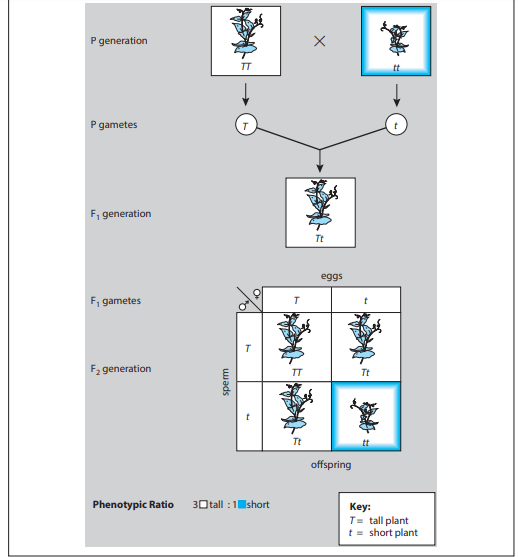
- when gametes are produced, each allele segregates into a separate gamete so each gamete contains only a single allele per trait. During fertilization, each gamete contributes one allele per trait, providing the offspring with two alleles per trait.
EXCEPTIONS: mitochondrial DNA (single copy, inherited separately from chromosomal DNA) and Y chromosomes (only one is carried in males, by default results in 1 allele)
- genetic leakage: the gene flow from one species to another or the introduction of new alleles from an outside source. Ex: when mitochondrial DNA is incorporated into chromosomal DNA
complete dominance: a form of dominance in the heterozygous condition wherein the allele that is regarded as dominant completely masks the effect of the allele that is recessive.
dominant traits are not necessarily more common or more advantageous than recessive traits. Those labels only refer to the pattern of inheritance that the allele follows and say nothing about the frequency of advantageousness of the allele.
monohybrid cross: breeding in which a single trait is studied
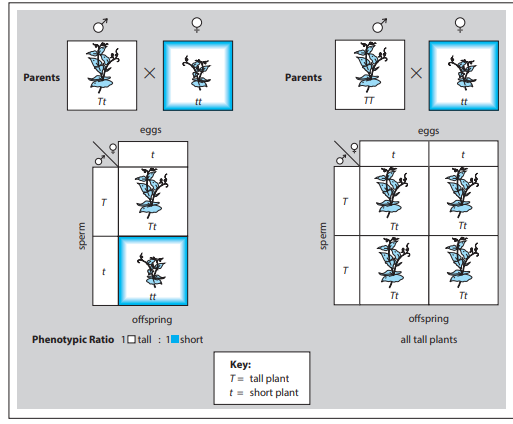
testcross: method to determine genotype of an organism displaying a dominant phenotype
- the organism (who is either homozygous dominant or heterozygous) is crossed with a homozygous recessive organism and the phenotypic ratio seen in the offspring indicates the genotype of the parent
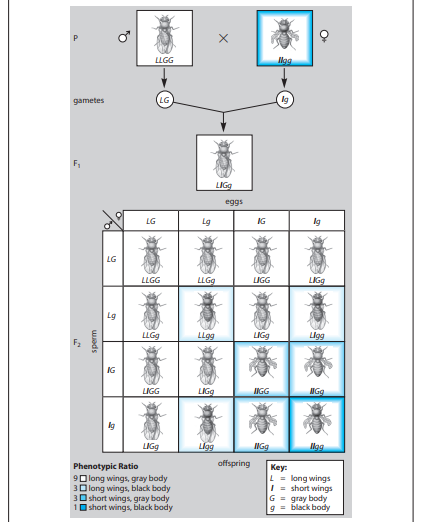
law of independent assortment
- alleles of different genes segregate into gametes independently of one another; distribution of alleles for one trait has no influence on the distribution of alleles for the other trait
- however, if genes are linked (are on the same chromosome), they do not assort independently, and are inherited together, changing the expected outcomes in the offspring
dihybrid cross: a breeding between two individuals who differ in two observed traits that are controlled by two distinct genes
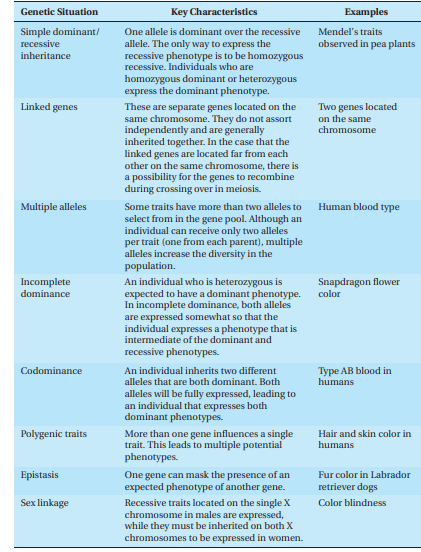
EXCEPTIONS to Mendel's laws
- linked genes: occur on the same chromosome, will assort together into a gamete, combination of gametes produced is not as diverse as would be the case with nonlinked alleles
- Multiple Alleles: although each individual can only inherit up to 2 alleles per trait, there may be >2 alleles in the gene pool. Ex: human ABO blood types (3 possible alleles (Ia, Ib, and i), resulting in 4 possible phenotypes)
- Incomplete Dominance: the heterozygote expresses an intermediate phenotype instead of the dominant phenotype (as seen in complete dominance); 2 possible alleles, yet 3 possible phenotypes. Ex: red (RR) flowers, pink (Rr) flowers, and white (rr) flowers
- Codominance: the trait has multiple alleles and >2 of them are dominant. If an individual inherits 2 different dominant alleles, they express both phenotypes (as opposed to blended type like in incomplete dominance). Ex: type AB blood
- Polygenic Traits: more than 1 gene influences a single trait. Because more than one gene is involved, the number of potential phenotypes is increased, resulting in continuous variation. Ex: skin and hair color in humans
- Epistasis: one gene interferes with the expression of another gene. Ex: fur color in labrador retrievers; one gene (B) controls color of fur, the other gene (E) controls deposition of pigment in the fur. E controls the expression of B, because if a dog is homozygous recessive (ee) than no matter what alleles it has for B, it will have yellow fur because pigment is not deposited.
- Pleiotropy: common in genetic diseases, a single gene influences multiple traits (ex: sickle cell trait, mutation is in hemoglobin gene, but symptoms are many)
- Sex linkage: men who recessive a recessive allele will express it despite not having 2 copies of the gene. This is why sex-linked recessive traits are commonly seen in males
- penetrance: the amount or probability that a gene is expressed in the phenotype of the individual carrying the allele; measured by the proportion of carriers in the population expressing the phenotype. Example: polydactyly is expressed by a dominant allele, however not all individuals with the dominant allele will have the extra digits.
- expressivity: quantifies the proportion to which a penetrate allele is expressed. Example: those with polydactyly may have extra digits but that digit could be a complete finger, or it could be a stub; they could also have extra digits on multiple appendages, such as multiple extra toes and extra fingers.
Pedigree Analysis: suspect sex-linked inheritance if many more males are affected than females. Think recessive allele if the trait skips generations
Bilder und Dateien der Mindmap
Informationen
- Beschreibung
- Mindmap am Topic 1C: Mendelian Genetics, erstellt von 000 000 am 10/10/2021.
- Erstellt von
- 000 000
- Aufrufe
- 1
- Bewertung