
Mindmap
Noise:Ch 5
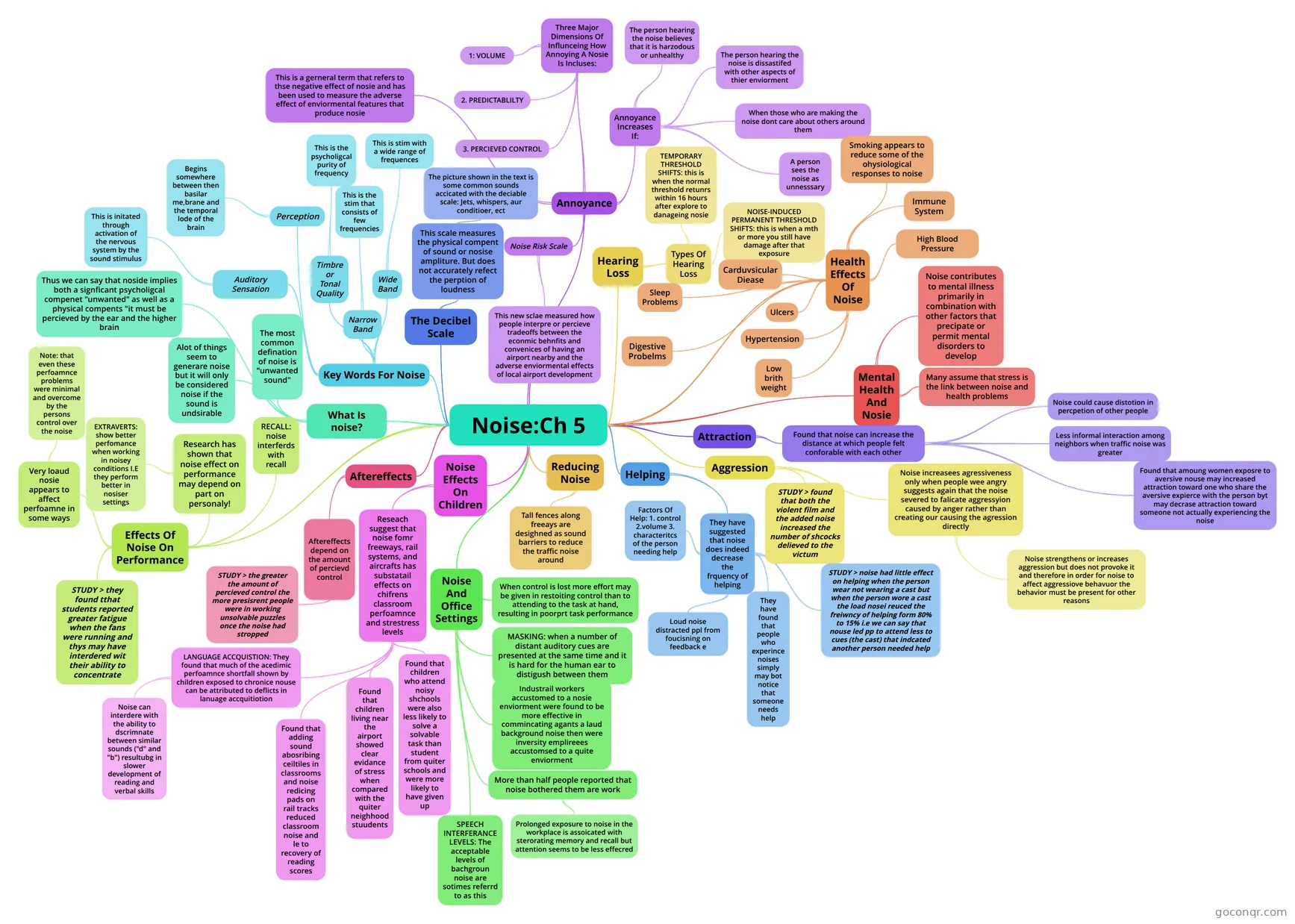
Mind map: Noise: Ch 5
Inhalt der Mindmap
Noise:Ch 5
What Is noise?
- The most common defination of noise is "unwanted sound"
- Alot of things seem to generare noise but it will only be considered noise if the sound is undsirable
- Thus we can say that noside implies both a signficant psycholigcal compenet "unwanted" as well as a physical compents "it must be percieved by the ear and the higher brain
Key Words For Noise
- Auditory Sensation
- This is initated through activation of the nervous system by the sound stimulus
- Perception
- Begins somewhere between then basilar me,brane and the temporal lode of the brain
- Timbre or Tonal Quality
- This is the psycholigcal purity of frequency
- Narrow Band
- This is the stim that consists of few frequencies
- Wide Band
- This is stim with a wide range of frequences
- Auditory Sensation
The Decibel Scale
- This scale measures the physical compent of sound or nosise ampliture. But does not accurately refect the perption of loudness
- The picture shown in the text is some common sounds accicated with the deciable scale: Jets, whispers, aur conditioer, ect
- This scale measures the physical compent of sound or nosise ampliture. But does not accurately refect the perption of loudness
Annoyance
- This is a gerneral term that refers to thse negative effect of nosie and has been used to measure the adverse effect of enviormental features that produce nosie
- Three Major Dimensions Of Influnceing How Annoying A Nosie Is Incluses:
- 1: VOLUME
- 2. PREDICTABLILTY
- 3. PERCIEVED CONTROL
- Annoyance Increases If:
- A person sees the noise as unnesssary
- When those who are making the noise dont care about others around them
- The person hearing the noise believes that it is harzodous or unhealthy
- The person hearing the noise is dissastifed with other aspects of thier enviorment
- Noise Risk Scale
- This new sclae measured how people interpre or percieve tradeoffs between the econmic behnfits and convenices of having an airport nearby and the adverse enviormental effects of local airport development
Hearing Loss
- Types Of Hearing Loss
- TEMPORARY THRESHOLD SHIFTS: this is when the normal threshold retunrs within 16 hours after explore to danageing nosie
- NOISE-INDUCED PERMANENT THRESHOLD SHIFTS: this is when a mth or more you still have damage after that exposure
- Types Of Hearing Loss
Health Effects Of Noise
- Immune System
- Digestive Probelms
- Ulcers
- Carduvsicular Diease
- Hypertension
- Low brith weight
- Sleep Problems
- High Blood Pressure
- Smoking appears to reduce some of the ohysiological responses to noise
Mental Health And Nosie
- Many assume that stress is the link between noise and health problems
- Noise contributes to mental illness primarily in combination with other factors that precipate or permit mental disorders to develop
Effects Of Noise On Performance
- Very loaud nosie appears to affect perfoamne in some ways
- Note: that even these perfoamnce problems were minimal and overcome by the persons control over the noise
- Research has shown that noise effect on performance may depend on part on personaly!
- EXTRAVERTS: show better perfomance when working in noisey conditions I.E they perform better in nosiser settings
- RECALL: noise interferds with recall
- STUDY > they found tthat students reported greater fatigue when the fans were running and thys may have interdered wit their ability to concentrate
- Very loaud nosie appears to affect perfoamne in some ways
Aftereffects
- Aftereffects depend on the amount of percievd control
- STUDY > the greater the amount of percieved control the more presisrent people were in working unsolvable puzzles once the noise had stropped
- Aftereffects depend on the amount of percievd control
Noise Effects On Children
- Reseach suggest that noise fomr freeways, rail systems, and aircrafts has substatail effects on chifrens classroom perfoamnce and strestress levels
- LANGUAGE ACCQUISTION: They found that much of the acedimic perfoamnce shortfall shown by children exposed to chronice nouse can be attributed to deflicts in lanuage accquitiotion
- Noise can interdere with the ability to dscrimnate between similar sounds ("d" and "b") resultubg in slower development of reading and verbal skills
- Found that children who attend noisy shchools were also less likely to solve a solvable task than student from quiter schools and were more likely to have given up
- Found that children living near the airport showed clear evidance of stress when compared with the quiter neighhood stuudents
- Found that adding sound abosribing ceiltiles in classrooms and noise redicing pads on rail tracks reduced classroom noise and le to recovery of reading scores
- LANGUAGE ACCQUISTION: They found that much of the acedimic perfoamnce shortfall shown by children exposed to chronice nouse can be attributed to deflicts in lanuage accquitiotion
- Reseach suggest that noise fomr freeways, rail systems, and aircrafts has substatail effects on chifrens classroom perfoamnce and strestress levels
Noise And Office Settings
- More than half people reported that noise bothered them are work
- Prolonged exposure to noise in the workplace is assoicated with sterorating memory and recall but attention seems to be less effecred
- MASKING: when a number of distant auditory cues are presented at the same time and it is hard for the human ear to distigush between them
- SPEECH INTERFERANCE LEVELS: The acceptable levels of bachgroun noise are sotimes referrd to as this
- Industrail workers accustomed to a nosie enviorment were found to be more effective in commincating agants a laud background noise then were inversity emplireees accustomsed to a quite enviorment
- When control is lost more effort may be given in restoiting control than to attending to the task at hand, resulting in poorprt task performance
- More than half people reported that noise bothered them are work
Attraction
- Found that noise can increase the distance at which people felt conforable with each other
- Less informal interaction among neighbors when traffic noise was greater
- Found that amoung women exposre to aversive nouse may increased attraction toward one who share the aversive expierce with the person byt may decrase attraction toward someone not actually experiencing the noise
- Noise could cause distotion in percpetion of other people
- Found that noise can increase the distance at which people felt conforable with each other
Aggression
- STUDY > found that both the violent film and the added noise increased the number of shcocks delieved to the victum
- Noise increasees agressiveness only when people wee angry suggests again that the noise severed to falicate aggressyion caused by anger rather than creating our causing the agression directly
- Noise strengthens or increases aggression but does not provoke it and therefore in order for noise to affect aggressiove behavuor the behavior must be present for other reasons
Helping
- They have suggested that noise does indeed decrease the frquency of helping
- STUDY > noise had little effect on helping when the person wear not wearing a cast but when the person wore a cast the load nosei reuced the freiwncy of helping form 80% to 15% i.e we can say that nouse led pp to attend less to cues (the cast) that indcated another person needed help
- They have found that people who experince noises simply may bot notice that someone needs help
- Loud noise distracted ppl from foucisning on feedback e
- Factors Of Help: 1. control 2.volume 3. characteritcs of the person needing help
- They have suggested that noise does indeed decrease the frquency of helping
Reducing Noise
- Tall fences along freeays are desighned as sound barriers to reduce the traffic noise around
Informationen
- Beschreibung
- Mindmap am Noise:Ch 5, erstellt von Elisa Blasi am 08/11/2013.
- Erstellt von
- Elisa Blasi
- Aufrufe
- 48
- Bewertung