
Mindmap
T 23 ELABORATING CURRICULAR MATERIALS FOR THE ENGLISH CLASS.
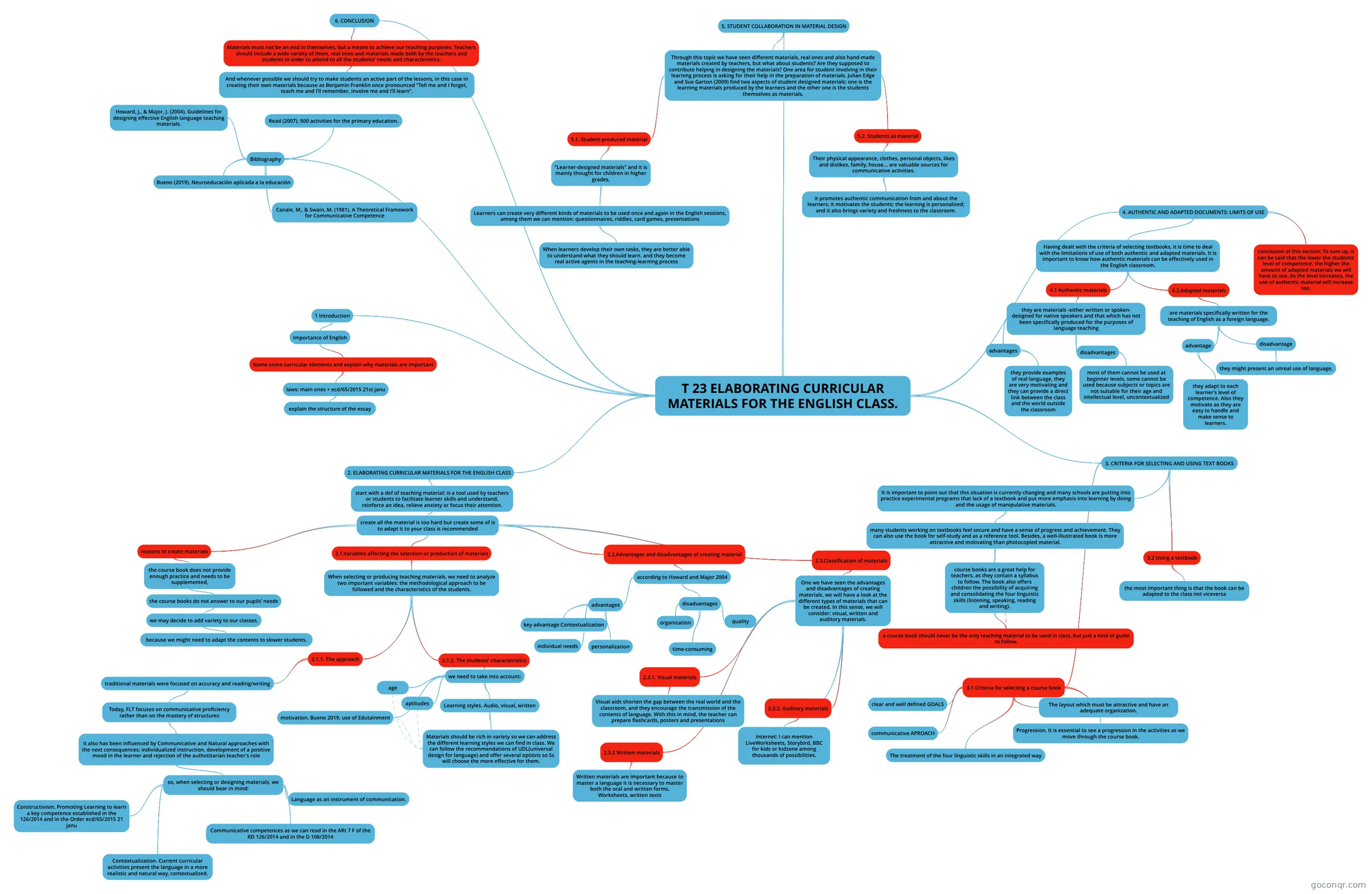
Mapa mental: Elaboración de materiales curriculares para la clase de inglés
Inhalt der Mindmap
T 23 ELABORATING CURRICULAR MATERIALS FOR THE ENGLISH CLASS.
1 Introduction
- Importance of English
- Name some curricular elements and explain why materials are important
- laws: main ones + ecd/65/2015 21st janu
- explain the structure of the essay
- laws: main ones + ecd/65/2015 21st janu
- Name some curricular elements and explain why materials are important
- Importance of English
2. ELABORATING CURRICULAR MATERIALS FOR THE ENGLISH CLASS
- start with a def of teaching material: is a tool used by teachers or students to facilitate learner skills and understand, reinforce an idea, relieve anxiety or focus their attention.
- create all the material is too hard but create some of is to adapt it to your class is recommended
- reasons to create materials
- the course book does not provide enough practice and needs to be supplemented,
- the course books do not answer to our pupils’ needs
- we may decide to add variety to our classes,
- because we might need to adapt the contents to slower students.
- we may decide to add variety to our classes,
- the course books do not answer to our pupils’ needs
- the course book does not provide enough practice and needs to be supplemented,
- 2.1.Variables affecting the selection or production of materials
- When selecting or producing teaching materials, we need to analyze two important variables: the methodological approach to be followed and the characteristics of the students.
- 2.1.1. The approach
- traditional materials were focused on accuracy and reading/writing
- Today, FLT focuses on communicative proficiency rather than on the mastery of structures
- it also has been influenced by Communicative and Natural approaches with the next consequences: individualized instruction, development of a positive mood in the learner and rejection of the authotitarian teacher's role
- so, when selecting or designing materials, we should bear in mind:
- Language as an instrument of communication.
- Communicative competences as we can read in the ARt 7 F of the RD 126/2014 and in the D 108/2014
- Constructivism. Promoting Learning to learn a key competence established in the 126/2014 and in the Order ecd/65/2015 21 janu
- Contextualization. Current curricular activities present the language in a more realistic and natural way, contextualized.
- so, when selecting or designing materials, we should bear in mind:
- it also has been influenced by Communicative and Natural approaches with the next consequences: individualized instruction, development of a positive mood in the learner and rejection of the authotitarian teacher's role
- Today, FLT focuses on communicative proficiency rather than on the mastery of structures
- traditional materials were focused on accuracy and reading/writing
- 2.1.2. The students’ characteristics
- we need to take into account:
- age
- aptitudes
- Learning styles. Audio, visual, written
- Materials should be rich in variety so we can address the different learning styles we can find in class. We can follow the recommendations of UDL(universal design for language) and offer several options so Ss will choose the more effective for them.
- motivation. Bueno 2019. use of Edutainment
- we need to take into account:
- 2.1.1. The approach
- When selecting or producing teaching materials, we need to analyze two important variables: the methodological approach to be followed and the characteristics of the students.
- 2.2.Advantages and disadvantages of creating material
- according to Howard and Major 2004
- advantages
- key advantage Contextualization
- individual needs
- personalization
- disadvantages
- organization
- quality
- time-consuming
- advantages
- according to Howard and Major 2004
- 2.3.Classification of materials
- One we have seen the advantages and disadvantages of creating materials, we will have a look at the different types of materials that can be created. In this sense, we will consider: visual, written and auditory materials.
- 2.3.1. Visual materials
- Visual aids shorten the gap between the real world and the classroom, and they encourage the transmission of the contents of language. With this in mind, the teacher can prepare flashcards, posters and presentations
- 2.3.2 Written materials
- Written materials are important because to master a language it is necessary to master both the oral and written forms, Worksheets, written texts
- 2.3.3. Auditory materials
- Internet: I can mention LiveWorksheets, Storybird, BBC for kids or kidzone among thousands of possibilities.
- 2.3.1. Visual materials
- One we have seen the advantages and disadvantages of creating materials, we will have a look at the different types of materials that can be created. In this sense, we will consider: visual, written and auditory materials.
- reasons to create materials
- create all the material is too hard but create some of is to adapt it to your class is recommended
- start with a def of teaching material: is a tool used by teachers or students to facilitate learner skills and understand, reinforce an idea, relieve anxiety or focus their attention.
3. CRITERIA FOR SELECTING AND USING TEXT BOOKS
- It is important to point out that this situation is currently changing and many schools are putting into practice experimental programs that lack of a textbook and put more emphasis into learning by doing and the usage of manipulative materials.
- many students working on textbooks feel secure and have a sense of progress and achievement. They can also use the book for self-study and as a reference tool. Besides, a well-illustrated book is more attractive and motivating than photocopied material.
- course books are a great help for teachers, as they contain a syllabus to follow. The book also offers children the possibility of acquiring and consolidating the four linguistic skills (listening, speaking, reading and writing).
- a course book should never be the only teaching material to be used in class, but just a kind of guide to follow.
- course books are a great help for teachers, as they contain a syllabus to follow. The book also offers children the possibility of acquiring and consolidating the four linguistic skills (listening, speaking, reading and writing).
- many students working on textbooks feel secure and have a sense of progress and achievement. They can also use the book for self-study and as a reference tool. Besides, a well-illustrated book is more attractive and motivating than photocopied material.
- 3.1 Criteria for selecting a course book
- clear and well defined GOALS
- communicative APROACH
- The treatment of the four linguistic skills in an integrated way
- The layout which must be attractive and have an adequate organization.
- Progression. It is essential to see a progression in the activities as we move through the course book.
- 3.2 Using a textbook
- the most important thing is that the book can be adapted to the class not viceversa
- It is important to point out that this situation is currently changing and many schools are putting into practice experimental programs that lack of a textbook and put more emphasis into learning by doing and the usage of manipulative materials.
4. AUTHENTIC AND ADAPTED DOCUMENTS: LIMITS OF USE
- Having dealt with the criteria of selecting textbooks, it is time to deal with the limitations of use of both authentic and adapted materials. It is important to know how authentic materials can be effectively used in the English classroom.
- 4.1 Authentic materials
- they are materials -either written or spoken- designed for native speakers and that which has not been specifically produced for the purposes of language teaching
- advantages
- they provide examples of real language, they are very motivating and they can provide a direct link between the class and the world outside the classroom
- disadvantages
- most of them cannot be used at beginner levels, some cannot be used because subjects or topics are not suitable for their age and intellectual level, uncontextualized
- advantages
- they are materials -either written or spoken- designed for native speakers and that which has not been specifically produced for the purposes of language teaching
- 4.2.Adapted materials
- are materials specifically written for the teaching of English as a foreign language.
- advantage
- they adapt to each learner’s level of competence. Also they motivate as they are easy to handle and make sense to learners.
- disadvantage
- they might present an unreal use of language,
- advantage
- are materials specifically written for the teaching of English as a foreign language.
- 4.1 Authentic materials
- conclusion of this section: To sum up, it can be said that the lower the students’ level of competence, the higher the amount of adapted materials we will have to use. As the level increases, the use of authentic material will increase too.
- Having dealt with the criteria of selecting textbooks, it is time to deal with the limitations of use of both authentic and adapted materials. It is important to know how authentic materials can be effectively used in the English classroom.
5. STUDENT COLLABORATION IN MATERIAL DESIGN
- Through this topic we have seen different materials, real ones and also hand-made materials created by teachers, but what about students? Are they supposed to contribute helping in designing the materials? One area for student involving in their learning process is asking for their help in the preparation of materials. Julian Edge and Sue Garton (2009) find two aspects of student designed materials: one is the learning materials produced by the learners and the other one is the students themselves as materials.
- 5.1. Student-produced material
- “Learner-designed materials” and it is mainly thought for children in higher grades,
- Learners can create very different kinds of materials to be used once and again in the English sessions, among them we can mention: questionnaires, riddles, card games, presentations
- When learners develop their own tasks, they are better able to understand what they should learn. and they become real active agents in the teaching-learning process
- Learners can create very different kinds of materials to be used once and again in the English sessions, among them we can mention: questionnaires, riddles, card games, presentations
- “Learner-designed materials” and it is mainly thought for children in higher grades,
- 5.2. Students as material
- Their physical appearance, clothes, personal objects, likes and dislikes, family, house... are valuable sources for communicative activities.
- it promotes authentic communication from and about the learners; it motivates the students; the learning is personalized; and it also brings variety and freshness to the classroom.
- Their physical appearance, clothes, personal objects, likes and dislikes, family, house... are valuable sources for communicative activities.
- 5.1. Student-produced material
- Through this topic we have seen different materials, real ones and also hand-made materials created by teachers, but what about students? Are they supposed to contribute helping in designing the materials? One area for student involving in their learning process is asking for their help in the preparation of materials. Julian Edge and Sue Garton (2009) find two aspects of student designed materials: one is the learning materials produced by the learners and the other one is the students themselves as materials.
6. CONCLUSION
- Materials must not be an end in themselves, but a means to achieve our teaching purposes. Teachers should include a wide variety of them, real ones and materials made both by the teachers and students in order to attend to all the students’ needs and characteristics.
- And whenever possible we should try to make students an active part of the lessons, in this case in creating their own materials because as Benjamin Franklin once pronounced “Tell me and I forget, teach me and I’ll remember, involve me and I’ll learn”.
- Materials must not be an end in themselves, but a means to achieve our teaching purposes. Teachers should include a wide variety of them, real ones and materials made both by the teachers and students in order to attend to all the students’ needs and characteristics.
Bibliography
- Bueno (2019). Neuroeducación aplicada a la educación
- Read (2007). 500 activities for the primary education.
- Howard, J., & Major, J. (2004). Guidelines for designing effective English language teaching materials.
- Canale, M., & Swain, M. (1981). A Theoretical Framework for Communicative Competence
Informationen
- Beschreibung
- C1 Profesores de Primaria (Opos) Mindmap am T 23 ELABORATING CURRICULAR MATERIALS FOR THE ENGLISH CLASS., erstellt von Jorge Pomar am 11/05/2022.
- Erstellt von
- Jorge Pomar
- Aufrufe
- 19
- Bewertung