
Mindmap
Contemporary cost management models
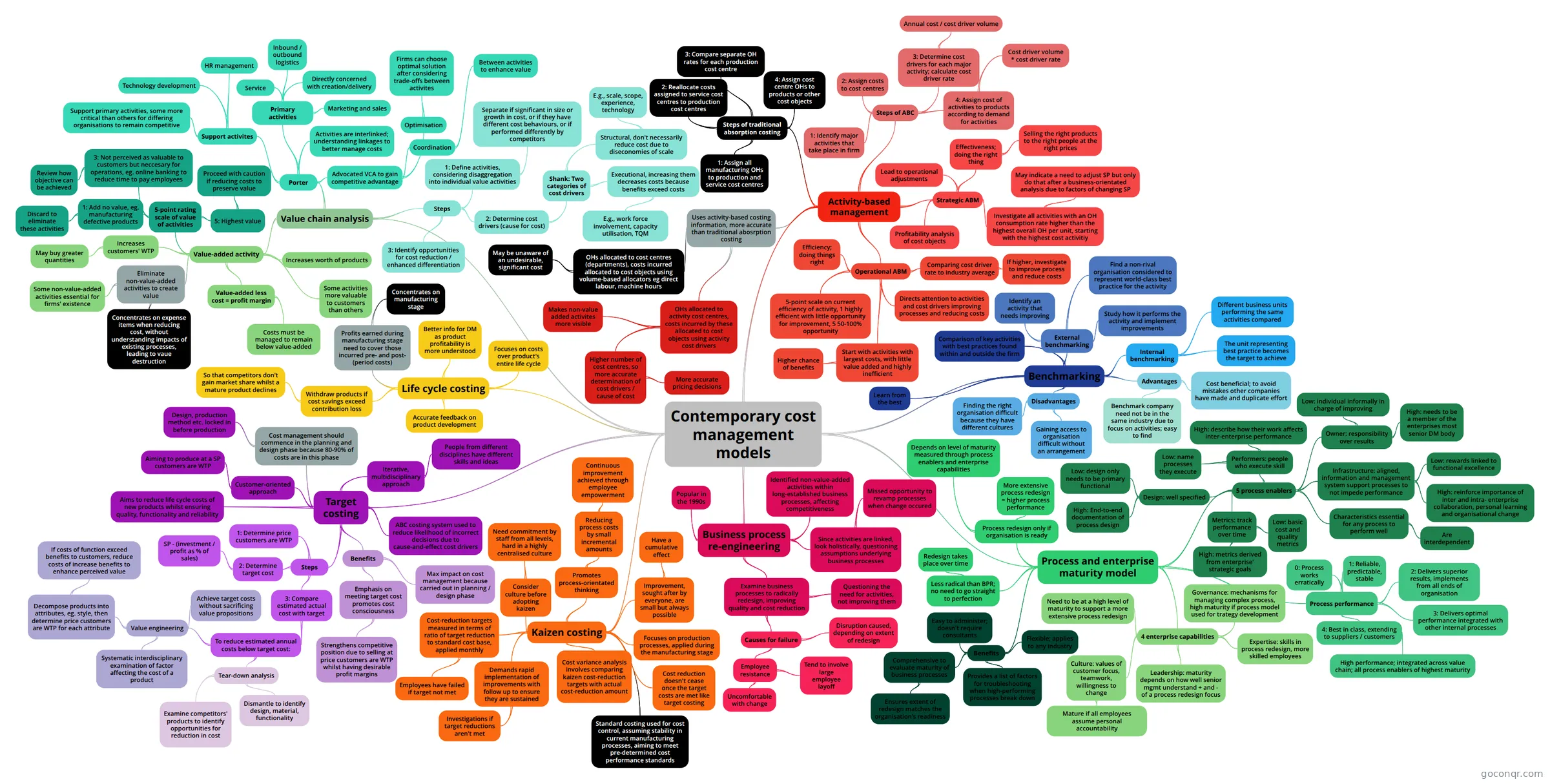
Mind map: Contemporary cost management models
Inhalt der Mindmap
Contemporary cost management models
Value chain analysis
- Value-added activity
- Increases worth of products
- Increases customers' WTP
- May buy greater quantities
- Eliminate non-value-added activities to create value
- Some non-value-added activities essential for firms' existence
- Concentrates on expense items when reducing cost, without understanding impacts of existing processes, leading to vaue destruction
- Some activities more valuable to customers than others
- 5-point rating scale of value of activities
- 1: Add no value, eg. manufacturing defective products
- Discard to eliminate these activities
- 3: Not perceived as valuable to customers but neccesary for operations, eg. online banking to reduce time to pay employees
- Review how objective can be achieved
- 5: Highest value
- Proceed with caution if reducing costs to preserve value
- 1: Add no value, eg. manufacturing defective products
- Value-added less cost = profit margin
- Costs must be managed to remain below value-added
- Porter
- Advocated VCA to gain competitive advantage
- Optimisation
- Firms can choose optimal solution after considering trade-offs between activites
- Coordination
- Between activities to enhance value
- Optimisation
- Activities are interlinked; understanding linkages to better manage costs
- Primary activities
- Directly concerned with creation/delivery
- Inbound / outbound logistics
- Marketing and sales
- Service
- Support activites
- Support primary activities, some more critical than others for differing organisations to remain competitive
- HR management
- Technology development
- Advocated VCA to gain competitive advantage
- Steps
- 1: Define activities, considering disaggregation into individual value activities
- Separate if significant in size or growth in cost, or if they have different cost behaviours, or if performed differently by competitors
- 2: Determine cost drivers (cause for cost)
- Shank: Two categories of cost drivers
- Structural, don't necessarily reduce cost due to diseconomies of scale
- E.g., scale, scope, experience, technology
- Executional, increasing them decreases costs because benefits exceed costs
- E.g., work force involvement, capacity utilisation, TQM
- Structural, don't necessarily reduce cost due to diseconomies of scale
- Shank: Two categories of cost drivers
- 3: Identify opportunities for cost reduction / enhanced differentiation
- 1: Define activities, considering disaggregation into individual value activities
- Value-added activity
Activity-based management
- Uses activity-based costing information, more accurate than traditional abosrption costing
- OHs allocated to activity cost centres, costs incurred by these allocated to cost objects using activity cost drivers
- Higher number of cost centres, so more accurate determination of cost drivers / cause of cost
- More accurate pricing decisions
- Makes non-value added activites more visible
- Higher number of cost centres, so more accurate determination of cost drivers / cause of cost
- OHs allocated to cost centres (departments), costs incurred allocated to cost objects using volume-based allocators eg direct labour, machine hours
- May be unaware of an undesirable, significant cost
- OHs allocated to activity cost centres, costs incurred by these allocated to cost objects using activity cost drivers
- Steps of traditional absorption costing
- 1: Assign all manufacturing OHs to production and service cost centres
- 2: Reallocate costs assigned to service cost centres to production cost centres
- 3: Compare separate OH rates for each production cost centre
- 4: Assign cost centre OHs to products or other cost objects
- Steps of ABC
- 1: Identify major activities that take place in firm
- 2: Assign costs to cost centres
- 3: Determine cost drivers for each major activity; calculate cost driver rate
- Annual cost / cost driver volume
- 4: Assign cost of activities to products according to demand for activities
- Cost driver volume * cost driver rate
- Operational ABM
- Efficiency; doing things right
- 5-point scale on current efficiency of activity, 1 highly efficient with little opportunity for improvement, 5 50-100% opportunity
- Directs attention to activities and cost drivers improving processes and reducing costs
- Start with activities with largest costs, with little value added and highly inefficient
- Higher chance of benefits
- Comparing cost driver rate to industry average
- If higher, investigate to improve process and reduce costs
- Strategic ABM
- Effectiveness; doing the right thing
- Selling the right products to the right people at the right prices
- Lead to operational adjustments
- Profitability analysis of cost objects
- Investigate all activities with an OH consumption rate higher than the highest overall OH per unit, starting with the highest cost activitiy
- May indicate a need to adjust SP but only do that after a business-orientated analysis due to factors of changing SP
- Effectiveness; doing the right thing
- Uses activity-based costing information, more accurate than traditional abosrption costing
Life cycle costing
- Focuses on costs over product's entire life cycle
- Profits earned during manufacturing stage need to cover those incurred pre- and post- (period costs)
- Concentrates on manufacturing stage
- Withdraw products if cost savings exceed contribution loss
- So that competitors don't gain market share whilst a mature product declines
- Accurate feedback on product development
- Better info for DM as product profitability is more understood
Target costing
- ABC costing system used to reduce likelihood of incorrect decisions due to cause-and-effect cost drivers
- Cost management should commence in the planning and design phase because 80-90% of costs are in this phase
- Design, production method etc. locked in before production
- Customer-oriented approach
- Aiming to produce at a SP customers are WTP
- Aims to reduce life cycle costs of new products whilst ensuring quality, functionality and reliability
- Iterative, multidisciplinary approach
- People from different disciplines have different skills and ideas
- Steps
- 1: Determine price customers are WTP
- 2: Determine target cost
- SP - (investment / profit as % of sales)
- 3: Compare estimated actual cost with target
- To reduce estimated annual costs below target cost:
- Tear-down analysis
- Examine competitors' products to identify opportunities for reduction in cost
- Dismantle to identify design, material, functionality
- Value engineering
- Systematic interdisciplinary examination of factor affecting the cost of a product
- Achieve target costs without sacrificing value propositions
- Decompose products into attributes, eg. style, then determine price customers are WTP for each attribute
- If costs of function exceed benefits to customers, reduce costs of increase benefits to enhance perceived value
- Tear-down analysis
- To reduce estimated annual costs below target cost:
- Benefits
- Max impact on cost management because carried out in planning / design phase
- Emphasis on meeting target cost promotes cost consciousness
- Strengthens competitive position due to selling at price customers are WTP whilst having desirable profit margins
Kaizen costing
- Focuses on production processes, applied during the manufacturing stage
- Promotes process-orientated thinking
- Reducing process costs by small incremental amounts
- Continuous improvement achieved through employee empowerment
- Reducing process costs by small incremental amounts
- Cost reduction doesn't cease once the target costs are met like target costing
- Cost-reduction targets measured in terms of ratio of target reduction to standard cost base, applied monthly
- Employees have failed if target not met
- Cost variance analysis involves comparing kaizen cost-reduction targets with actual cost-reduction amount
- Improvement, sought after by everyone, are small but always possible
- Have a cumulative effect
- Consider culture before adopting kaizen
- Need commitment by staff from all levels, hard in a highly centralised culture
- Demands rapid implementation of improvements with follow up to ensure they are sustained
- Investigations if target reductions aren't met
- Standard costing used for cost control, assuming stability in current manufacturing processes, aiming to meet pre-determined cost performance standards
Benchmarking
- Learn from the best
- Comparison of key activities with best practices found within and outside the firm
- External benchmarking
- Identify an activity that needs improving
- Find a non-rival organisation considered to represent world-class best practice for the activity
- Study how it performs the activity and implement improvements
- Internal benchmarking
- Different business units performing the same activities compared
- The unit representing best practice becomes the target to achieve
- Advantages
- Cost beneficial; to avoid mistakes other companies have made and duplicate effort
- Benchmark company need not be in the same industry due to focus on activities; easy to find
- Disadvantages
- Finding the right organisation difficult because they have different cultures
- Gaining access to organisation difficult without an arrangement
Process and enterprise maturity model
- Process redesign only if organisation is ready
- Depends on level of maturity measured through process enablers and enterprise capabilities
- More extensive process redesign = higher process performance
- Less radical than BPR; no need to go straight to perfection
- Redesign takes place over time
- 5 process enablers
- Characteristics essential for any process to perform well
- Are interdependent
- Design: well specified
- Low: design only needs to be primary functional
- High: End-to-end documentation of process design
- Performers: people who execute skill
- Low: name processes they execute
- High: describe how their work affects inter-enterprise performance
- Owner: responsibility over results
- Low: individual informally in charge of improving
- High: needs to be a member of the enterprises most senior DM body
- Infrastructure: aligned, information and management system support processes to not impede performance
- Low: rewards linked to functional excellence
- High: reinforce importance of inter and intra- enterprise collaboration, personal learning and organisational change
- Metrics: track performance over time
- Low: basic cost and quality metrics
- High: metrics derived from enterprise' strategic goals
- Characteristics essential for any process to perform well
- 4 enterprise capabilities
- Need to be at a high level of maturity to support a more extensive process redesign
- Leadership: maturity depends on how well senior mgmt understand + and - of a process redesign focus
- Culture: values of customer focus, teamwork, willingness to change
- Mature if all employees assume personal accountability
- Expertise: skills in process redesign, more skilled employees
- Governance: mechanisms for managing complex process, high maturity if process model used for trategy development
- Process performance
- 0: Process works erratically
- 1: Reliable, predictable, stable
- 2: Delivers superior results, implements from all ends of organisation
- 3: Delivers optimal performance integrated with other internal processes
- 4: Best in class, extending to suppliers / customers
- High performance; integrated across value chain; all process enablers of highest maturity
- Benefits
- Comprehensive to evaluate maturity of business processes
- Ensures extent of redesign matches the organisation's readiness
- Flexible; applies to any industry
- Easy to administer; doesn't require consultants
- Provides a list of factors for troubleshooting when high-performing processes break down
- Comprehensive to evaluate maturity of business processes
- Process redesign only if organisation is ready
Business process re-engineering
- Popular in the 1990s
- Identified non-value-added activities within long-established business processes, affecting competitiveness
- Since activities are linked, look holistically, questioning assumptions underlying business processes
- Missed opportunity to revamp processes when change occured
- Examine business processes to radically redesign, improving quality and cost reduction
- Questioning the need for activities, not improving them
- Causes for failure
- Disruption caused, depending on extent of redesign
- Employee resistance
- Uncomfortable with change
- Tend to involve large employee layoff
Informationen
- Beschreibung
- Accounting and finance Mindmap am Contemporary cost management models, erstellt von Abbie Goffin am 11/05/2022.
- Erstellt von
- Abbie Goffin
- Aufrufe
- 0
- Bewertung