
Mindmap
APPLICE REGULATIONS FOR CARGO HANLING
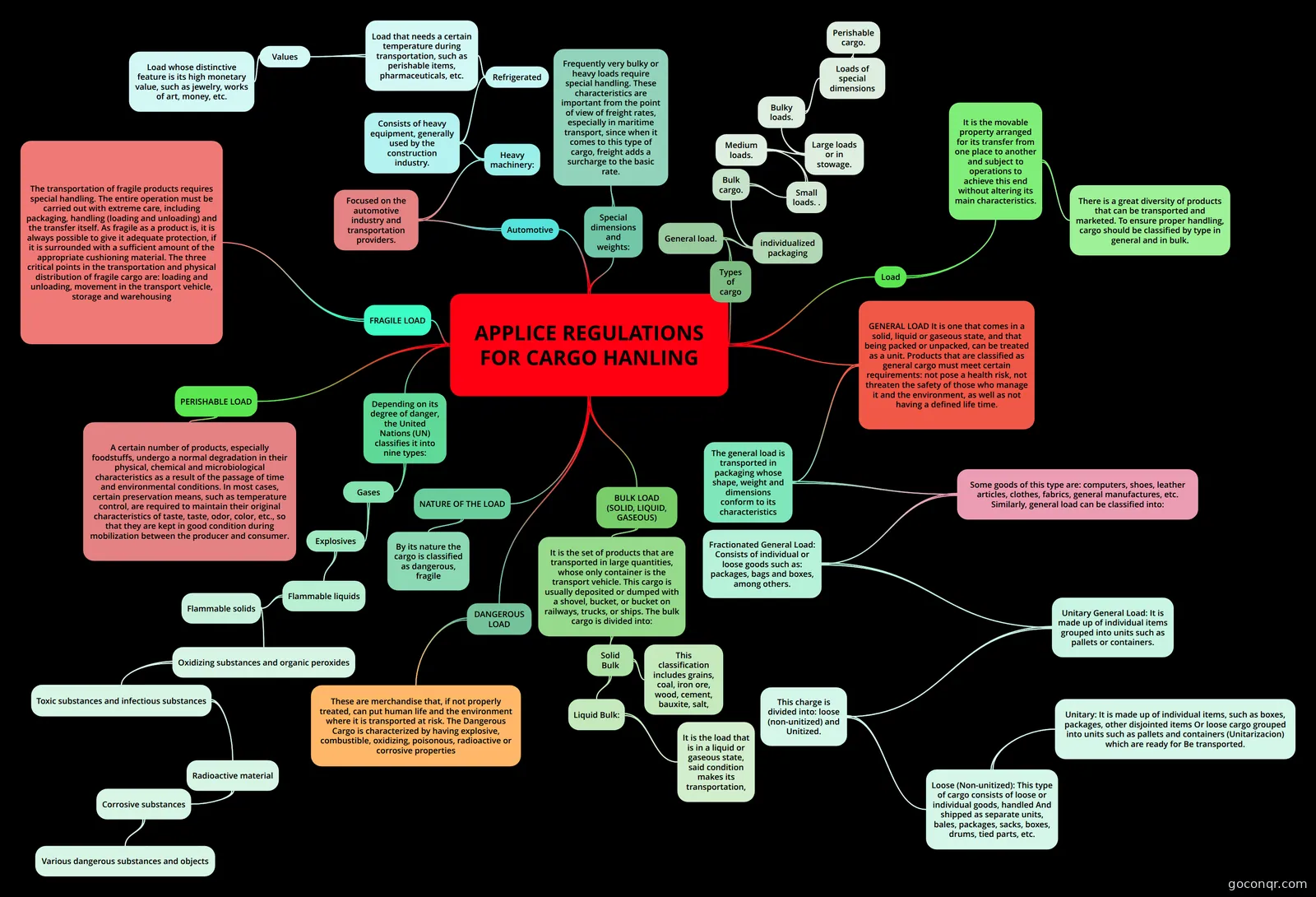
Mind map: types of cargo
Inhalt der Mindmap
APPLICE REGULATIONS FOR CARGO HANLING
Load
- It is the movable property arranged for its transfer from one place to another and subject to operations to achieve this end without altering its main characteristics.
- There is a great diversity of products that can be transported and marketed. To ensure proper handling, cargo should be classified by type in general and in bulk.
- It is the movable property arranged for its transfer from one place to another and subject to operations to achieve this end without altering its main characteristics.
GENERAL LOAD It is one that comes in a solid, liquid or gaseous state, and that being packed or unpacked, can be treated as a unit. Products that are classified as general cargo must meet certain requirements: not pose a health risk, not threaten the safety of those who manage it and the environment, as well as not having a defined life time.
- The general load is transported in packaging whose shape, weight and dimensions conform to its characteristics
- Some goods of this type are: computers, shoes, leather articles, clothes, fabrics, general manufactures, etc. Similarly, general load can be classified into:
- Fractionated General Load: Consists of individual or loose goods such as: packages, bags and boxes, among others.
- Unitary General Load: It is made up of individual items grouped into units such as pallets or containers.
- This charge is divided into: loose (non-unitized) and Unitized.
- Loose (Non-unitized): This type of cargo consists of loose or individual goods, handled And shipped as separate units, bales, packages, sacks, boxes, drums, tied parts, etc.
- Unitary: It is made up of individual items, such as boxes, packages, other disjointed items Or loose cargo grouped into units such as pallets and containers (Unitarizacion) which are ready for Be transported.
- Loose (Non-unitized): This type of cargo consists of loose or individual goods, handled And shipped as separate units, bales, packages, sacks, boxes, drums, tied parts, etc.
- This charge is divided into: loose (non-unitized) and Unitized.
- Unitary General Load: It is made up of individual items grouped into units such as pallets or containers.
- Fractionated General Load: Consists of individual or loose goods such as: packages, bags and boxes, among others.
- Some goods of this type are: computers, shoes, leather articles, clothes, fabrics, general manufactures, etc. Similarly, general load can be classified into:
- The general load is transported in packaging whose shape, weight and dimensions conform to its characteristics
BULK LOAD (SOLID, LIQUID, GASEOUS)
- It is the set of products that are transported in large quantities, whose only container is the transport vehicle. This cargo is usually deposited or dumped with a shovel, bucket, or bucket on railways, trucks, or ships. The bulk cargo is divided into:
- Solid Bulk
- This classification includes grains, coal, iron ore, wood, cement, bauxite, salt,
- Liquid Bulk:
- It is the load that is in a liquid or gaseous state, said condition makes its transportation,
- Solid Bulk
- It is the set of products that are transported in large quantities, whose only container is the transport vehicle. This cargo is usually deposited or dumped with a shovel, bucket, or bucket on railways, trucks, or ships. The bulk cargo is divided into:
NATURE OF THE LOAD
- By its nature the cargo is classified as dangerous, fragile
DANGEROUS LOAD
- These are merchandise that, if not properly treated, can put human life and the environment where it is transported at risk. The Dangerous Cargo is characterized by having explosive, combustible, oxidizing, poisonous, radioactive or corrosive properties
Depending on its degree of danger, the United Nations (UN) classifies it into nine types:
- Gases
- Explosives
- Flammable liquids
- Flammable solids
- Oxidizing substances and organic peroxides
- Toxic substances and infectious substances
- Radioactive material
- Corrosive substances
- Various dangerous substances and objects
- Corrosive substances
- Radioactive material
- Toxic substances and infectious substances
- Oxidizing substances and organic peroxides
- Flammable solids
- Flammable liquids
- Explosives
- Gases
PERISHABLE LOAD
- A certain number of products, especially foodstuffs, undergo a normal degradation in their physical, chemical and microbiological characteristics as a result of the passage of time and environmental conditions. In most cases, certain preservation means, such as temperature control, are required to maintain their original characteristics of taste, taste, odor, color, etc., so that they are kept in good condition during mobilization between the producer and consumer.
FRAGILE LOAD
- The transportation of fragile products requires special handling. The entire operation must be carried out with extreme care, including packaging, handling (loading and unloading) and the transfer itself. As fragile as a product is, it is always possible to give it adequate protection, if it is surrounded with a sufficient amount of the appropriate cushioning material. The three critical points in the transportation and physical distribution of fragile cargo are: loading and unloading, movement in the transport vehicle, storage and warehousing
Automotive
- Focused on the automotive industry and transportation providers.
- Heavy machinery:
- Consists of heavy equipment, generally used by the construction industry.
- Refrigerated
- Load that needs a certain temperature during transportation, such as perishable items, pharmaceuticals, etc.
- Values
- Load whose distinctive feature is its high monetary value, such as jewelry, works of art, money, etc.
- Values
- Load that needs a certain temperature during transportation, such as perishable items, pharmaceuticals, etc.
- Refrigerated
- Consists of heavy equipment, generally used by the construction industry.
- Heavy machinery:
- Focused on the automotive industry and transportation providers.
Special dimensions and weights:
- Frequently very bulky or heavy loads require special handling. These characteristics are important from the point of view of freight rates, especially in maritime transport, since when it comes to this type of cargo, freight adds a surcharge to the basic rate.
Types of cargo
- General load.
- individualized packaging
- Bulk cargo.
- Small loads. .
- Medium loads.
- Large loads or in stowage.
- Bulky loads.
- Loads of special dimensions
- Perishable cargo.
- Loads of special dimensions
- Bulky loads.
- Large loads or in stowage.
- Medium loads.
- Small loads. .
- Bulk cargo.
- individualized packaging
- General load.
Informationen
- Beschreibung
- Sandra gaytan Ramírez
- Erstellt von
- SANDRA RUMINA GAYTAN RAMIREZ
- Aufrufe
- 3
- Bewertung
Mehr zu Cargo Types and Classification