
Mindmap
Environmental Chemistry
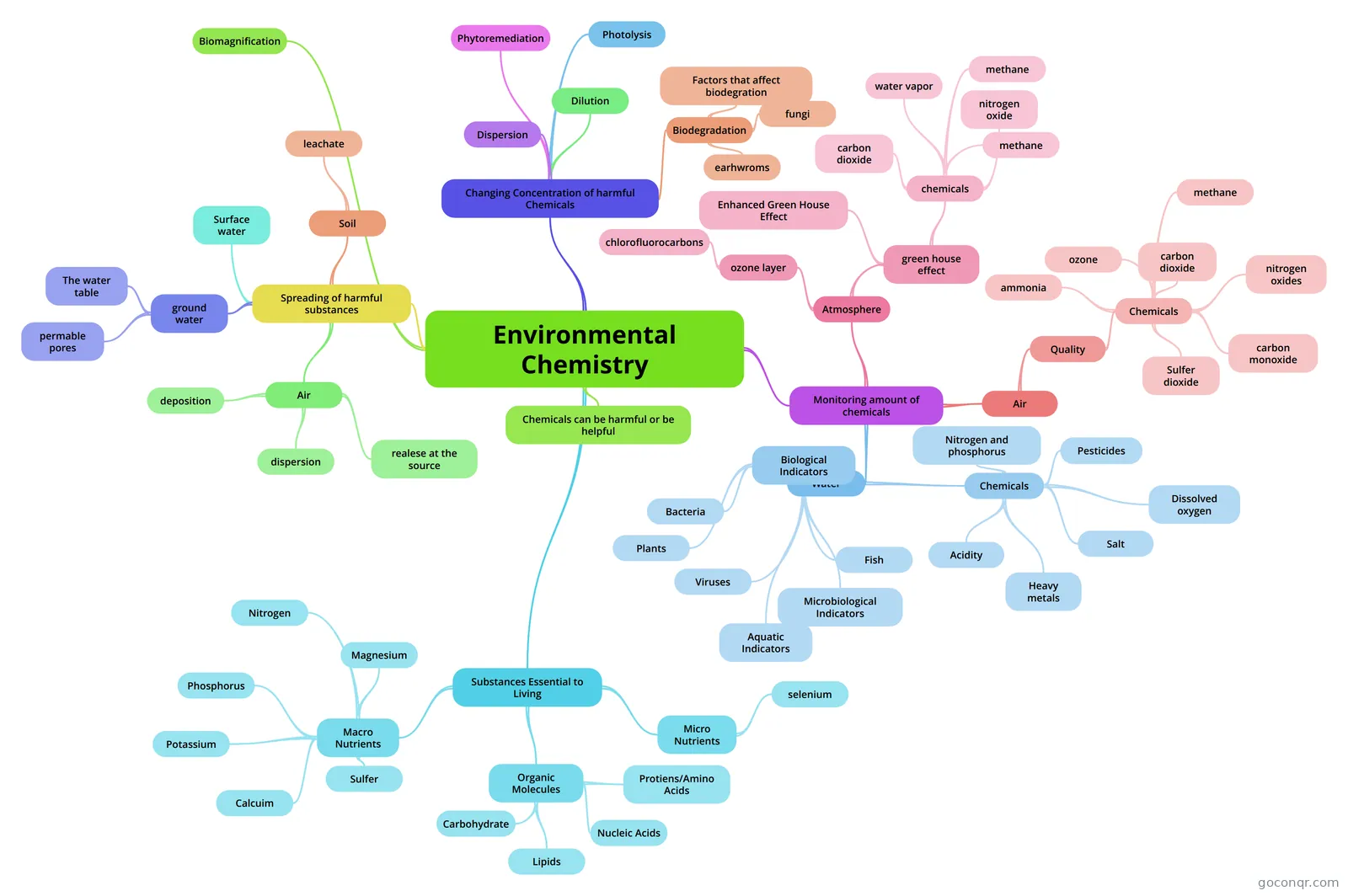
Mind map: Environmental chemistry
Inhalt der Mindmap
Environmental Chemistry
Chemicals can be harmful or be helpful
Monitoring amount of chemicals
- It is important for us to monitor the amount of chemicals we use in different substances.
- Water
- Biological Indicators
- Microbiological Indicators
- Bacteria can cause serious health problems. One of the more common bacteria that we hear about is E-Coli.
- Aquatic Indicators
- There are many types of aquatic indicators including leechs, clams, flatworms ,water boatman, and water striders.
- Fish
- Bacteria
- Viruses
- Plants
- Microbiological Indicators
- Chemicals
- Acidity
- We want the acidity in water to be close to neutral. It can't be to basic or to acidic.
- Dissolved oxygen
- Dissolved oxygen is essential for the health of aquatic life such as fish, insects, and micro-organisms. The amount of dissolved oxygen in the water depends on the temperature, turbulance due to wind or the speed of moving water, the amount of photosynthesis by plants and algae in the water, and the number of organisms using up the oxygen.
- Heavy metals
- Bio magnification - increase in concentration of a chemical or element as it moves up the food chain. If a small fish eats a small amount of mercury by the time it gets to us, humans, it is quite a large concentration of mercury in the cycle. This means we injest more than we are supposed to.
- Nitrogen and phosphorus
- Nitrogen and phosphorus and nitrogen are important to all living things, but too much can be harmful. You can find these chemicals in fertilizer.
- Salt
- Low levels of salts needed Acids and bases reacting (nuetralize the chemical)
- Pesticides
- Pesticides aren't always bad. They may harm one thing but be good for there food. So there food has time to repopulate.
- Acidity
- Biological Indicators
- Air
- Quality
- Chemicals
- Sulfer dioxide
- ozone
- carbon dioxide
- ammonia
- carbon monoxide
- nitrogen oxides
- methane
- Chemicals
- Quality
- Atmosphere
- green house effect
- chemicals
- carbon dioxide
- water vapor
- methane
- methane
- nitrogen oxide
- Enhanced Green House Effect
- The enhanced green house effect results from the greater concentration of gases trapping even more heat. It result in us having a greater temperature on earth. This is known as global warming. The ice caps can melt and the ocean levels will rise, the world will start to flood the earth.
- chemicals
- ozone layer
- Abosrbs most of the suns UV rays.
- chlorofluorocarbons
- An organic compound that only contain carbon, flourine and chloride. They cause the ozone layer to deplete. Can be released by hairspray and other airosole. They are banned in someplaces because the ozone was thinning to much.
- green house effect
Spreading of harmful substances
- Air
- realese at the source
- dispersion
- chemicals move in all directions
- deposition
- ground water
- The water table
- It is the surface where the water pressure head is equal to atmospheric pressure. Also how close the ground water is to the surface. The amount of water under the surface
- permable pores
- The water table
- Surface water
- Soil
- leachate
- Air
Changing Concentration of harmful Chemicals
- Dispersion
- Dilution
- Biodegradation
- Break down of materials by organisms such as earthworms, bacteria, and fungi; "bio" refers to living things and "degrade" mean to break up.
- Factors that affect biodegration
- whether or not the chemical structure of the materials is biodegrateable
- earhwroms
- fungi
- Phytoremediation
- technique that reduces the concentration of harmful chemicals in the soil or groundwater. Plants are used to clean up pesticides.
- Photolysis
Substances Essential to Living
- Macro Nutrients
- Need lots
- Nitrogen
- NEED OPTIMAL AMOUNTS -makes protiens- makes chlorophyll- stems and leaves- nucleic acid- grows and repairs tissue
- Phosphorus
- NEED OPTIMAL AMOUNTS - root and flower growth - cellular respiration and photosynthesis- making bones, teeth, and DNA
- Potassium
- NEED OPTIMAL AMOUNTS - stimulates growth - making protiens - fights diseases - making chlorophyll - muscle contractions - nerve impulses
- Magnesium
- NEED OPTIMAL AMOUNTS- composition of chlorophyll - helps photosynthesis - making bones and teeth - absorbs calcium and potassium
- Calcuim
- NEED OPTIMAL AMOUNTS - cell walls - cell division - bones and teeth - blood clotting - muscle and nerve function
- Sulfer
- NEED OPTIMAL AMOUNTS- produce fruit and grains - make protiens - detoxification
- Organic Molecules
- Carbohydrate
- NEED sugar simple or complex molecules made of C,H,O
- Lipids
- Fat C, H, O
- Protiens/Amino Acids
- Meat, eggs, and dairy
- Nucleic Acids
- DNA, RNA - carries genetic material
- Carbohydrate
- Micro Nutrients
- need small amounts
- selenium
- NEED OPTIMAL AMOUNTS - need it but only a little bit
- Macro Nutrients
Biomagnification
Informationen
- Beschreibung
- This is information on Environmental Chemistry made by a Grade 9 Student.
- Erstellt von
- K.Hendrickson
- Aufrufe
- 42
- Bewertung
Mehr zu Environmental Chemistry