
Mindmap
Adaptation and Competence
Inhalt der Mindmap
Adaptation and Competence
different domains of adjustment
- areas of demand
- Psychological adjustment (well being/ emotional satisfaction)
- Sociocultural adjustment: ability to fit in and get tasks done)
- Cross Cultural adaptation: ability to negotiate the culture and accomplish tasks to fit in.
- Stable and functional relationships
- some degree of the host culture
- Cross cultural adjustment: one's cping or psychological health when moving to new culture
- both parties adapt to each other
- Critique of western theories: focus on individual, independence, reason and self-enhancement
Acculturation
- Not straightforward adaptation
- Integration/ biculturalism: fully embrace and identify with both cultures
- deliberately resisting new culture and maintain elements of old
- Not based solely on individual's adjustment
- Majority people accept or expect integration of minority
- attitude of majority towards minority/strangers
- Segregation: separate them intentionally'unintentionally
- Multiculturalism: maintain both group and new culture identities
- Melting Pot (assimilation model): expect people to lose their own cultural identity and become mainstream
- Exclusion: negate their existence/ have no relations with them
- Cultural pluralism: members of co-cultural groups should embrace their own culture
- Selective adaptation: acceptance of some elements of the dominant culture but not others
- Diaspora: group from specific homeland is pread out across a wide geographic area
- Hybridity: diasporic groups rub together against local cultures (cultural blends)
- Have different types of power
- Dominant culture pics terms that benefit them
- Cultural adjustment can be predictable or negotiated through communication and power relations with dominant cultures
Returning Home
- Return cultural adjustment: adjusting to one's culture psychologically and behaviourally
- Partial re-acculturation
- Psychlogical adjustment
- Process And Nature of Return Cultural Adjustment
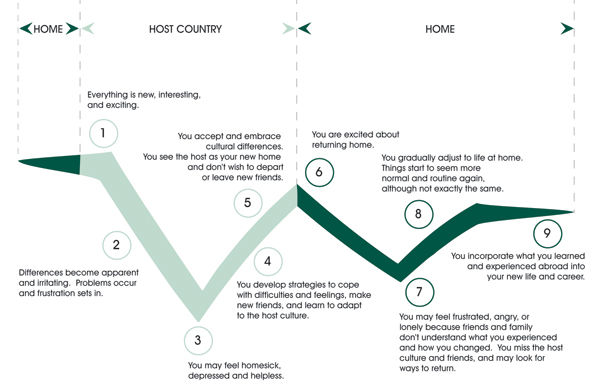
- W-curve of return adjustment
- Change in relationships
- Unrealistic expectations and disillusionment
- ambivalent, critical of own home culture
- Lack of appreciation
- Making it Easier
- Cultural preparation
- Communication in new culture
- interacting with host nationals
- Open-minded, adventurous, patient, realistic expectations
- Suspend judgement on unfamiliar things
- accept need to retreat from time to time
- talk to people in host culture about misunderstandings
- Needs of partners and children
- Aspects of adjustment= spouse's expectations and adaptation
- Adjustment varies
- Contact with home
- Mediating person: help people understand different cultures
- Alienated approach
- Missing abroad culture
- being critical and bitter about home culture
- Resocialized approach: quickly shed abroad culture and re-adapt
- Proactive Approach: sees the good in home and host cultures
- Cultural preparation
- Return cultural adjustment: adjusting to one's culture psychologically and behaviourally
Intercultural Communication Competence
- Understanding
- 5 aspects of effectiveness
- Communicate interpersonally
- Adjust to differet cutures
- deal with different societal systems
- establish interpersonal relationships
- understand others
- Competence
- one's culture specific understanding
- culture general understanding and positive feeling for the other culture
- Skills and attitude x intercultural competence and effectiveness
- Charisma, flexibility, empathy, non-enthocentrism, person-ability strength, opimism, self-efficacy, facilitate communication
- Communication effectiveness: accomplish tasks (achievement of interaction goals)
- Communication competence: effective + appropriateness to the rules of he situation
- Intercultural Communication Competence
- motivation
- knowledge of how to communicate well/ task specific details
- skills of knowing how to gain knowledge of the other culture, episodes and relationships
- social, linguistic, communicative and relational competence
- Guo Ming Chen and William Starosta Model
- 1. Affective Dimension: intercultural sensitivity, focuses on emotions and feelings
- 2. Behavioural/ Skill dimension: task accomplishments in intercultural situations
- 3. Cognitive/ knowledge dimension: intercultural sensitivity, deals with awareness of difference
- Multicultural person: serve as a catalyst for dislogue between cultures
- move easily between cultures
- 'lives on the boundary'
- Never fully belong to one culture
- Intercultural transformation: learn new ways of thinking, feeling and behaving
- wide range of intercultural experince
- Return from travel as more complex, broad minded and effective individuals
- 5 aspects of effectiveness
- Going beyond
- variables can be more or less important depending on culture/mission
- structural and cultural factors
- disposition
- environment
- Women spoke of identities in relation to context of being included or excluded (race, religion, ethnicity and gender)
- travelers need to find their own sense of rootedness/ home to help them sustain difficulties
- Being multicultural might leave us with a sense of void in our identity
- variables can be more or less important depending on culture/mission
- Understanding
Bilder und Dateien der Mindmap
Informationen
- Beschreibung
- Mindmap am Adaptation and Competence, erstellt von inezlim94 am 04/11/2015.
- Erstellt von
- inezlim94
- Aufrufe
- 0
- Bewertung