
Mindmap
Introduction to E-Learning
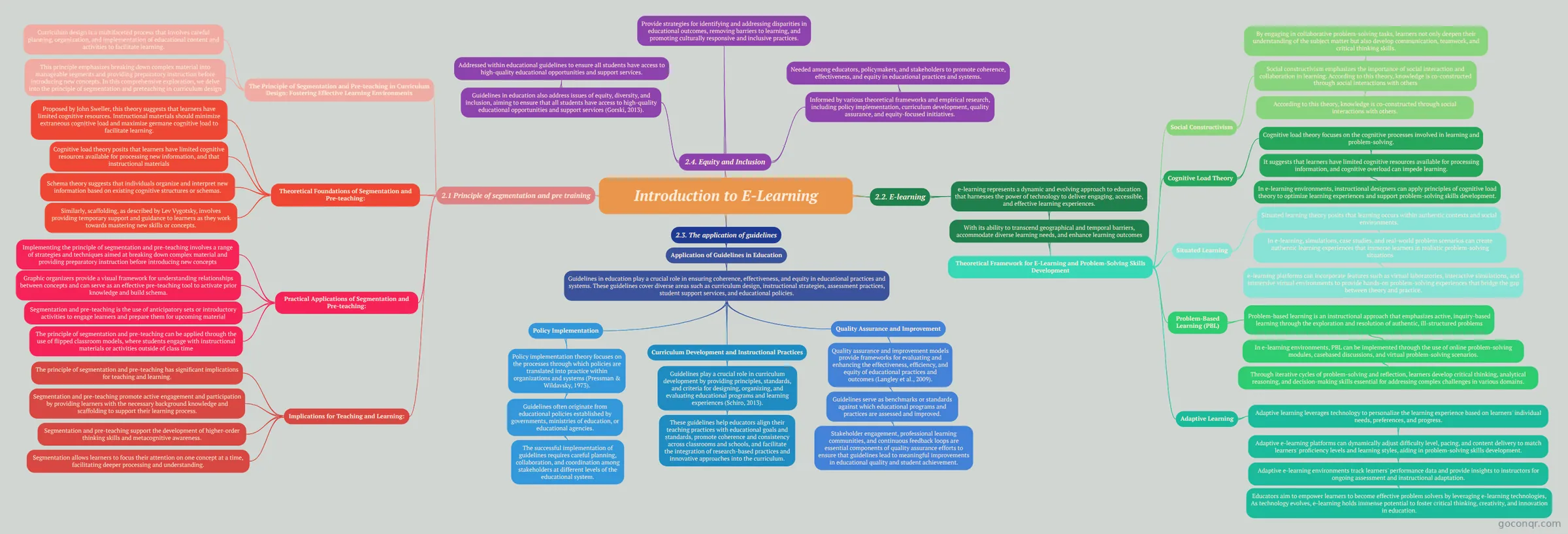
Mind map: Introduction to E-Learning
Inhalt der Mindmap
Introduction to E-Learning
2.1 Principle of segmentation and pre training
- The Principle of Segmentation and Pre-teaching in Curriculum Design: Fostering Effective Learning Environments
- Curriculum design is a multifaceted process that involves careful planning, organization, and implementation of educational content and activities to facilitate learning.
- This principle emphasizes breaking down complex material into manageable segments and providing preparatory instruction before introducing new concepts. In this comprehensive exploration, we delve into the principle of segmentation and preteaching in curriculum design
- Theoretical Foundations of Segmentation and Pre-teaching:
- Proposed by John Sweller, this theory suggests that learners have limited cognitive resources. Instructional materials should minimize extraneous cognitive load and maximize germane cognitive load to facilitate learning.
- Cognitive load theory posits that learners have limited cognitive resources available for processing new information, and that instructional materials
- Schema theory suggests that individuals organize and interpret new information based on existing cognitive structures or schemas.
- Similarly, scaffolding, as described by Lev Vygotsky, involves providing temporary support and guidance to learners as they work towards mastering new skills or concepts.
- Practical Applications of Segmentation and Pre-teaching:
- Implementing the principle of segmentation and pre-teaching involves a range of strategies and techniques aimed at breaking down complex material and providing preparatory instruction before introducing new concepts
- Graphic organizers provide a visual framework for understanding relationships between concepts and can serve as an effective pre-teaching tool to activate prior knowledge and build schema.
- Segmentation and pre-teaching is the use of anticipatory sets or introductory activities to engage learners and prepare them for upcoming material
- The principle of segmentation and pre-teaching can be applied through the use of flipped classroom models, where students engage with instructional materials or activities outside of class time
- Implications for Teaching and Learning:
- The principle of segmentation and pre-teaching has significant implications for teaching and learning.
- Segmentation and pre-teaching promote active engagement and participation by providing learners with the necessary background knowledge and scaffolding to support their learning process.
- Segmentation and pre-teaching support the development of higher-order thinking skills and metacognitive awareness.
- Segmentation allows learners to focus their attention on one concept at a time, facilitating deeper processing and understanding.
- The Principle of Segmentation and Pre-teaching in Curriculum Design: Fostering Effective Learning Environments
2.2. E-learning
- e-learning represents a dynamic and evolving approach to education that harnesses the power of technology to deliver engaging, accessible, and effective learning experiences.
- With its ability to transcend geographical and temporal barriers, accommodate diverse learning needs, and enhance learning outcomes
- Theoretical Framework for E-Learning and Problem-Solving Skills Development
- Social Constructivism
- Social constructivism emphasizes the importance of social interaction and collaboration in learning. According to this theory, knowledge is co-constructed through social interactions with others
- According to this theory, knowledge is co-constructed through social interactions with others.
- By engaging in collaborative problem-solving tasks, learners not only deepen their understanding of the subject matter but also develop communication, teamwork, and critical thinking skills.
- Social constructivism emphasizes the importance of social interaction and collaboration in learning. According to this theory, knowledge is co-constructed through social interactions with others
- Cognitive Load Theory
- Cognitive load theory focuses on the cognitive processes involved in learning and problem-solving.
- It suggests that learners have limited cognitive resources available for processing information, and cognitive overload can impede learning.
- In e-learning environments, instructional designers can apply principles of cognitive load theory to optimize learning experiences and support problem-solving skills development.
- It suggests that learners have limited cognitive resources available for processing information, and cognitive overload can impede learning.
- Cognitive load theory focuses on the cognitive processes involved in learning and problem-solving.
- Situated Learning
- Situated learning theory posits that learning occurs within authentic contexts and social environments.
- In e-learning, simulations, case studies, and real-world problem scenarios can create authentic learning experiences that immerse learners in realistic problem-solving situations
- e-learning platforms can incorporate features such as virtual laboratories, interactive simulations, and immersive virtual environments to provide hands-on problem-solving experiences that bridge the gap between theory and practice.
- In e-learning, simulations, case studies, and real-world problem scenarios can create authentic learning experiences that immerse learners in realistic problem-solving situations
- Situated learning theory posits that learning occurs within authentic contexts and social environments.
- Problem-Based Learning (PBL)
- Problem-based learning is an instructional approach that emphasizes active, inquiry-based learning through the exploration and resolution of authentic, ill-structured problems
- In e-learning environments, PBL can be implemented through the use of online problem-solving modules, casebased discussions, and virtual problem-solving scenarios.
- Through iterative cycles of problem-solving and reflection, learners develop critical thinking, analytical reasoning, and decision-making skills essential for addressing complex challenges in various domains.
- In e-learning environments, PBL can be implemented through the use of online problem-solving modules, casebased discussions, and virtual problem-solving scenarios.
- Problem-based learning is an instructional approach that emphasizes active, inquiry-based learning through the exploration and resolution of authentic, ill-structured problems
- Adaptive Learning
- Adaptive learning leverages technology to personalize the learning experience based on learners' individual needs, preferences, and progress.
- Adaptive e-learning platforms can dynamically adjust difficulty level, pacing, and content delivery to match learners' proficiency levels and learning styles, aiding in problem-solving skills development.
- Adaptive e-learning environments track learners' performance data and provide insights to instructors for ongoing assessment and instructional adaptation.
- Educators aim to empower learners to become effective problem solvers by leveraging e-learning technologies, As technology evolves, e-learning holds immense potential to foster critical thinking, creativity, and innovation in education.
- Adaptive e-learning environments track learners' performance data and provide insights to instructors for ongoing assessment and instructional adaptation.
- Adaptive e-learning platforms can dynamically adjust difficulty level, pacing, and content delivery to match learners' proficiency levels and learning styles, aiding in problem-solving skills development.
- Adaptive learning leverages technology to personalize the learning experience based on learners' individual needs, preferences, and progress.
- Social Constructivism
- Theoretical Framework for E-Learning and Problem-Solving Skills Development
- With its ability to transcend geographical and temporal barriers, accommodate diverse learning needs, and enhance learning outcomes
- e-learning represents a dynamic and evolving approach to education that harnesses the power of technology to deliver engaging, accessible, and effective learning experiences.
2.3. The application of guidelines
- Application of Guidelines in Education
- Guidelines in education play a crucial role in ensuring coherence, effectiveness, and equity in educational practices and systems. These guidelines cover diverse areas such as curriculum design, instructional strategies, assessment practices, student support services, and educational policies.
- Policy Implementation
- Policy implementation theory focuses on the processes through which policies are translated into practice within organizations and systems (Pressman & Wildavsky, 1973).
- Guidelines often originate from educational policies established by governments, ministries of education, or educational agencies.
- The successful implementation of guidelines requires careful planning, collaboration, and coordination among stakeholders at different levels of the educational system.
- Guidelines often originate from educational policies established by governments, ministries of education, or educational agencies.
- Policy implementation theory focuses on the processes through which policies are translated into practice within organizations and systems (Pressman & Wildavsky, 1973).
- Curriculum Development and Instructional Practices
- Guidelines play a crucial role in curriculum development by providing principles, standards, and criteria for designing, organizing, and evaluating educational programs and learning experiences (Schiro, 2013).
- These guidelines help educators align their teaching practices with educational goals and standards, promote coherence and consistency across classrooms and schools, and facilitate the integration of research-based practices and innovative approaches into the curriculum.
- Guidelines play a crucial role in curriculum development by providing principles, standards, and criteria for designing, organizing, and evaluating educational programs and learning experiences (Schiro, 2013).
- Quality Assurance and Improvement
- Quality assurance and improvement models provide frameworks for evaluating and enhancing the effectiveness, efficiency, and equity of educational practices and outcomes (Langley et al., 2009).
- Guidelines serve as benchmarks or standards against which educational programs and practices are assessed and improved.
- Stakeholder engagement, professional learning communities, and continuous feedback loops are essential components of quality assurance efforts to ensure that guidelines lead to meaningful improvements in educational quality and student achievement.
- Guidelines serve as benchmarks or standards against which educational programs and practices are assessed and improved.
- Quality assurance and improvement models provide frameworks for evaluating and enhancing the effectiveness, efficiency, and equity of educational practices and outcomes (Langley et al., 2009).
- Policy Implementation
- Guidelines in education play a crucial role in ensuring coherence, effectiveness, and equity in educational practices and systems. These guidelines cover diverse areas such as curriculum design, instructional strategies, assessment practices, student support services, and educational policies.
- Application of Guidelines in Education
2.4. Equity and Inclusion
- Guidelines in education also address issues of equity, diversity, and inclusion, aiming to ensure that all students have access to high-quality educational opportunities and support services (Gorski, 2013).
- Addressed within educational guidelines to ensure all students have access to high-quality educational opportunities and support services.
- Provide strategies for identifying and addressing disparities in educational outcomes, removing barriers to learning, and promoting culturally responsive and inclusive practices.
- Informed by various theoretical frameworks and empirical research, including policy implementation, curriculum development, quality assurance, and equity-focused initiatives.
- Needed among educators, policymakers, and stakeholders to promote coherence, effectiveness, and equity in educational practices and systems.
- Guidelines in education also address issues of equity, diversity, and inclusion, aiming to ensure that all students have access to high-quality educational opportunities and support services (Gorski, 2013).
Informationen
- Beschreibung
- Mindmap am Introduction to E-Learning, erstellt von Dilan Medina am 11/05/2024.
- Erstellt von
- Dilan Medina
- Aufrufe
- 3
- Bewertung