
Mindmap
Nouns
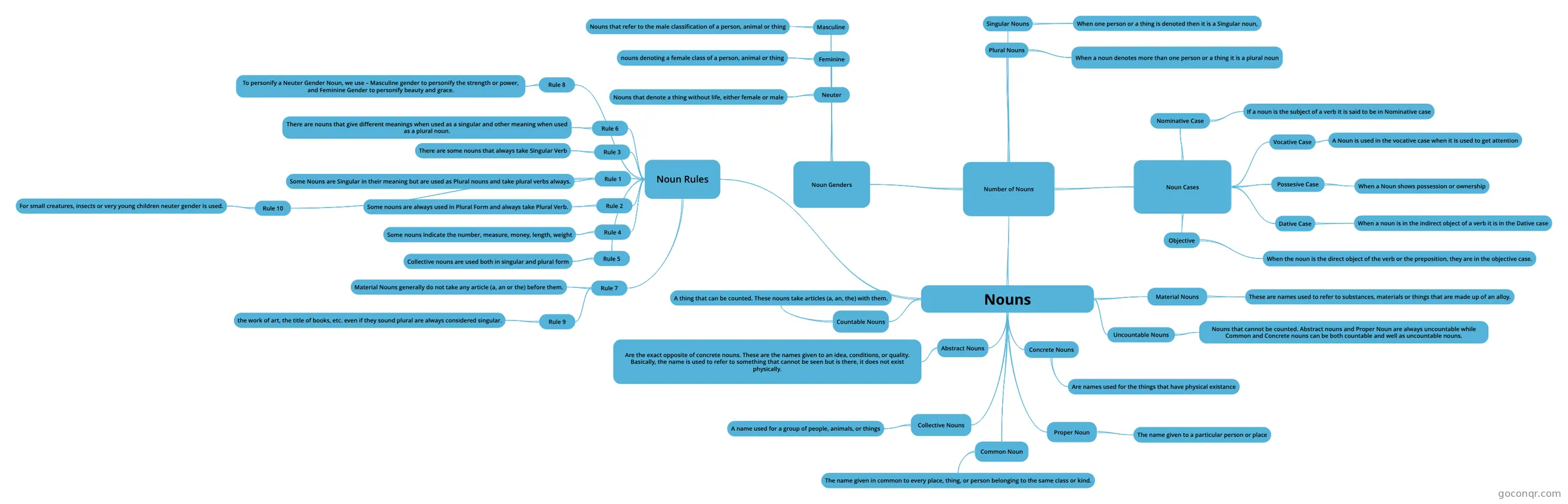
Mind map: Nouns
Inhalt der Mindmap
Nouns
Common Noun
- The name given in common to every place, thing, or person belonging to the same class or kind.
Proper Noun
- The name given to a particular person or place
Collective Nouns
- A name used for a group of people, animals, or things
Concrete Nouns
- Are names used for the things that have physical existance
Abstract Nouns
- Are the exact opposite of concrete nouns. These are the names given to an idea, conditions, or quality. Basically, the name is used to refer to something that cannot be seen but is there, it does not exist physically.
Material Nouns
- These are names used to refer to substances, materials or things that are made up of an alloy.
Countable Nouns
- A thing that can be counted. These nouns take articles (a, an, the) with them.
Uncountable Nouns
- Nouns that cannot be counted. Abstract nouns and Proper Noun are always uncountable while Common and Concrete nouns can be both countable and well as uncountable nouns.
Number of Nouns
- Singular Nouns
- When one person or a thing is denoted then it is a Singular noun,
- Plural Nouns
- When a noun denotes more than one person or a thing it is a plural noun
- Noun Genders
- Masculine
- Nouns that refer to the male classification of a person, animal or thing
- Feminine
- nouns denoting a female class of a person, animal or thing
- Neuter
- Nouns that denote a thing without life, either female or male
- Masculine
- Noun Cases
- Possesive Case
- When a Noun shows possession or ownership
- Vocative Case
- A Noun is used in the vocative case when it is used to get attention
- Dative Case
- When a noun is in the indirect object of a verb it is in the Dative case
- Nominative Case
- If a noun is the subject of a verb it is said to be in Nominative case
- Objective
- When the noun is the direct object of the verb or the preposition, they are in the objective case.
- Possesive Case
- Singular Nouns
Noun Rules
- Rule 1
- Some Nouns are Singular in their meaning but are used as Plural nouns and take plural verbs always.
- Rule 10
- For small creatures, insects or very young children neuter gender is used.
- Rule 2
- Some nouns are always used in Plural Form and always take Plural Verb.
- Rule 3
- There are some nouns that always take Singular Verb
- Rule 4
- Some nouns indicate the number, measure, money, length, weight
- Rule 5
- Collective nouns are used both in singular and plural form
- Rule 6
- There are nouns that give different meanings when used as a singular and other meaning when used as a plural noun.
- Rule 7
- Material Nouns generally do not take any article (a, an or the) before them.
- Rule 9
- the work of art, the title of books, etc. even if they sound plural are always considered singular.
- Rule 8
- To personify a Neuter Gender Noun, we use – Masculine gender to personify the strength or power, and Feminine Gender to personify beauty and grace.
- Rule 1
Informationen
- Beschreibung
- Mindmap am Nouns, erstellt von JAIME PORRAS BRAOJOS am 28/01/2025.
- Erstellt von
- JAIME PORRAS BRAOJOS
- Aufrufe
- 0
- Bewertung
Mehr zu Types and functions of nouns