
Mindmap
Elements Of Life
Inhalt der Mindmap
Elements Of Life
Where do elements come from
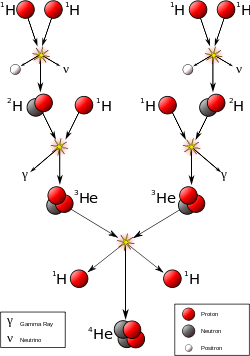
- Nuclear Fusion
- Two light atomic nuclei fuse together to create a single heavier nucleus of a new element, releasing enormous amounts of energy
- Requires high temperature and pressure to overcome the repellent forces of the positive nuclei
- Can only occur in the centre of stars as the nuclei are moving with much more energy
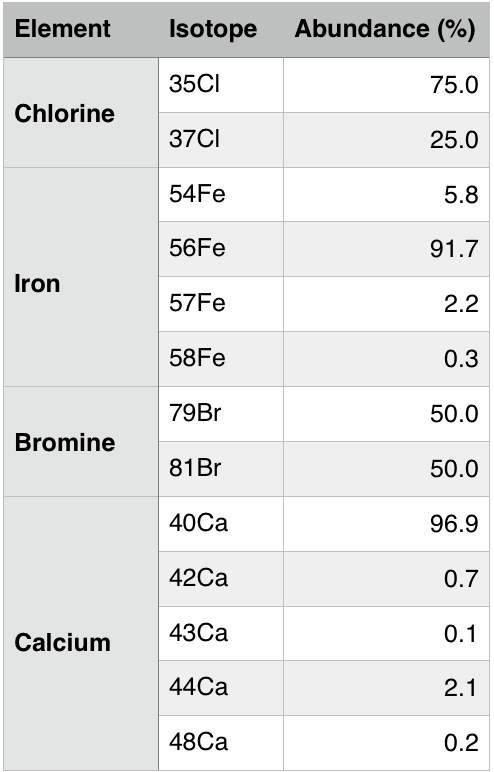
- Isotopes
- Atoms of the same element with different mass numbers. This causes a difference in mass
- The relative atomic mass (Ar) is the average of the relative isotopic masses, taking into account their abundances.
- This is measured by mass spectrometry
- Sample atoms are ionised and seperated according to their mass to charge ratios.
- The separated ions are detected, along with their abundance
- This is measured by mass spectrometry
- Nuclear Fusion
Spectroscopy
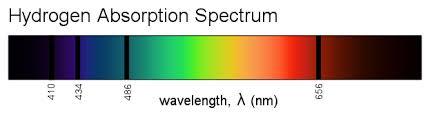
- Absorption spectra
- Glowing stars emit all light frequencies
- In the photosphere small molecules absorb some of the emitted radiation
- Lines appear black when light has been absorbed
- Emission spectra
- When molecules absorb energy they are raised from their ground state to an exited state
- They lose energy by emitting electromagnetic radiation in the form of visible light
- Ultraviolet light emission spectrum is the Lyman
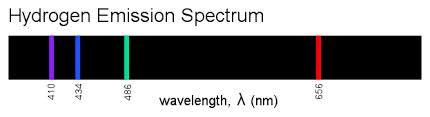
- Hydrogen emission spectrum in visible light is the Balmer series
- Lines become closer together at higher frequencies
- Speed of light = wavelength x frequency
- Bohr's theory
- Electron in the hydrogen atom only exists in certain definite energy levels or electron shells
- A photon of light is emitted or absorbed when the electron changes from one energy level to another
- The energy of the photon is equal to the difference between the two energy levels /\E
- Since E=hv it follows that the freqeuncy of the emitted or absorbed light is related to /\E by /\E=hv
- Unique to each element as there are different gaps between energy levels
- When molecules absorb energy they are raised from their ground state to an exited state
- Under certain conditions a substance can absorb or emit electromagnetic radiation
- Flame tests
- Li+ Bight red
- Na+ yellow
- K+ lilac
- Cu2+ blue green
- Ba2+ apple green
- Ca2+ brick red
- Absorption spectra
Electron Structure
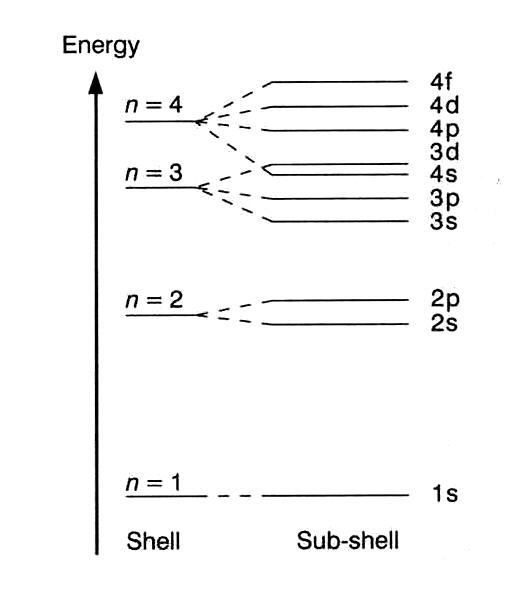
- Shells
- (n=1) 2 electrons
- (n=2) 8 electrons
- (n=3) 18 electrons
- (n=4) 32 electrons
- Sub shells
- S
- 2 electrons
- 1 s orbital
- P
- 3 p orbitals
- 6 electrons
- D
- 5 D orbitals
- 10 electrons
- F
- 7 f orbitals
- 14 electrons
- S
- Electron configurations
- Orbitals are filled in order of increasing energy
- Orbitals are filled up singly, before pairing up
- The S orbital in the 4th shell fills up before the D orbital in the 3rd shell as the energy levels are lower
- The 3d sub shell is written alongside other n=3 sub shells even though it is filled after 4s
- Shells
Periodicity
- The occurance of periodic patterns
- Metals to non metals across the group
- First ionisation energy
- Melting and boiling points
Covalent Bonding
- Molecule Shape
- Electron repulsion - electron pairs try to be as far from each other as possible
- Planar Triangular
- 120
- E.g. Boron Flouride BF3
- 3 Groups of electrons No lone pairs
- Tetrahederal
- four groups of electrons round an atom
- 109.5
- E.g. Methane, CH4
- Bent
- Two lone pairs and Two single covalent bonds
- E.g, water
- 104.5
- Linear
- Two single or double covalent bonds around the central aton
- 180
- E.g. BeCl2
- Bipyrimidal
- Five groups of electrons round a central atom
- E.g. Phosphorous pentachloride PCl5
- Either 120 or 90, depending on the position within the molecule
- Octohederal
- Six groups of electrons round a central atom
- E.g. SF6
- 90
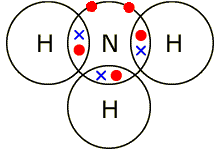
- Pyramidal
- 107
- Ammonia
- 3 groups of electrons One lone pair
- Elements achieve a full outer shell by sharing electrons
- Shown by dot and cross diagrams
- Electron pairs that form bonds are bonding pairs
- Electron pairs not involved in bonding are lone pairs
- when two pairs of electrons form a covalent bond, it is a double bond
- E.g. Oxygen, O2
- Dative Covalent Bonding
- Both bonding electrons come from the same atom
- Shown by an arrow coming away from the donating atom
- E.g. Carbon Monoxide, CO
- Simple Molecular
- E.g. CO2, Cl2
- Weak intermolecular bonds between molecules
- Low melting point
- Giant Covalent Structure
- E.g. graphite, diamond
- Very high melting point
- Insoluble
- Group 4 elements
- Molecule Shape
Moles
- The Avagadro constant is 6.02 x 10^23
- Empirical Formula
- Use mass given in the question to work out molecular formula from the empirical formula
- Simplest ratio for moles of atoms
- Water of crystalisation
- Water in ionic substances, formed when the substance crystalises
Group 1
- Reactivity increases down a group
- First ionisation energy
- energy required to remove an electron from every atom from the outer shell in one mole of isolated gaseous atoms of an element
- One mole of gaseous elements with positive charge is formed
- energy is always needed as electrons are attracted to the positive nucleus
- Decreases down the group as electrons are more shielded by full shells
- Increases across the peroid as the nucleus has more of a positive charge
- energy required to remove an electron from every atom from the outer shell in one mole of isolated gaseous atoms of an element
- Lithium Sodium Potassium Rubidium Caesium Francium
- Soft, weak, with a low melting point
- Reactive with water and oxygen
Group 2
- Carbonates
- Formulae: MgCO3 CaCO3 SrCO3 BaCO3
- Less soluble down the group
- Decompose when heated
- BaCO3 > BaO + CO2
- More difficult to decompose down the group
- More thermally stable
- Charge density: same charge over smaller size = stronger force on electrons
- Hydroxides
- Increasingly soluble
- Mg(OH)2 to Ba(OH)2
- Formulae: Mg(OH)2 Ca(OH)2 Sr(OH)2 Ba(OH)2
- Increasingly soluble
- Oxides
- Formulae: MgO, CaO, SrO, BaO
- Reacts with acids: MgO + H2OSO4 > MgSO4 + H2O
- More reactive going down the group
- Electron sheilding
- Magnesium Calcium Strontium Barium
- Carbonates
Salts
- Acid
- A proton donator
- Has a pH of less than 7
- Turns litmus paper red
- Reacts with carbonates to give carbon doixide
- Neutralised by bases
- H2SO4, HCl
- Base
- Proton (H+) acceptor
- Reacts with an acid to produce water and a salt
- Alkali
- Dissolves in water to produce OH- ions
- All alkalis are bases but not all bases are alkalis
- Oxides, hydroxides, ammonia
- Water is amphoteric (can act as a base or acid)
- Bronsted-Lowry Theory: An acid is a H+ donator and a base is a H+ accpetor
- Acid
Ionic Bonding
- Ion: An atom which has lost or gained an electron and therefore has a charge
- E.g. Na+
- Cations = positive
- H+ Hydrogen NH4+ ammonium Li+ Lithium
- Mg2+ magnesium Fe2+ Iron [II] Ca2+ Calcium
- Al3+ Aluminium Fe3+ Iron [III}
- Metals
- Anions = negative
- Non metals
- F- Flourine Cl- Chlorine OH- hydroxide NO3- nitrate HCO3- hydrogen carbonate
- O2- Oxide CO3 2- Carbonate SO4 2- Sulphate
- Held together in ELECTROSTATIC bonds by their opposite charges
- Ionic salts
- Acid + alkali > salt + water
- Acid + carbonate > salt + water + carbon doixide
- Acid + metal > salt + hydrogen
- Form regularly shaped crystals
- High melting points
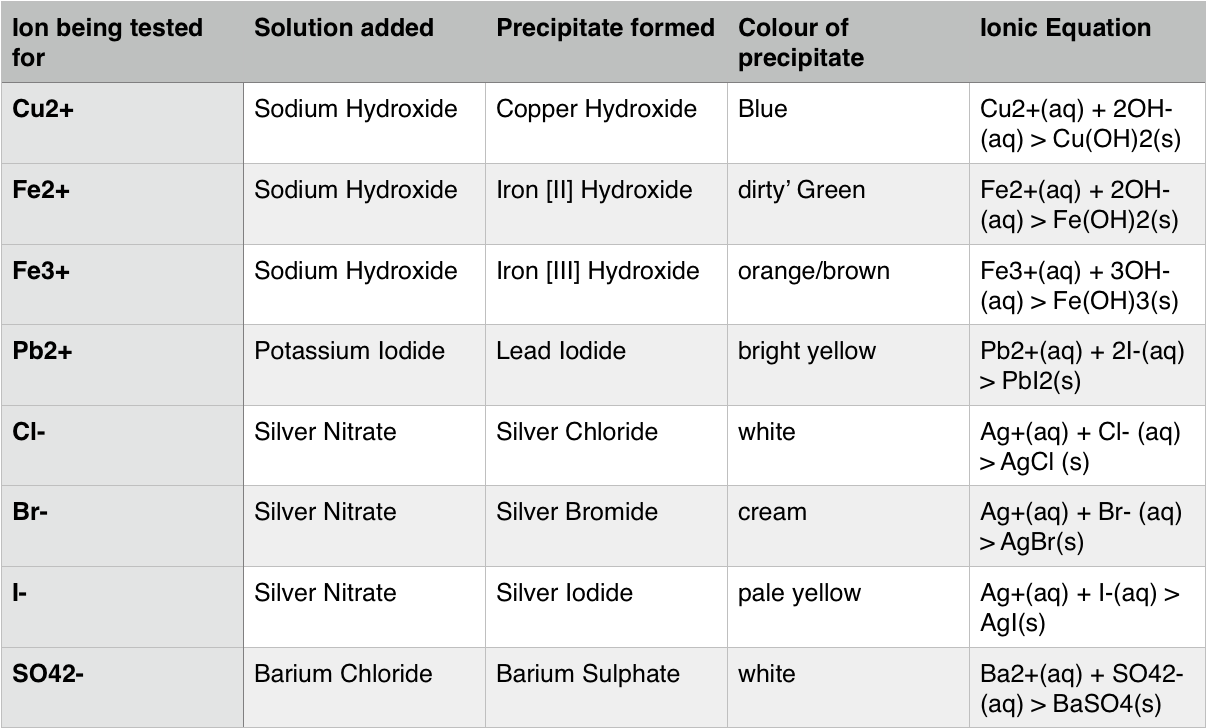
- Precipitates
- Formed when soluble reactants form an insoluble salt
- Non soluble ionic compounds
- Barium, calcium, lead, and silver sulphates
- Silver and lead halides
- Metal carbonates
- Metal hydroxides (except group 1 and ammonium hydroxide
- Spectator ions
- ions not involved in the reaction so are not included in the ionic equation
- Electrons are transferred from metal ions to nonmetal ions
- Ion: An atom which has lost or gained an electron and therefore has a charge
Bilder und Dateien der Mindmap
Informationen
- Beschreibung
- Mindmap for AS level topic Elements Of Life
- Erstellt von
- Alice Storr
- Aufrufe
- 133
- Tags
- Bewertung