
Mindmap
Pack 6 - Cell recognition and immune system Part 1
Inhalt der Mindmap
Pack 6 - Cell recognition and immune system Part 1
Important definitions:
- A pathogen is an organism that causes a disease
- An antigen is the protein shape on the outside of a cell that stimulates an immune response
- An antibody is a large y-shaped protein molecule that has a specific shape, complimentary to that of one particular antigen
Cell identification
- All types of cells have specific molecules on their surface that can be used to identify them
- This allows the immune system to identify cells as being self or non-self
- All types of cells have specific molecules on their surface that can be used to identify them
Defence mechanisms:
- Non-specific mechanisms
- Primary defences (barriers to pathogen entry)
- 1. The skin
- The cells of the epidermis
- 2. Mucous membranes
- Goblet cells produce sticky mucus which traps pathogens
- 3. HCl in the stomach
- This denatures proteins/enzymes of pathogens and kills them
- 4. Tears in the eyes
- Contains lysozymes this hydrolyses peptidoglycan in bacterial cells
- 5. Wax in ear canals
- Traps pathogens
- 1. The skin
- Phagocytosis
- When physical barriers are breached by pathogens the non-specific immune response takes place
- Pathogens or infected body cells release a chemical alarm causing the dilation of local blood vessels causing the area to become warm and red
- The permeability of the capillaries also increases causing swelling
- This means phagocytic white blood cells move to the area
- The permeability of the capillaries also increases causing swelling
- Pathogens or infected body cells release a chemical alarm causing the dilation of local blood vessels causing the area to become warm and red
- REMEMBER
- 1. Phagocytes are attracted by chemicals produced by pathogens
- 2. Phagocyte attaches to pathogen
- 3. It engulfs the pathogen to form vesicles called phagosomes
- 4. Lysosomes in phagocytes fuse with phagosomes
- 5. Hydrolytic enzymes released from lysosomes hydrolyse pathogens
- 6. Soluble products of digestion are absorbed into the cytoplasm of phagocytes
- 5. Hydrolytic enzymes released from lysosomes hydrolyse pathogens
- 4. Lysosomes in phagocytes fuse with phagosomes
- 3. It engulfs the pathogen to form vesicles called phagosomes
- 2. Phagocyte attaches to pathogen
- 1. Phagocytes are attracted by chemicals produced by pathogens
- When physical barriers are breached by pathogens the non-specific immune response takes place
- Primary defences (barriers to pathogen entry)
- Specific Immune Response
- This is a response to detection of pathogens or antigens that involves white blood cells called B lymphocytes and T lymphocytes
- B cells and T cells
- B lymphocytes originate and mature in the Bone marrow
- T lymphocytes originate in the bone marrow and mature in the thymus
- B and T cells have specialised receptor molecules on their cell surface membranes
- Each cell is capable of recognising one specific shape of antigen
- Each has different protein receptor molecules on its surface complimentary to the shape of one specific antigen
- There are not many lymphocytes specific to one antigen
- Each has different protein receptor molecules on its surface complimentary to the shape of one specific antigen
- Each cell is capable of recognising one specific shape of antigen
- Clonal Selection is:
- The lymphocyte with complimentary protein receptors to those of the pathogen/antigen will be "selected" and stimulated to divide to build up numbers to a level where they can be effective in destroying the pathogen
- B cells and T cells
- Cell mediated immunity - T cells
- T cells respond to an organisms own cells that have been infected by a pathogen
- 1. Phagocytes and infected body cells place some of the pathogen's antigens on their cell surface - called antigen presentation
- 2. The helper T cells with the specific receptor for the antigen come into contact with the infected cells and the receptor on the T helper cells binds with the antigen, this is the selection of the correct T lymphocyte
- 3. This stimulates the selected T cell to divide rapidly by mitosis
- 4. These cloned T helper cells will:
- Form T memory cells
- Stimulate phagocytosis
- Stimulate B cells to divide and produce antibodies
- Activate cytotoxic cells
- 5. Activated cytotoxic T cells kill infected cells by producing a protein called perforin that makes holes in the cell surface membrane
- This makes the CSM permeable and water and solutes enter/exit freely
- Ideal for killing virus'
- 4. These cloned T helper cells will:
- 3. This stimulates the selected T cell to divide rapidly by mitosis
- 2. The helper T cells with the specific receptor for the antigen come into contact with the infected cells and the receptor on the T helper cells binds with the antigen, this is the selection of the correct T lymphocyte
- Humoral Immunity - B cells
- B cells respond to infection by producing antibodies, antibodies are proteins that are soluble in the blood and tissue fluid of the body
- 1. An antigen enters the blood
- 2. There will be one B cell that has an antibody on its surface whose shape fits the antigen, the shapes of the antibody and antigen are complementary
- 3. The specific B cells take in these antigens by endocytosis and present them on the surface of the cell
- 4. Specific T helper cells attach and stimulate this B cell to divide by mitosis to form a clone of B cells that will produce antibodies to that specific antigen
- This process is called clonal selection
- 5. B cells develop into:
- Plasma cells
- These cells secrete antibodies into the blood plasma this is the primary response
- B memory cells
- These an enable an increased and more rapid response to a second exposure to infection (secondary response)
- Plasma cells
- 4. Specific T helper cells attach and stimulate this B cell to divide by mitosis to form a clone of B cells that will produce antibodies to that specific antigen
- 3. The specific B cells take in these antigens by endocytosis and present them on the surface of the cell
- 2. There will be one B cell that has an antibody on its surface whose shape fits the antigen, the shapes of the antibody and antigen are complementary
- This is a response to detection of pathogens or antigens that involves white blood cells called B lymphocytes and T lymphocytes
- Non-specific mechanisms
Multiplication of pathogens:
- Bacteria multiply by binary fission
- Virus multiplication:
- They enter the host cell and use the host cell's DNA replication and protein production to produce new viral particles
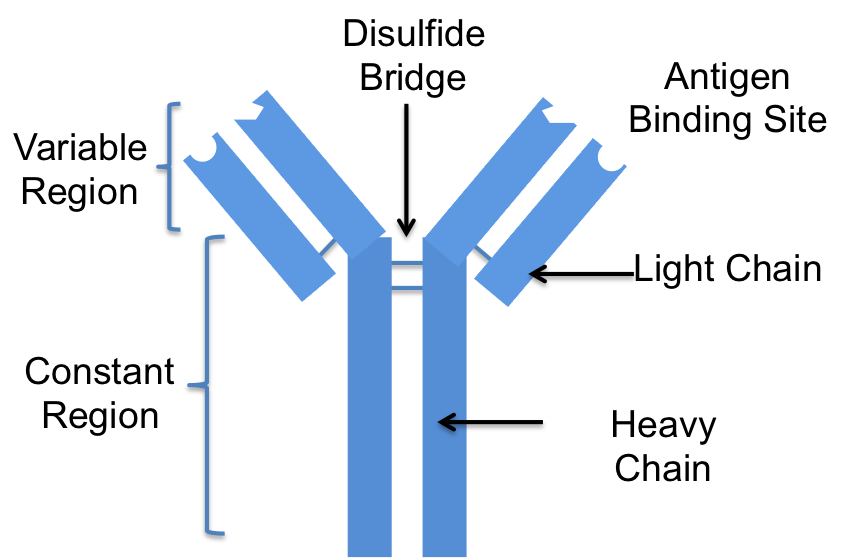
Antibody structure
- Made up of:
- A constant region
- Four polypeptide chains (two light two heavy) held together by disulphide bridges
- A variable region, this has a specific shape due to its amino acid sequence.
- The shape of the variable region and antigen are complementary to each other, this is the antigen binding site
- A hinge region that enables antibodies to attach to more than one antigen
- 4 polypeptide bonds = quaternary structure
- Antigen binding site = tertiary structure
- Primary structure determines how polypeptide chains fold
- Antigen binding site = tertiary structure
- Made up of:
Agglutination
- Antibodies bind to antigens at the ANTIGEN BINDING SITE at the tip of the variable region
- This prepares pathogens for destruction
- Pathogens clump together (loads of antibodies joining to pathogens which join together) and can no longer attack host cells
- The clumps are engulfed by phagocytic cells
- Antibodies bind to antigens at the ANTIGEN BINDING SITE at the tip of the variable region
Responses
- Primary Response:
- This is the first time the immune system encounters a pathogen, the initial selection of the correct B cell and subsequent cloning take time as there is only one B cell specific to the antigen
- Antibodies are secreted into the blood
- Antibodies attach to and destroy pathogens and any antigens they produce
- Individual plasma cells only survive for a few days and memory cells survive for a long time
- Antibodies attach to and destroy pathogens and any antigens they produce
- Secondary response
- This is a much greater and quicker response because of the memory cells
- This is because the memory cells remaining in the cells increase the chance of the B cells of the correct type meeting the pathogen
- This is a much greater and quicker response because of the memory cells
- Primary Response:
Vaccination
- Vaccination produces immunity to specific diseases by exposing someone to antigenic material that has been rendered harmless
- Active immunity
- This is produced by the stimulation of antibodies and memory cells by the body's immune system
- Natural active immunity = response by the immune system to infection
- Artificial active immunities = response by the immune system to vaccination
- Passive immunity
- Produced when antibodies are introduced from an outside source
- Antibodies are not replaced by the body and no memory cells are produced
- Maternal antibodies are passed to foetus from the mother across the placenta
- Anti-venom given to snake-bite victims
- Produced when antibodies are introduced from an outside source
- Herd immunity
- When a large proportion of the population is vaccinated it is hard for the pathogen to spread
- Ethics
- Development involves animals
- Is it fair to make the vaccine compulsory in order to be effective?
- Should expensive vaccines continue when a diseases is nearly eradicated
Bilder und Dateien der Mindmap
Informationen
- Beschreibung
- Information about the immune system
- Erstellt von
- Jacob Shepherd
- Aufrufe
- 129
- Tags
- Bewertung