
Mindmap
Microbial transport and communcation
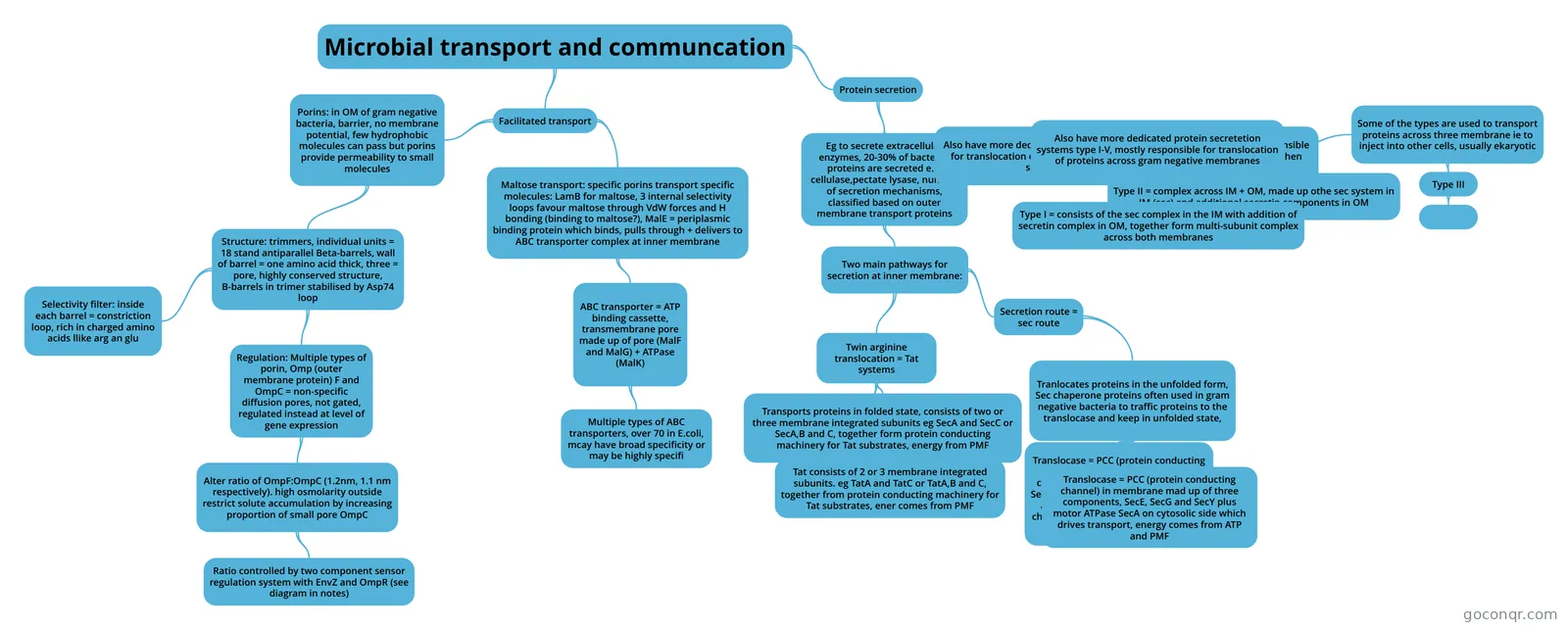
Mind map: Microbial transport and communication
Inhalt der Mindmap
Microbial transport and communcation
Facilitated transport
- Porins: in OM of gram negative bacteria, barrier, no membrane potential, few hydrophobic molecules can pass but porins provide permeability to small molecules
- Structure: trimmers, individual units = 18 stand antiparallel Beta-barrels, wall of barrel = one amino acid thick, three = pore, highly conserved structure, B-barrels in trimer stabilised by Asp74 loop
- Selectivity filter: inside each barrel = constriction loop, rich in charged amino acids llike arg an glu
- Regulation: Multiple types of porin, Omp (outer membrane protein) F and OmpC = non-specific diffusion pores, not gated, regulated instead at level of gene expression
- Alter ratio of OmpF:OmpC (1.2nm, 1.1 nm respectively). high osmolarity outside restrict solute accumulation by increasing proportion of small pore OmpC
- Ratio controlled by two component sensor regulation system with EnvZ and OmpR (see diagram in notes)
- Alter ratio of OmpF:OmpC (1.2nm, 1.1 nm respectively). high osmolarity outside restrict solute accumulation by increasing proportion of small pore OmpC
- Structure: trimmers, individual units = 18 stand antiparallel Beta-barrels, wall of barrel = one amino acid thick, three = pore, highly conserved structure, B-barrels in trimer stabilised by Asp74 loop
- Maltose transport: specific porins transport specific molecules: LamB for maltose, 3 internal selectivity loops favour maltose through VdW forces and H bonding (binding to maltose?), MalE = periplasmic binding protein which binds, pulls through + delivers to ABC transporter complex at inner membrane
- ABC transporter = ATP binding cassette, transmembrane pore made up of pore (MalF and MalG) + ATPase (MalK)
- Multiple types of ABC transporters, over 70 in E.coli, mcay have broad specificity or may be highly specifi
- ABC transporter = ATP binding cassette, transmembrane pore made up of pore (MalF and MalG) + ATPase (MalK)
- Porins: in OM of gram negative bacteria, barrier, no membrane potential, few hydrophobic molecules can pass but porins provide permeability to small molecules
Protein secretion
- Eg to secrete extracellular enzymes, 20-30% of bacterial proteins are secreted e.g. cellulase,pectate lysase, number of secretion mechanisms, classified based on outer membrane transport proteins
- Two main pathways for secretion at inner membrane:
- Secretion route = sec route
- Tranlocates proteins in the unfolded form, Sec chaperone proteins often used in gram negative bacteria to traffic proteins to the translocase and keep in unfolded state,
- Translocase = PCC (protein conducting channel), made up of membrane channel components SecY, SecG and SecE, an associated SecA motor ATPase accepts proteins from ribosome or chaperone and drvies transport. Enery comes from ATP and PMF
- Translocase = PCC (protein conducting channel) in membrane mad up of three components, SecE, SecG and SecY plus motor ATPase SecA on cytosolic side which drives transport, energy comes from ATP and PMF
- Tranlocates proteins in the unfolded form, Sec chaperone proteins often used in gram negative bacteria to traffic proteins to the translocase and keep in unfolded state,
- Twin arginine translocation = Tat systems
- Tat translocates proteins in the folded form
- Tat consists of 2 or 3 membrane integrated subunits. eg TatA and TatC or TatA,B and C, together from protein conducting machinery for Tat substrates, ener comes from PMF
- Transports proteins in folded state, consists of two or three membrane integrated subunits eg SecA and SecC or SecA,B and C, together form protein conducting machinery for Tat substrates, energy from PMF
- Tat translocates proteins in the folded form
- Secretion route = sec route
- Also have more dedicated protein secretion systems, type I-V, mostly responsible for translocation of proteins across gram negative bacterial membranes, then sometimes sec and Tat for transpo across iM
- Type II = complex across IM + OM, made up othe sec system in IM (sec) and additional secretin components in OM
- Also have more dedicated protein secretetion systems type I-V, mostly responsible for translocation of proteins across gram negative membranes
- Type I = consists of the sec complex in the IM with addition of secretin complex in OM, together form multi-subunit complex across both membranes
- Some of the types are used to transport proteins across three membrane ie to inject into other cells, usually ekaryotic
- Type III
- Type III
- Two main pathways for secretion at inner membrane:
- Eg to secrete extracellular enzymes, 20-30% of bacterial proteins are secreted e.g. cellulase,pectate lysase, number of secretion mechanisms, classified based on outer membrane transport proteins
Informationen
- Beschreibung
- Mindmap am Microbial transport and communcation, erstellt von Emily Lythgoe am 11/02/2016.
- Erstellt von
- Emily Lythgoe
- Aufrufe
- 1
- Bewertung