
Mindmap
Chapter 6: Learning
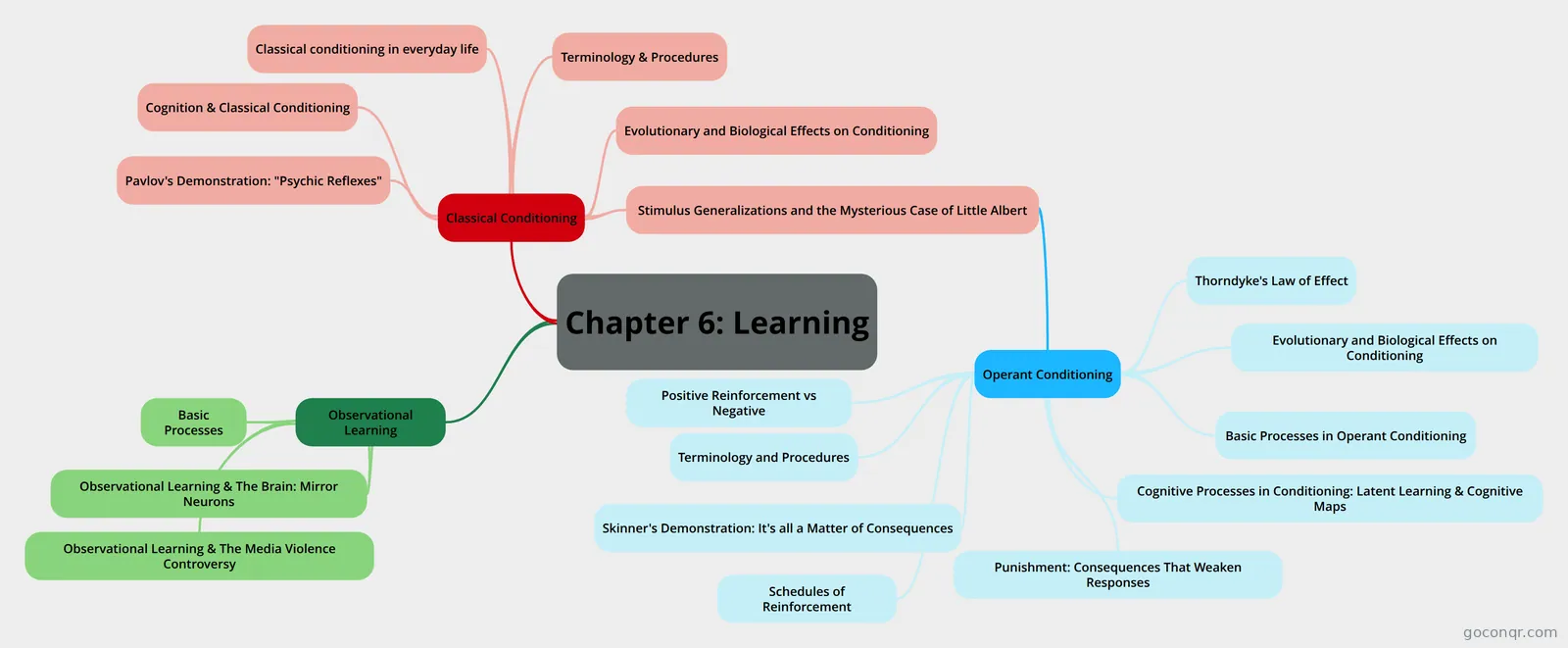
Mind map: chapter 6 learning
Inhalt der Mindmap
Chapter 6: Learning
Classical Conditioning
- Pavlov's Demonstration: "Psychic Reflexes"
- -While studying the role of saliva in dogs, Pavlov came acroos what he called "psychic reflexes" -Pavlov would present meat powder to the dog and then collect saliva -Dogs who were accustomed to the procedure would start salivating before the meat powder was presented
- Terminology & Procedures
- -Unconditional stimulus-a stimulus that evokes an unconditioned response without previous conditioning (unlearned reaction) -Conditioned stimulus- previously neutral stimulus that has through conditioning acquired the capacity to evoke a conditioned response -a trial in classical conditioning ocnisits of any presentation of a stimulis or pair of stimuli
- Classical conditioning in everyday life
- -Researchers have generally worked with extremely simple responses -Evaluative conditioning referes to changed in the liking of a stimulus that result from pairing that stimulus with other positive or negative stimuli -Spontaneous recovery is the reappearance of an extinguished response after a period of non exposure to the conditioned stimulus
- Cognition & Classical Conditioning
- -The cognitive element in conditioning was absent from Pavlov's original theorizing and much of the classic work that followed -Rescorla asserts that environmental stimuli serve as signals and that some stimuli are better, or more dependable signals than others. -Rescorla manipulates the predictive value of a conditioned stimulus
- Evolutionary and Biological Effects on Conditioning
- -Many people develop aversions to food that has been followed by nausea from illness, alcohol intoxication, or food poisoning (sauce bearnise syndrom) -Prepardness involved a species-specific predispositon to be conditioned in certain ways and not others -Operant conditioning is a form of learning in which responses come to be controlled by their consequences
- Stimulus Generalizations and the Mysterious Case of Little Albert
- -Stimulus generalization occurs when an organism that has learned a response to a specific stimulus responds in the same way to new stimuli that are similar to the original stimulus --Higer-order conditioning, in which a conditioned stimulus functions as if it were an unconditioned stimulus -Many human conditioned responses are the product of higher-order conditioning
- Operant Conditioning
- Evolutionary and Biological Effects on Conditioning
- -Instinctive drift occurs when an animal's innate response tendencies interfere with conditioning processes -Learning is a very general process because the biological bases of learning an the basic problems confronted by various organism are much the same across species -Reinforcement is not automatic when favourable consequences follow a response
- Cognitive Processes in Conditioning: Latent Learning & Cognitive Maps
- -Three groups of food deprived rats learned how to get through a maze to get to the food -The positive reinforcement lead them to increase there time of finding the food in 17 days -Phenomenom: Latent learning that is not apparent from behaviour when it first occurs
- Punishment: Consequences That Weaken Responses
- -Punishement occurs when an event following a response weakens the tendency to make that response -Children who are physically punished can be associated with poor-quality parent child relationships, behaviour, and poor academics -Can also result in mental problems and delinquency
- Positive Reinforcement vs Negative
- -Positive reinforcement occurs when a response is strengthened because it is followed by the presentation of a rewarding stimulus -Negative reinforcement occurs when a response is strengthened because it is followed by the removal of an aversion stimulus -Ine escape learning an organism acquires a response that decreases or ends some aversive stimulation
- Schedules of Reinforcement
- -A schedule of reinforcement determines which occurrences of a specific response result in the presentation of a reinforcer -Continous reinforcement occurs when every instance of a designated respose is reinforced -Intermittent or partial reinforcement occurs when a designated response is reinforced only some of the time
- Basic Processes in Operant Conditioning
- -Shaping, which consists of the reinforcement of closer and closer approximations of a desired response -Resistance to extinction occurs when an organism continues to make a response after delivery of the reinforcer has been terminated -Discriminative stimulus are cues that influence operant behaviour by indicating that probable consequences of a response
- Terminology and Procedures
- Operant chamber, skinner box, small enclosure in which an animal can make a specific response that is recorded while the consequences of the response are systematically controlled -To emit means to send forth -Reinforcement contingencies are the circumstances or ruled that determine whether responses lead to the presentation of reinforcers
- Thorndyke's Law of Effect
- -Instrumental learning is another term for operant conditioning -Thorndike studies animals and created the puzzle box for cats with food available just outside so that they would learn how to escape -Law of effect, if a response in the presence of s stimulus leads to satisfyin effects the association between the stimulus and the response is strengthened
- Skinner's Demonstration: It's all a Matter of Consequences
- -Reinforcement occurs when an event following a response increases an organisms tendancy to make that response -Created the baby box to help improve a child's upbringing -Something that is reinforcing for an organism may not be reinforcing for another
- Evolutionary and Biological Effects on Conditioning
- Pavlov's Demonstration: "Psychic Reflexes"
Observational Learning
- Basic Processes
- -Four key processes: 1.Attention-learn through observation, must pay attention to another person's behaviour and it's consequences 2.Rentention-Must store in your memory a mental representation of what you have witnessed 3. Reproduciton-enacting a modelled response depends on your ability to reproduce the response by converting your stored mental images into overt behaviour 4.Motivation-you are unlikely to reproduce an observed response unless you are motivated to do so
- Observational Learning & The Media Violence Controversy
- -Excessive Tv watching may have negative effects on academic performance and health -Children are very impressionable and many pick up responses from what they watch on TV -Children especially pick up aggressive behaviours from what they watch on TV
- Observational Learning & The Brain: Mirror Neurons
- -Mirror neutrons are neutrons that are activated by performing an action or by seeing another monkey or person perform the same action -Mirror neutrons are neutrons that internally represent an action -Humans also have mirror neuron circuits, which have been found in both the frontal love and the parietal lobe
- Basic Processes
Informationen
- Beschreibung
- Mindmap am Chapter 6: Learning, erstellt von strattonchloe am 16/03/2016.
- Erstellt von
- strattonchloe
- Aufrufe
- 1.020
- Bewertung