
Mindmap
S01 - Topography of the Major Features of the Brain and Spinal Cord

Inhalt der Mindmap
S01 - Topography of the Major Features of the Brain and Spinal Cord
Recognise the major features of the anatomy of the brain and spinal cord as seen externally and in coronal and transverse sections and summarise the major functions of these areas
- Lobes
- Temporal
- Language
- Parietal
- Movement
- Occipital
- Vision
- Frontal
- Planning
- Temporal
- Brainstem
- Medulla
- Pons
- Midbrain
- Tegmentum
- Tectum
- Limbic System
- Thalamus
- Hypothalamus
- Lobes
Describe the major functions of the cerebral cortex, cerebral white matter, basal ganglia, diencephalon, brainstem and cerebellum
- Cerebral Cortex
- Cerebral white matter
- Due to myelinated axons - signals
- Basal Ganglia
- Voluntary control
- Action Selection
- Which action to select at any one time
- Habits
- Emotional
- Diencephalon
- Thalamus
- Junctional area for sensory neurones
- Hypothalamus
- Controls visceral autonomic nervous system
- e.g. fight or flight response
- Controls visceral autonomic nervous system
- Pineal Gland
- Controls circadian rhythm
- Pituitary Gland
- Endocrine function
- Thalamus
- Brainstem
- Pons
- Switchboard connecting cerebellum to cerebral cortex
- Latin for bridge
- Medulla
- Decussation occurs here
- Relay information
- Touch
- Taste
- Hearing
- Pons
- Cerebellum
- Movement centre
Identify normal anatomical features of the brain on images produced by CT and MRI scanning
- CT Scan
- MRI scan
Identify and describe the blood supply to and from the brain and spinal cord on specimens and angiograms and appreciate its clinical significance
- Brain Blood Supply
- Anterior Cerebral Artery
- Middle Cerebral Artery
- Posterior Cerebral Artery
- Spinal Cord
- Brain Blood Supply
Identify and locate major functional areas of the cerebellum and brainstem from external views including the attachments of cranial nerves.
- Functional Areas
- Cerebellum
- Pons
- Medulla
- Cranial Nerve Attachments
- Telencephalon
- Olfactory
- Diencephalon
- Optic
- Mesencephalon
- Occulomotor
- Trochlear
- Pons
- Trigeminal
- Abducent
- Facial
- Medulla
- Vestibulocochlear
- Glossopharyngeal
- Vagus
- Accessory
- Hypoglossal
- Telencephalon
- Functional Areas
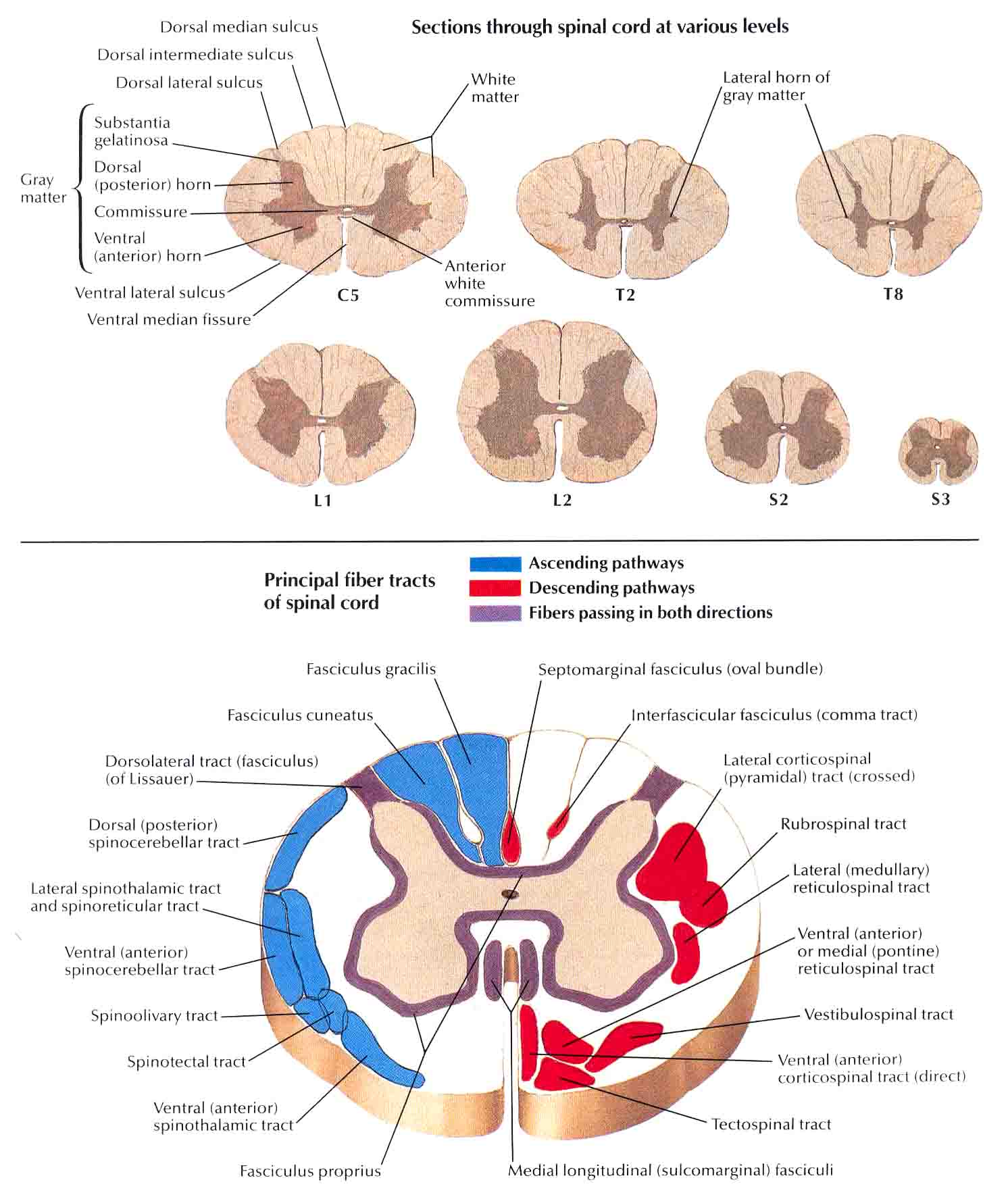
Identify and describe the functional areas of the spinal cord in transverse section, and describe the major features that differentiate spinal segments from different regions
- Features of spinal cord
- Sections
Locate and identify cranial nerves and their foramen on specimens, models and diagrams; and describe the functions of each cranial nerve
- Functions and Foramen
- Olfactory
- Smell
- Cribiform Plate
- Optic
- Sight
- Optic canal
- Occulomotor
- Pupillary muscles and ciliary muscles
- Superior Orbital Fissure
- Trochlear
- Superior Oblique Muscle
- Superior Orbital Fissure
- Trigeminal
- Opthalmic
- Sensory; eyes, nose etc.
- SOF
- Maxillary
- Oral and nasal cavities
- Foramen Rotundum
- Mandibular
- Lower lip, cheek, face etc.
- Foramen Ovale
- Opthalmic
- Abducent
- Lateral Rectus muscle
- SOF
- Facial Nerve
- Temporal
- Zygomatic
- Buccal
- Marginal Mandibular
- Cervical
- Innervates
- Salivary Glands
- Facial muscles
- Taste from anterior 2/3 of tongue
- Stylomastoid foramen
- Vestibulocochlear
- Balance and hearing
- Internal Acoustic Meatus
- Glossopharyngeal
- Posterior 1/3 of tongue, carotid body and sinus, palatine tonsils, parotid gland etc.
- Jugular foramen
- Vagus
- Heart, soft palate, larynx
- Jugular Foramen
- Accessory
- SCM and Trapezius
- Jugular Foramen
- Hypoglossal
- Hypoglossal Canal
- Hypoglossus, genioglossus and styloglossus muscles + all intrinsic muscles of tongue
- Olfactory
- Functions and Foramen
Bilder und Dateien der Mindmap


Informationen
- Beschreibung
- BAB Mindmap am S01 - Topography of the Major Features of the Brain and Spinal Cord, erstellt von chris.brees am 18/01/2014.
- Erstellt von
- chris.brees
- Aufrufe
- 242
- Tags
- Bewertung