
Mindmap
Applied Ethics - Genetic Modification
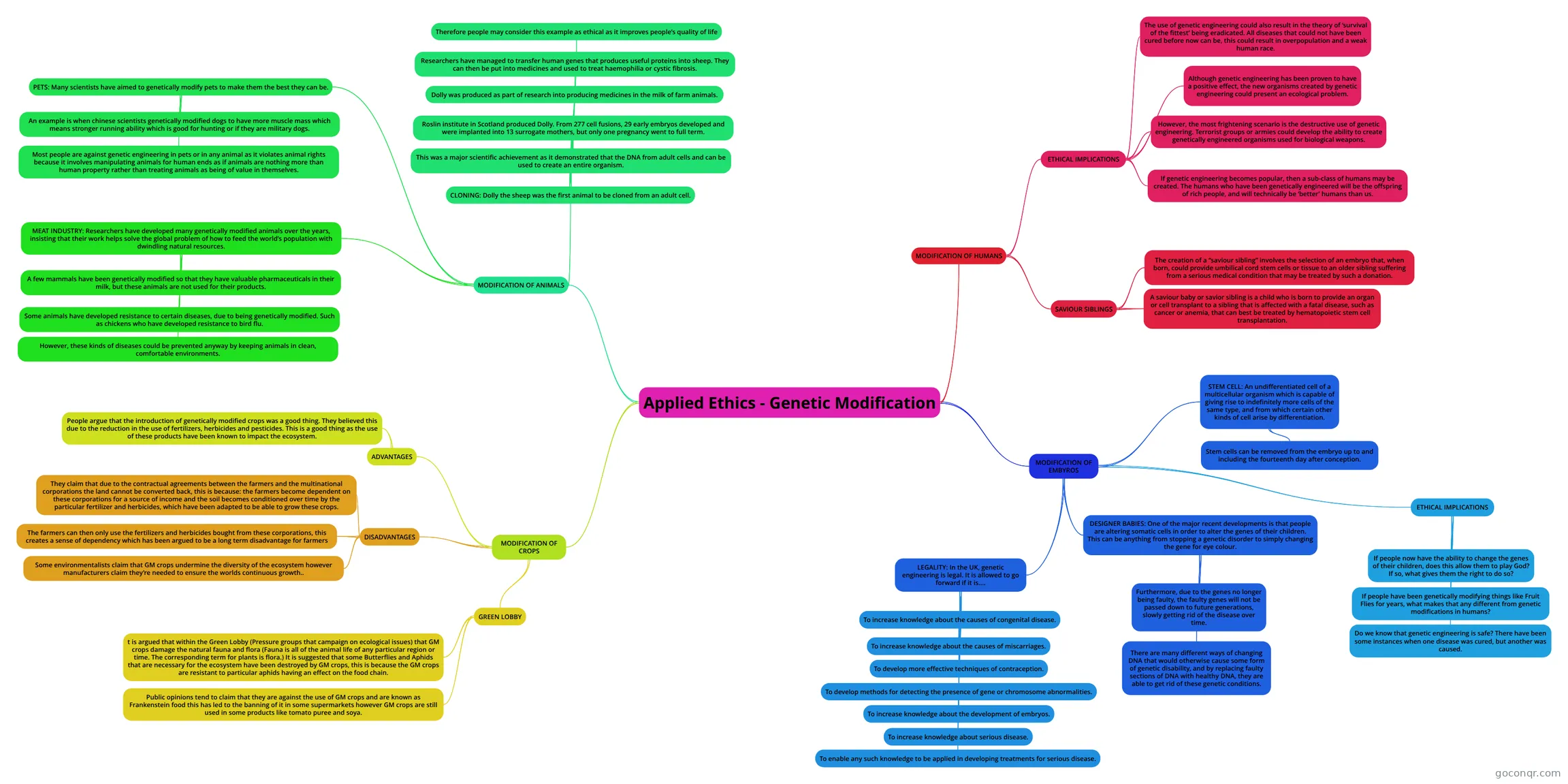
Mind map: Applied ethics genetic modification
Inhalt der Mindmap
Applied Ethics - Genetic Modification
MODIFICATION OF HUMANS
- SAVIOUR SIBLINGS
- A saviour baby or savior sibling is a child who is born to provide an organ or cell transplant to a sibling that is affected with a fatal disease, such as cancer or anemia, that can best be treated by hematopoietic stem cell transplantation.
- The creation of a “saviour sibling” involves the selection of an embryo that, when born, could provide umbilical cord stem cells or tissue to an older sibling suffering from a serious medical condition that may be treated by such a donation.
- ETHICAL IMPLICATIONS
- Although genetic engineering has been proven to have a positive effect, the new organisms created by genetic engineering could present an ecological problem.
- However, the most frightening scenario is the destructive use of genetic engineering. Terrorist groups or armies could develop the ability to create genetically engineered organisms used for biological weapons.
- If genetic engineering becomes popular, then a sub-class of humans may be created. The humans who have been genetically engineered will be the offspring of rich people, and will technically be ‘better’ humans than us.
- The use of genetic engineering could also result in the theory of ‘survival of the fittest’ being eradicated. All diseases that could not have been cured before now can be, this could result in overpopulation and a weak human race.
- SAVIOUR SIBLINGS
MODIFICATION OF EMBYROS
- STEM CELL: An undifferentiated cell of a multicellular organism which is capable of giving rise to indefinitely more cells of the same type, and from which certain other kinds of cell arise by differentiation.
- Stem cells can be removed from the embryo up to and including the fourteenth day after conception.
- DESIGNER BABIES: One of the major recent developments is that people are altering somatic cells in order to alter the genes of their children. This can be anything from stopping a genetic disorder to simply changing the gene for eye colour.
- There are many different ways of changing DNA that would otherwise cause some form of genetic disability, and by replacing faulty sections of DNA with healthy DNA, they are able to get rid of these genetic conditions.
- Furthermore, due to the genes no longer being faulty, the faulty genes will not be passed down to future generations, slowly getting rid of the disease over time.
- LEGALITY: In the UK, genetic engineering is legal. It is allowed to go forward if it is....
- To increase knowledge about the causes of congenital disease.
- To increase knowledge about the causes of miscarriages.
- To develop more effective techniques of contraception.
- To develop methods for detecting the presence of gene or chromosome abnormalities.
- To increase knowledge about the development of embryos.
- To increase knowledge about serious disease.
- To enable any such knowledge to be applied in developing treatments for serious disease.
- ETHICAL IMPLICATIONS
- If people now have the ability to change the genes of their children, does this allow them to play God? If so, what gives them the right to do so?
- If people have been genetically modifying things like Fruit Flies for years, what makes that any different from genetic modifications in humans?
- Do we know that genetic engineering is safe? There have been some instances when one disease was cured, but another was caused.
- STEM CELL: An undifferentiated cell of a multicellular organism which is capable of giving rise to indefinitely more cells of the same type, and from which certain other kinds of cell arise by differentiation.
MODIFICATION OF CROPS
- ADVANTAGES
- People argue that the introduction of genetically modified crops was a good thing. They believed this due to the reduction in the use of fertilizers, herbicides and pesticides. This is a good thing as the use of these products have been known to impact the ecosystem.
- DISADVANTAGES
- They claim that due to the contractual agreements between the farmers and the multinational corporations the land cannot be converted back, this is because: the farmers become dependent on these corporations for a source of income and the soil becomes conditioned over time by the particular fertilizer and herbicides, which have been adapted to be able to grow these crops.
- The farmers can then only use the fertilizers and herbicides bought from these corporations, this creates a sense of dependency which has been argued to be a long term disadvantage for farmers
- Some environmentalists claim that GM crops undermine the diversity of the ecosystem however manufacturers claim they’re needed to ensure the worlds continuous growth..
- GREEN LOBBY
- t is argued that within the Green Lobby (Pressure groups that campaign on ecological issues) that GM crops damage the natural fauna and flora (Fauna is all of the animal life of any particular region or time. The corresponding term for plants is flora.) It is suggested that some Butterflies and Aphids that are necessary for the ecosystem have been destroyed by GM crops, this is because the GM crops are resistant to particular aphids having an effect on the food chain.
- Public opinions tend to claim that they are against the use of GM crops and are known as Frankenstein food this has led to the banning of it in some supermarkets however GM crops are still used in some products like tomato puree and soya.
- ADVANTAGES
MODIFICATION OF ANIMALS
- CLONING: Dolly the sheep was the first animal to be cloned from an adult cell.
- This was a major scientific achievement as it demonstrated that the DNA from adult cells and can be used to create an entire organism.
- Roslin institute in Scotland produced Dolly. From 277 cell fusions, 29 early embryos developed and were implanted into 13 surrogate mothers, but only one pregnancy went to full term.
- Dolly was produced as part of research into producing medicines in the milk of farm animals.
- Researchers have managed to transfer human genes that produces useful proteins into sheep. They can then be put into medicines and used to treat haemophilia or cystic fibrosis.
- Therefore people may consider this example as ethical as it improves people’s quality of life
- PETS: Many scientists have aimed to genetically modify pets to make them the best they can be.
- An example is when chinese scientists genetically modified dogs to have more muscle mass which means stronger running ability which is good for hunting or if they are military dogs.
- Most people are against genetic engineering in pets or in any animal as it violates animal rights because it involves manipulating animals for human ends as if animals are nothing more than human property rather than treating animals as being of value in themselves.
- MEAT INDUSTRY: Researchers have developed many genetically modified animals over the years, insisting that their work helps solve the global problem of how to feed the world’s population with dwindling natural resources.
- A few mammals have been genetically modified so that they have valuable pharmaceuticals in their milk, but these animals are not used for their products.
- Some animals have developed resistance to certain diseases, due to being genetically modified. Such as chickens who have developed resistance to bird flu.
- However, these kinds of diseases could be prevented anyway by keeping animals in clean, comfortable environments.
- CLONING: Dolly the sheep was the first animal to be cloned from an adult cell.
Informationen
- Beschreibung
- Mindmap am Applied Ethics - Genetic Modification, erstellt von Shay Anderson am 10/04/2016.
- Erstellt von
- Shay Anderson
- Aufrufe
- 2
- Bewertung