
Mindmap
Science and Religion
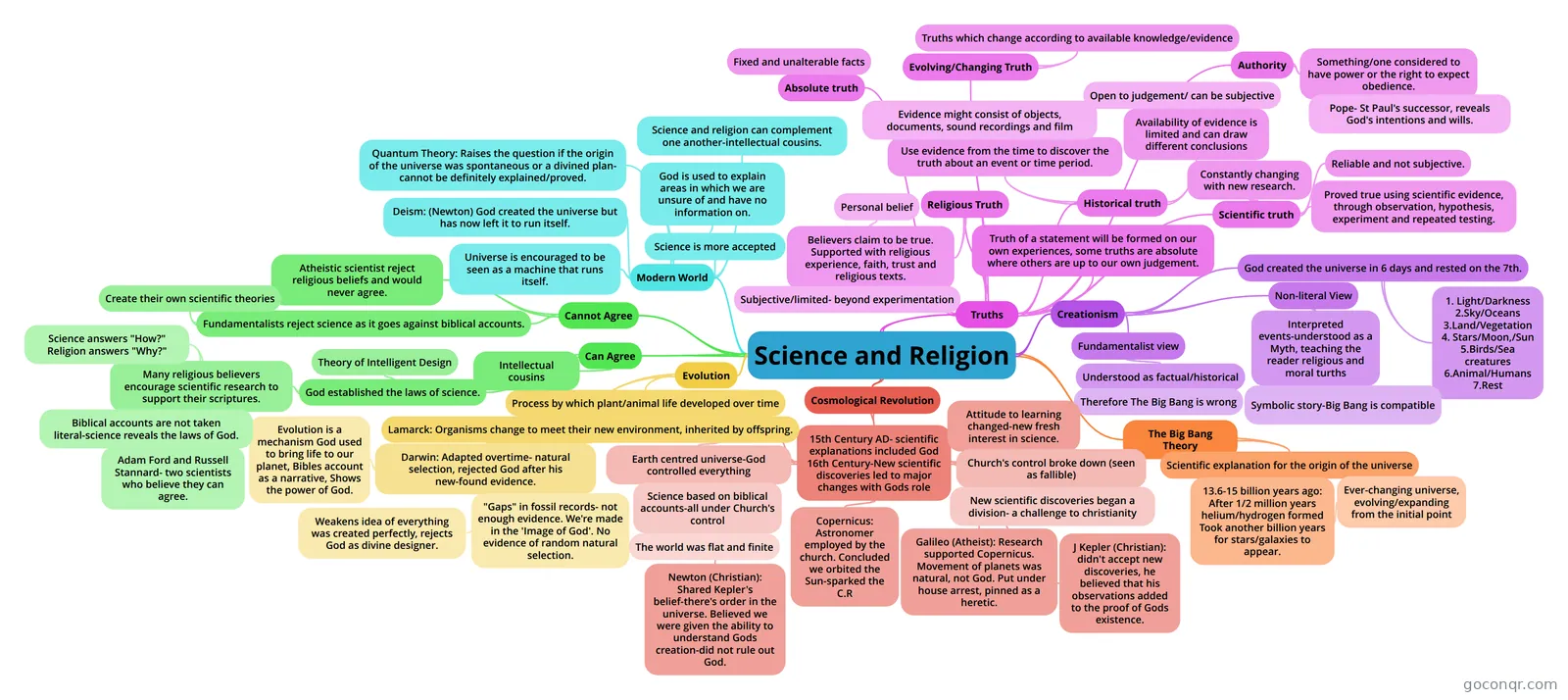
Mind map: Science and religion
Inhalt der Mindmap
Science and Religion
Truths
- Scientific truth
- Proved true using scientific evidence, through observation, hypothesis, experiment and repeated testing.
- Reliable and not subjective.
- Constantly changing with new research.
- Historical truth
- Use evidence from the time to discover the truth about an event or time period.
- Evidence might consist of objects, documents, sound recordings and film
- Availability of evidence is limited and can draw different conclusions
- Open to judgement/ can be subjective
- Use evidence from the time to discover the truth about an event or time period.
- Truth of a statement will be formed on our own experiences, some truths are absolute where others are up to our own judgement.
- Religious Truth
- Believers claim to be true. Supported with religious experience, faith, trust and religious texts.
- Personal belief
- Subjective/limited- beyond experimentation
- Believers claim to be true. Supported with religious experience, faith, trust and religious texts.
- Absolute truth
- Fixed and unalterable facts
- Evolving/Changing Truth
- Truths which change according to available knowledge/evidence
- Authority
- Something/one considered to have power or the right to expect obedience.
- Pope- St Paul's successor, reveals God's intentions and wills.
- Something/one considered to have power or the right to expect obedience.
- Scientific truth
Creationism
- God created the universe in 6 days and rested on the 7th.
- 1. Light/Darkness 2.Sky/Oceans 3.Land/Vegetation 4. Stars/Moon,/Sun 5.Birds/Sea creatures 6.Animal/Humans 7.Rest
- Fundamentalist view
- Understood as factual/historical
- Therefore The Big Bang is wrong
- Understood as factual/historical
- Non-literal View
- Interpreted events-understood as a Myth, teaching the reader religious and moral turths
- Symbolic story-Big Bang is compatible
- Interpreted events-understood as a Myth, teaching the reader religious and moral turths
- God created the universe in 6 days and rested on the 7th.
The Big Bang Theory
- Scientific explanation for the origin of the universe
- 13.6-15 billion years ago: After 1/2 million years helium/hydrogen formed Took another billion years for stars/galaxies to appear.
- Ever-changing universe, evolving/expanding from the initial point
- 13.6-15 billion years ago: After 1/2 million years helium/hydrogen formed Took another billion years for stars/galaxies to appear.
- Scientific explanation for the origin of the universe
Cosmological Revolution
- 15th Century AD- scientific explanations included God 16th Century-New scientific discoveries led to major changes with Gods role
- Medieval world view
- Earth centred universe-God controlled everything
- Science based on biblical accounts-all under Church's control
- The world was flat and finite
- Science based on biblical accounts-all under Church's control
- Earth centred universe-God controlled everything
- Attitude to learning changed-new fresh interest in science.
- Church's control broke down (seen as fallible)
- New scientific discoveries began a division- a challenge to christianity
- Church's control broke down (seen as fallible)
- Copernicus: Astronomer employed by the church. Concluded we orbited the Sun-sparked the C.R
- Galileo (Atheist): Research supported Copernicus. Movement of planets was natural, not God. Put under house arrest, pinned as a heretic.
- Newton (Christian): Shared Kepler's belief-there's order in the universe. Believed we were given the ability to understand Gods creation-did not rule out God.
- J Kepler (Christian): didn't accept new discoveries, he believed that his observations added to the proof of Gods existence.
- Medieval world view
- 15th Century AD- scientific explanations included God 16th Century-New scientific discoveries led to major changes with Gods role
Evolution
- Process by which plant/animal life developed over time
- Lamarck: Organisms change to meet their new environment, inherited by offspring.
- Darwin: Adapted overtime- natural selection, rejected God after his new-found evidence.
- Weakens idea of everything was created perfectly, rejects God as divine designer.
- "Gaps" in fossil records- not enough evidence. We're made in the 'Image of God'. No evidence of random natural selection.
- Evolution is a mechanism God used to bring life to our planet, Bibles account as a narrative, Shows the power of God.
- Darwin: Adapted overtime- natural selection, rejected God after his new-found evidence.
Can Agree
- God established the laws of science.
- Many religious believers encourage scientific research to support their scriptures.
- Biblical accounts are not taken literal-science reveals the laws of God.
- Adam Ford and Russell Stannard- two scientists who believe they can agree.
- Science answers "How?" Religion answers "Why?"
- Theory of Intelligent Design
- Many religious believers encourage scientific research to support their scriptures.
- Intellectual cousins
- God established the laws of science.
Cannot Agree
- Atheistic scientist reject religious beliefs and would never agree.
- Fundamentalists reject science as it goes against biblical accounts.
- Create their own scientific theories
Modern World
- Science is more accepted
- God is used to explain areas in which we are unsure of and have no information on.
- Universe is encouraged to be seen as a machine that runs itself.
- Deism: (Newton) God created the universe but has now left it to run itself.
- Quantum Theory: Raises the question if the origin of the universe was spontaneous or a divined plan- cannot be definitely explained/proved.
- Science and religion can complement one another-intellectual cousins.
Informationen
- Beschreibung
- Mindmap am Science and Religion, erstellt von Esme Gillen am 12/04/2016.
- Erstellt von
- Esme Gillen
- Aufrufe
- 2
- Bewertung