
Mindmap
Creating Trusts - Formalities and Construction
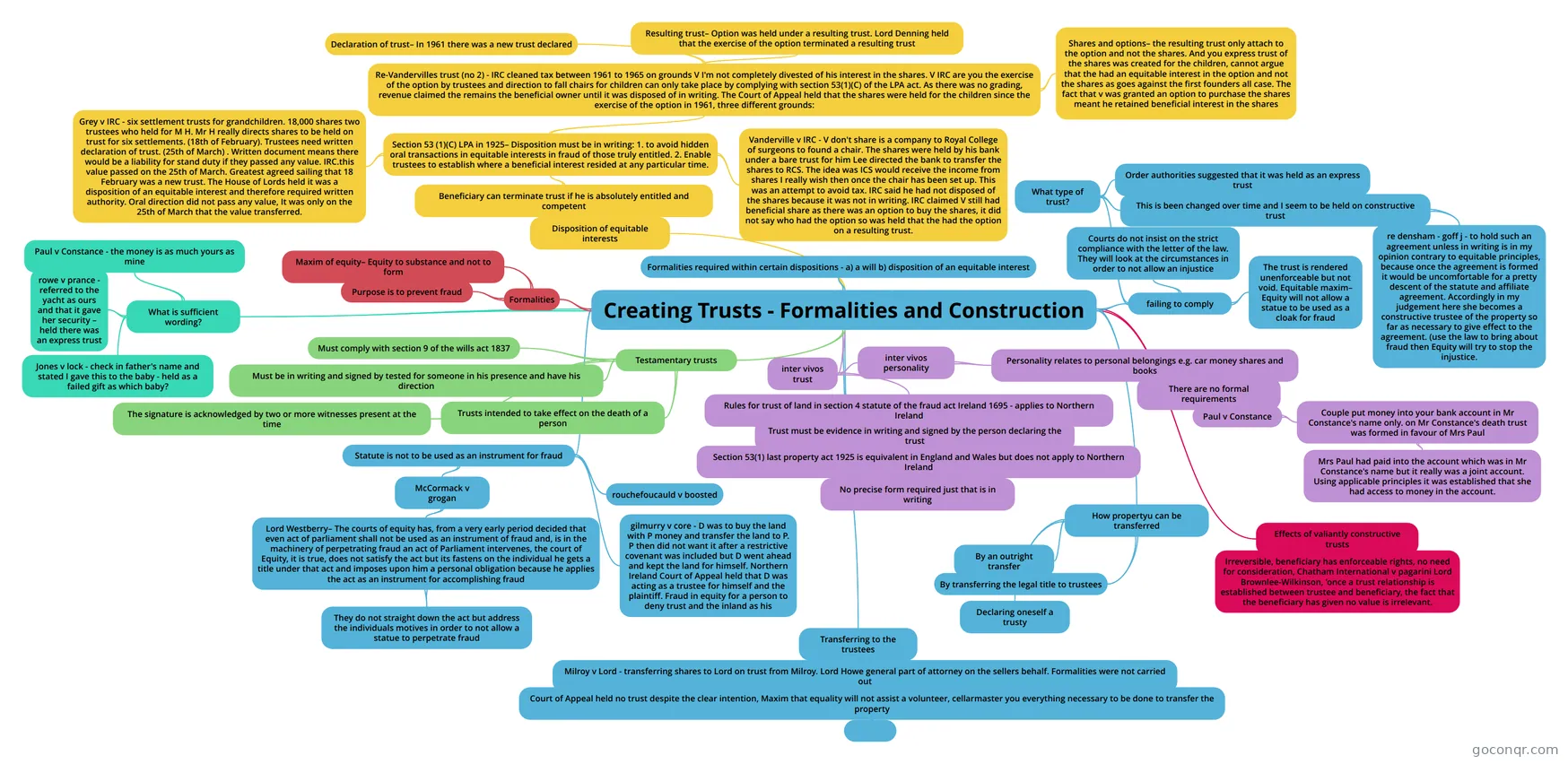
Mind map: Creating Trusts - Formalities and Construction
Inhalt der Mindmap
Creating Trusts - Formalities and Construction
Formalities required within certain dispositions - a) a will b) disposition of an equitable interest
Formalities
- Maxim of equity– Equity to substance and not to form
- Purpose is to prevent fraud
Testamentary trusts
- Trusts intended to take effect on the death of a person
- Must comply with section 9 of the wills act 1837
- Must be in writing and signed by tested for someone in his presence and have his direction
- The signature is acknowledged by two or more witnesses present at the time
inter vivos trust
- Rules for trust of land in section 4 statute of the fraud act Ireland 1695 - applies to Northern Ireland
- Trust must be evidence in writing and signed by the person declaring the trust
- Section 53(1) last property act 1925 is equivalent in England and Wales but does not apply to Northern Ireland
- No precise form required just that is in writing
- Section 53(1) last property act 1925 is equivalent in England and Wales but does not apply to Northern Ireland
- Trust must be evidence in writing and signed by the person declaring the trust
- inter vivos personality
- Personality relates to personal belongings e.g. car money shares and books
- There are no formal requirements
- Paul v Constance
- Couple put money into your bank account in Mr Constance's name only. on Mr Constance's death trust was formed in favour of Mrs Paul
- Mrs Paul had paid into the account which was in Mr Constance's name but it really was a joint account. Using applicable principles it was established that she had access to money in the account.
- Couple put money into your bank account in Mr Constance's name only. on Mr Constance's death trust was formed in favour of Mrs Paul
- Paul v Constance
- There are no formal requirements
- Personality relates to personal belongings e.g. car money shares and books
- Rules for trust of land in section 4 statute of the fraud act Ireland 1695 - applies to Northern Ireland
failing to comply
- The trust is rendered unenforceable but not void. Equitable maxim– Equity will not allow a statue to be used as a cloak for fraud
- Courts do not insist on the strict compliance with the letter of the law. They will look at the circumstances in order to not allow an injustice
- What type of trust?
- Order authorities suggested that it was held as an express trust
- This is been changed over time and I seem to be held on constructive trust
- re densham - goff j - to hold such an agreement unless in writing is in my opinion contrary to equitable principles, because once the agreement is formed it would be uncomfortable for a pretty descent of the statute and affiliate agreement. Accordingly in my judgement here she becomes a constructive trustee of the property so far as necessary to give effect to the agreement. (use the law to bring about fraud then Equity will try to stop the injustice.
Statute is not to be used as an instrument for fraud
- McCormack v grogan
- Lord Westberry– The courts of equity has, from a very early period decided that even act of parliament shall not be used as an instrument of fraud and, is in the machinery of perpetrating fraud an act of Parliament intervenes, the court of Equity, it is true, does not satisfy the act but its fastens on the individual he gets a title under that act and imposes upon him a personal obligation because he applies the act as an instrument for accomplishing fraud
- They do not straight down the act but address the individuals motives in order to not allow a statue to perpetrate fraud
- Lord Westberry– The courts of equity has, from a very early period decided that even act of parliament shall not be used as an instrument of fraud and, is in the machinery of perpetrating fraud an act of Parliament intervenes, the court of Equity, it is true, does not satisfy the act but its fastens on the individual he gets a title under that act and imposes upon him a personal obligation because he applies the act as an instrument for accomplishing fraud
- rouchefoucauld v boosted
- gilmurry v core - D was to buy the land with P money and transfer the land to P. P then did not want it after a restrictive covenant was included but D went ahead and kept the land for himself. Northern Ireland Court of Appeal held that D was acting as a trustee for himself and the plaintiff. Fraud in equity for a person to deny trust and the inland as his
- McCormack v grogan
Disposition of equitable interests
- Beneficiary can terminate trust if he is absolutely entitled and competent
- Section 53 (1)(C) LPA in 1925– Disposition must be in writing: 1. to avoid hidden oral transactions in equitable interests in fraud of those truly entitled. 2. Enable trustees to establish where a beneficial interest resided at any particular time.
- Vanderville v IRC - V don't share is a company to Royal College of surgeons to found a chair. The shares were held by his bank under a bare trust for him Lee directed the bank to transfer the shares to RCS. The idea was ICS would receive the income from shares I really wish then once the chair has been set up. This was an attempt to avoid tax. IRC said he had not disposed of the shares because it was not in writing. IRC claimed V still had beneficial share as there was an option to buy the shares, it did not say who had the option so was held that the had the option on a resulting trust.
- Grey v IRC - six settlement trusts for grandchildren. 18,000 shares two trustees who held for M H. Mr H really directs shares to be held on trust for six settlements. (18th of February). Trustees need written declaration of trust. (25th of March) . Written document means there would be a liability for stand duty if they passed any value. IRC.this value passed on the 25th of March. Greatest agreed sailing that 18 February was a new trust. The House of Lords held it was a disposition of an equitable interest and therefore required written authority. Oral direction did not pass any value, It was only on the 25th of March that the value transferred.
- Re-Vandervilles trust (no 2) - IRC cleaned tax between 1961 to 1965 on grounds V I'm not completely divested of his interest in the shares. V IRC are you the exercise of the option by trustees and direction to fall chairs for children can only take place by complying with section 53(1)(C) of the LPA act. As there was no grading, revenue claimed the remains the beneficial owner until it was disposed of in writing. The Court of Appeal held that the shares were held for the children since the exercise of the option in 1961, three different grounds:
- Declaration of trust– In 1961 there was a new trust declared
- Resulting trust– Option was held under a resulting trust. Lord Denning held that the exercise of the option terminated a resulting trust
- Shares and options– the resulting trust only attach to the option and not the shares. And you express trust of the shares was created for the children, cannot argue that the had an equitable interest in the option and not the shares as goes against the first founders all case. The fact that v was granted an option to purchase the shares meant he retained beneficial interest in the shares
- Section 53 (1)(C) LPA in 1925– Disposition must be in writing: 1. to avoid hidden oral transactions in equitable interests in fraud of those truly entitled. 2. Enable trustees to establish where a beneficial interest resided at any particular time.
- Beneficiary can terminate trust if he is absolutely entitled and competent
How propertyu can be transferred
- By an outright transfer
- By transferring the legal title to trustees
- Declaring oneself a trusty
Effects of valiantly constructive trusts
- Irreversible, beneficiary has enforceable rights, no need for consideration, Chatham International v pagarini Lord Brownlee-Wilkinson, 'once a trust relationship is established between trustee and beneficiary, the fact that the beneficiary has given no value is irrelevant.
What is sufficient wording?
- Paul v Constance - the money is as much yours as mine
- Jones v lock - check in father's name and stated I gave this to the baby - held as a failed gift as which baby?
- rowe v prance - referred to the yacht as ours and that it gave her security – held there was an express trust
Transferring to the trustees
- Milroy v Lord - transferring shares to Lord on trust from Milroy. Lord Howe general part of attorney on the sellers behalf. Formalities were not carried out
- Court of Appeal held no trust despite the clear intention, Maxim that equality will not assist a volunteer, cellarmaster you everything necessary to be done to transfer the property
- Court of Appeal held no trust despite the clear intention, Maxim that equality will not assist a volunteer, cellarmaster you everything necessary to be done to transfer the property
- Milroy v Lord - transferring shares to Lord on trust from Milroy. Lord Howe general part of attorney on the sellers behalf. Formalities were not carried out
Informationen
- Beschreibung
- Mindmap am Creating Trusts - Formalities and Construction, erstellt von ZC_ am 11/05/2016.
- Erstellt von
- ZC_
- Aufrufe
- 1
- Bewertung