
Mindmap
Animal Physiology
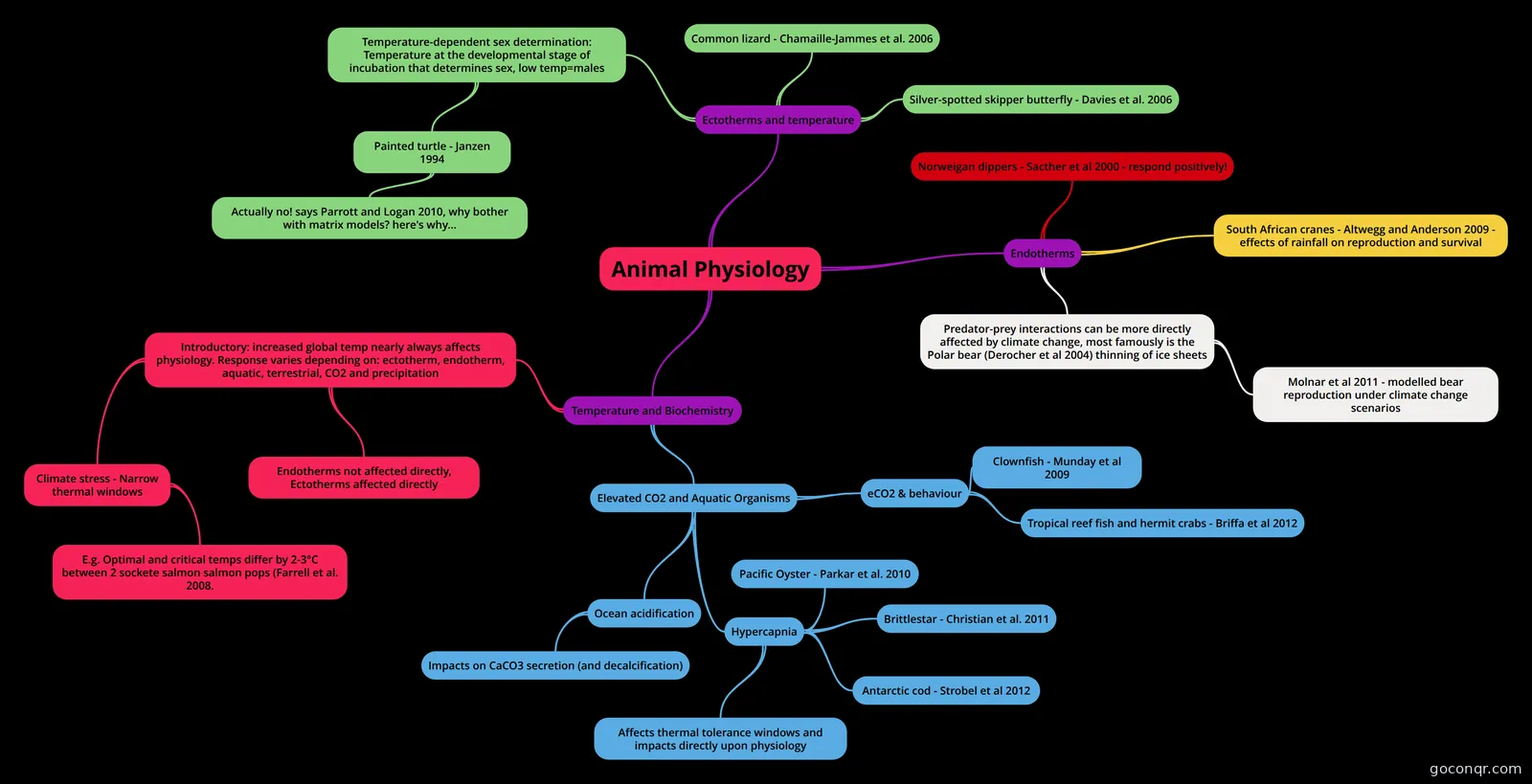
Mind map: Animal Physiology
Inhalt der Mindmap
Animal Physiology
Temperature and Biochemistry
- Introductory: increased global temp nearly always affects physiology. Response varies depending on: ectotherm, endotherm, aquatic, terrestrial, CO2 and precipitation
- Endotherms not affected directly, Ectotherms affected directly
- Climate stress - Narrow thermal windows
- E.g. Optimal and critical temps differ by 2-3°C between 2 sockete salmon salmon pops (Farrell et al. 2008.
- Elevated CO2 and Aquatic Organisms
- Ocean acidification
- Impacts on CaCO3 secretion (and decalcification)
- Hypercapnia
- Reduced O2 due to increased CO2 levels
- Affects thermal tolerance windows and impacts directly upon physiology
- Antarctic cod - Strobel et al 2012
- Investigated the thermal placticity (adjusted to gradual change in environment) abilities to higher temp and pCO2 (dissolved) levels by studying metabolic responses at different organisation levels. Acclimated at high temp 7°C and low temp 0°C, and 2 CO2 concentrations - 0.04 and 0.2KPa, before being subjected to a range of temps (0, 7, 12). Fish acclimated at high CO2, had lower mitochondrial respiration in their livers than individuals kept in low CO2. This is important because reduced mr could impact on energy budgets in the sp. - Shifting or disturbing liver functions thereby likely reducing whole animal performance over large time-scale.
- Brittlestar - Christian et al. 2011
- Found that they became lethargic in eCO2, thus not coping with higher temps (>26°C). It appears that 25°C approximates the thermotolerance threshold for brittlestar, indicating that this species is living near its upper limits
- Pacific Oyster - Parkar et al. 2010
- Found reduced fertilization and embryo development, size of larvae and pat, and increase in abnormal morphology of larva. Both sydney rock oyster and pacific had this but SRO had great sensitivity. In the absence of adaptation, pacific may become the more dominant species.
- eCO2 & behaviour
- Tropical reef fish and hermit crabs - Briffa et al 2012
- Suggests that through its direct physiological effects eCOs could impact the behaviour with the ability to find settlement sites and shelters, the ability to detect predators, prey and food. Due to exposure to high CO2.
- Clownfish - Munday et al 2009
- Reared in ambient or eCO2 conditions for first 11 days from hatching. Young fish were then presented with a choice of odour cues in laboratory trials. Selection of anemone odours reduced for fish raised in eCO2. Also became attracted to parental odours - normally avoid to reduce inbreeding.
- Tropical reef fish and hermit crabs - Briffa et al 2012
- Ocean acidification
- Introductory: increased global temp nearly always affects physiology. Response varies depending on: ectotherm, endotherm, aquatic, terrestrial, CO2 and precipitation
Ectotherms and temperature
- Common lizard - Chamaille-Jammes et al. 2006
- Studied four isolated populations Found that their body size dramatically increased in all age classes over 18 years. This was related to temperature increase experienced during the first month of life (august). Daily maximum temperature in August increased by 22°C and yearling snout-vent-length increased by about 28%. As a result, female body size increased, and as fecundity is strongly dependent on female body size, clutch size and total reproductive output increased too. All components therefore positively responded to temperature increase, thus the common lizard has been advantageous with the shift in temperature. Positive correlations all round.
- Silver-spotted skipper butterfly - Davies et al. 2006
- Egg laying rates are temperature-dependent and females actively adjust microhabitat usage in response to temperature variations. Climate warming ha therefore increased the availability of thermally suitable habitat for the butterfly at the cool, northern edge of the species distribution - therefore increased egg-laying rate
- Temperature-dependent sex determination: Temperature at the developmental stage of incubation that determines sex, low temp=males
- Painted turtle - Janzen 1994
- 18 year study concluded that as little as 1-2°C shift in incubation temperature can drastically alter the sex ratio. A 4°C increase in mean temperature would prevent all future male offspring from being produced, and vice versa with females. Corresponds with mean July temp - developmental stage when embryonic sex is determined. Around 23.5°C would be an ideal temperature for a 50:50 sex ratio It is unlikely that TSD taxa can evolve quick enough to counteract the effects of climate change, but there may be behavioural adaptations that could save them such as next choice and depth.
- Actually no! says Parrott and Logan 2010, why bother with matrix models? here's why...
- Incorporated these variables into population model and demonstrated through matrix modelling and an understanding of the thermal properties of nest and soil materials, that the painted turtle populations and sex ratios would likely be unaffected by a mean increase of 4°C in temperature. Only when the soil and nest properties fail to buffer the eggs from high variation (15.7°C) around the average would an increase be detrimental to male development and so species populations.
- Painted turtle - Janzen 1994
- Common lizard - Chamaille-Jammes et al. 2006
Endotherms
- Predator-prey interactions can be more directly affected by climate change, most famously is the Polar bear (Derocher et al 2004) thinning of ice sheets
- Fragmented ice sheets will: - Increase energy demands by increasing distances bears have to travel to find food - Increase time between hunting as bears wait for re-freeze of ice - Reduced winter fat reserves and so reproduction success of females
- Molnar et al 2011 - modelled bear reproduction under climate change scenarios
- Used 1990's reproduction and energy budget data to model bear reproduction under climate change scenarios. data showed that 28% of all pregnant females failed to reproduce for energetic reasons. Then predicted that a 1 month advance in spring ice break ups reduces pregnancy success by 40-73% with a 22-67% decline in litter size. 2 month advance has the potential to reduce reproductive success and litter size by 100%. The 1 month data is very broad results.
- Norweigan dippers - Sacther et al 2000 - respond positively!
- Endotherm physiology is less directly affected by increased temperature. However, indirect effects on foraging ability may have important effects on animal growth and reproduction. Dippers respond positively to climate change as they can only forage when rivers are free of ice cover, thus favouring warmer temperatures.
- South African cranes - Altwegg and Anderson 2009 - effects of rainfall on reproduction and survival
- Looked at the effects of rainfall on reproduction and survival. A matrix population model predicted that population growth rate tends to increase with increasing rainfall, but there are conflicting effects on reproduction and survival. e.g. drier springs but wetter summers might decrease reproduction but increase survival - so little overall effect on the population because shifts in survival are offset by shifts in reproduction. Reproduction is therefore positively associated with rainfall during early but not late breeding season.
- Predator-prey interactions can be more directly affected by climate change, most famously is the Polar bear (Derocher et al 2004) thinning of ice sheets
Informationen
- Beschreibung
- Undergraduate Global Change Biology Mindmap am Animal Physiology, erstellt von samanthaamcneil am 20/05/2016.
- Erstellt von
- samanthaamcneil
- Aufrufe
- 2
- Bewertung
Mehr zu Animal Structure and Physiology