
562640
Beschreibung

Mindmap von leahellis52, aktualisiert more than 1 year ago

|
Erstellt von leahellis52
vor mehr als 12 Jahre
|
|
Miracles
- For religious people, miracles are used to prove that God intervenes in our daily lives and his existence
- What is a miracle?
- An interruption to the process of nature that cannot be explained by natural laws
- Bears a deeper/religious significance than just breaking laws of nature
- When an 'invisible agent' affects the working days of the universe
- Swinburne's examples:Levitation, resurrection, water into wine etc
- Swinburne's examples:Levitation, resurrection, water into wine etc
- When an 'invisible agent' affects the working days of the universe
- Bears a deeper/religious significance than just breaking laws of nature
- An interruption to the process of nature that cannot be explained by natural laws
- What is a miracle?
- Aquinas: Miracles as interventions
- 'Those things must properly be called
miraculous which are done by divine power
apart from the order generally followed in things'
- Three definitions of miracles: 1.Events done by God that cannot be done by nature
- 2.Events which God does something nature can do but not in this order
- 3..Events that occur when God does what is usually done by the working of nature, but
without the operation of the principles of nature
- E.g. When someone ill recovers miraculously
- Hume: A law of nature tells us how bodies must behave when uninterfered with but a miracle occurs when the world is not
left to itself
- Hume: A law of nature tells us how bodies must behave when uninterfered with but a miracle occurs when the world is not
left to itself
- E.g. When someone ill recovers miraculously
- E.g.Jesus' resurrection; people can die and come back to life but not 24 hours later
- 3..Events that occur when God does what is usually done by the working of nature, but
without the operation of the principles of nature
- E.g.If gravity stopped working
- 2.Events which God does something nature can do but not in this order
- Three definitions of miracles: 1.Events done by God that cannot be done by nature
- 'Those things must properly be called
miraculous which are done by divine power
apart from the order generally followed in things'
- Ray Holland: Miracles as interpretations
- A religious person will interpret an event as a gift from God/miracle
- A non-religious would say it was a piece of luck/coincidence
- Even if an event is explainable by laws of nature, it can still be
interpreted as a miracle if it is taken as a religious sign
- A.K.A:The 'contingency miracle' - the presence of religious significance is
sufficient
- A.K.A:The 'contingency miracle' - the presence of religious significance is
sufficient
- Even if an event is explainable by laws of nature, it can still be
interpreted as a miracle if it is taken as a religious sign
- A non-religious would say it was a piece of luck/coincidence
- A religious person will interpret an event as a gift from God/miracle
- Richard Swinburne: Miracles as having religious
significance
- There are objective events which are miracles whether interpreted as such or not
- Sort of agrees with Holland
- There are objective events which are miracles whether interpreted as such or not
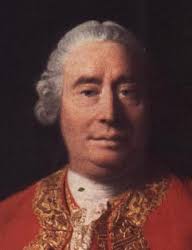
- David Hume
- A miracle is a violation of the laws of nature
- Hume's method was sceptical and critical
- The accounts/testimony of others allow us to form beliefs and may contribute to our knowledge
- testimony can be unreliable and falser so we must be critical...
- Is there a contrary testimony?
- What is the character of the witness?
- How many witnesses were there?
- How they delivered their testimony
- Does the witness have an interest in what they claim?
- We like to tell and hear remarkable stories
- Testimonies often come from those less enlightened
- Testimonies often come from those less enlightened
- We like to tell and hear remarkable stories
- Does the witness have an interest in what they claim?
- How they delivered their testimony
- How many witnesses were there?
- What is the character of the witness?
- Is there a contrary testimony?
- We shouldn't disregard things as miracles however to accept them as miracles is challenging
- The Indian Prince; our experience will always be limited so we might draw false conclusions
- The Indian Prince; our experience will always be limited so we might draw false conclusions
- testimony can be unreliable and falser so we must be critical...
- The accounts/testimony of others allow us to form beliefs and may contribute to our knowledge
- Hume's method was sceptical and critical
- 'Wise men proportion their belief to their evidence'
- We should believe in that which has happened the most often or has the greatest weight of evidence
- Laws of nature were extremely strong evidence form experience
- Needs to be infallible evidence to proceed with confidence
- Needs to be infallible evidence to proceed with confidence
- Laws of nature were extremely strong evidence form experience
- We should believe in that which has happened the most often or has the greatest weight of evidence
- Catch 22..
- 'A miracle is a violation of the laws of nature; and as firm and unalterable experience
has established these laws, the proof against a miracle...is as entire as any argument
from experience can possibly be imagined.'
- To identify a miracle, we must compare it to the uniform laws it breaks and in doing so we
highlight the evidence against the miracle which is more substantial and therefore overthrows the
proposed miracle
- To identify a miracle, we must compare it to the uniform laws it breaks and in doing so we
highlight the evidence against the miracle which is more substantial and therefore overthrows the
proposed miracle
- 'A miracle is a violation of the laws of nature; and as firm and unalterable experience
has established these laws, the proof against a miracle...is as entire as any argument
from experience can possibly be imagined.'
- Always reject the greater
miracle..
- In doing so, one is following the greatest weight of evidence and rejecting the most unlikely
scenario
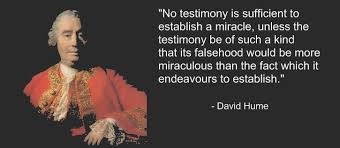
- '...no testimony is sufficient to establish a miracle, unless...its falsehood would be more miraculous (than it's truth).'
- '...no testimony is sufficient to establish a miracle, unless...its falsehood would be more miraculous (than it's truth).'
- In doing so, one is following the greatest weight of evidence and rejecting the most unlikely
scenario
- Possibility...
- '...no human testimony can have such force as to prove a miracle, and make it a foundation for any such system of religion'
- Many Christians use Jesus' miracles to support their religion as Jesus used miracles to prove his
divinity; his oneness with his heavenly father
- Hume accepts the possibility of miracles but not that there is any evidence for them
- Many Christians use Jesus' miracles to support their religion as Jesus used miracles to prove his
divinity; his oneness with his heavenly father
- '...no human testimony can have such force as to prove a miracle, and make it a foundation for any such system of religion'
- A miracle is a violation of the laws of nature
- Cause - dunamis
- Effect - teras
- Purpose - semeion
Medienanhänge




Möchten Sie kostenlos Ihre eigenen Mindmaps mit GoConqr erstellen? Mehr erfahren.