
Mindmap
1_Chapter 1 Internal Auditing, Risk & Governance
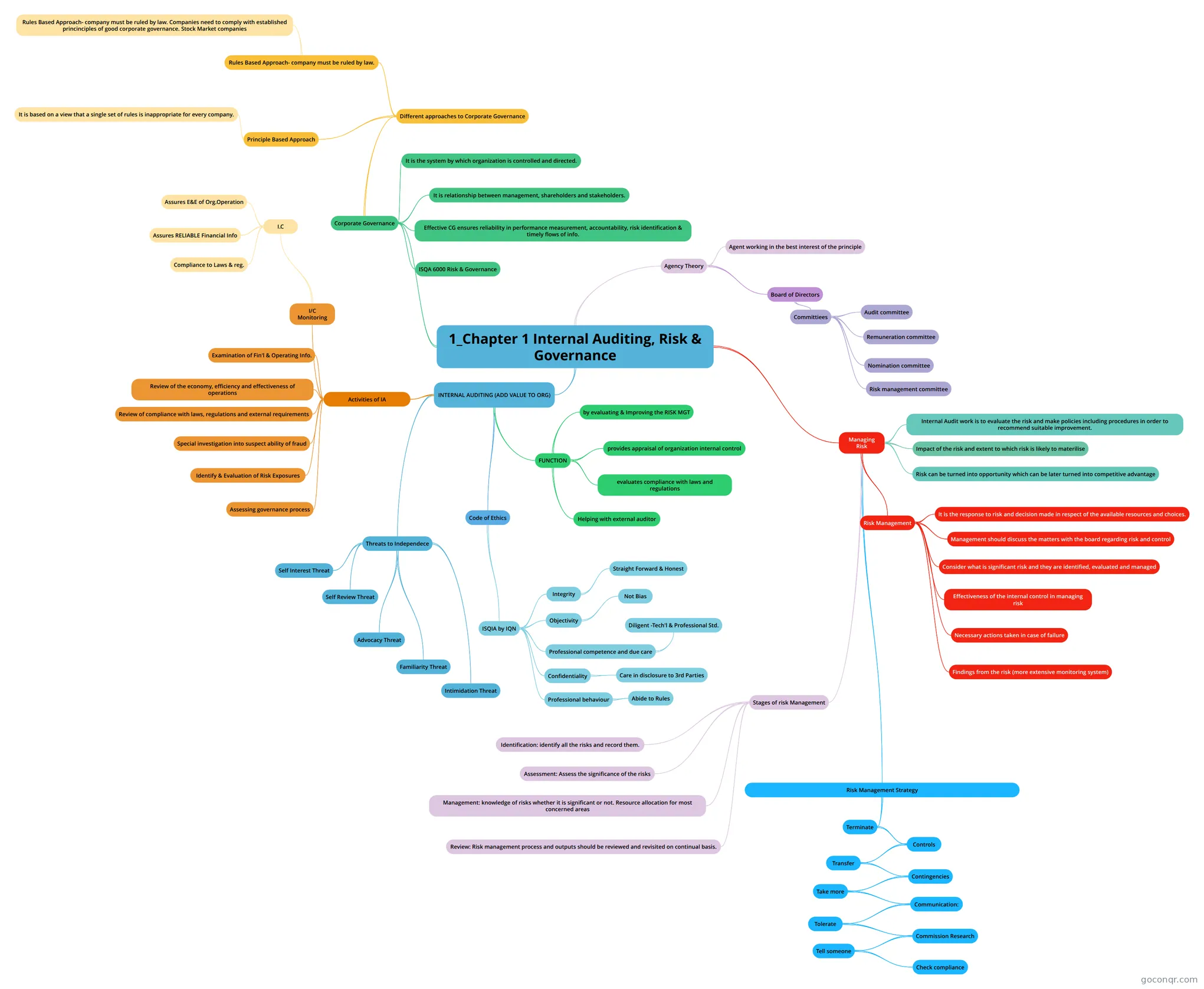
Mind map: Internal auditing, risk & governance
Inhalt der Mindmap
1_Chapter 1 Internal Auditing, Risk & Governance
INTERNAL AUDITING (ADD VALUE TO ORG)
- FUNCTION
- by evaluating & Improving the RISK MGT
- provides appraisal of organization internal control
- evaluates compliance with laws and regulations
- Helping with external auditor
- Activities of IA
- I/C Monitoring
- I.C
- Assures E&E of Org.Operation
- Assures RELIABLE Financial Info
- Compliance to Laws & reg.
- I.C
- Examination of Fin'l & Operating Info.
- Review of the economy, efficiency and effectiveness of operations
- Review of compliance with laws, regulations and external requirements
- Special investigation into suspect ability of fraud
- Identify & Evaluation of Risk Exposures
- Assessing governance process
- I/C Monitoring
- Code of Ethics
- ISQIA by IQN
- Integrity
- Straight Forward & Honest
- Objectivity
- Not Bias
- Professional competence and due care
- Diligent -Tech'l & Professional Std.
- Confidentiality
- Care in disclosure to 3rd Parties
- Professional behaviour
- Abide to Rules
- Integrity
- ISQIA by IQN
- Threats to Independece
- Self Interest Threat
- Self Review Threat
- Advocacy Threat
- Familiarity Threat
- Intimidation Threat
- FUNCTION
Corporate Governance
- It is the system by which organization is controlled and directed.
- It is relationship between management, shareholders and stakeholders.
- Effective CG ensures reliability in performance measurement, accountability, risk identification & timely flows of info.
- ISQA 6000 Risk & Governance
- Different approaches to Corporate Governance
- Rules Based Approach- company must be ruled by law.
- Rules Based Approach- company must be ruled by law. Companies need to comply with established princinciples of good corporate governance. Stock Market companies
- Principle Based Approach
- It is based on a view that a single set of rules is inappropriate for every company.
- Rules Based Approach- company must be ruled by law.
Agency Theory
- Agent working in the best interest of the principle
- Board of Directors
- Committiees
- Audit committee
- Remuneration committee
- Nomination committee
- Risk management committee
- Committiees
Managing Risk
- Internal Audit work is to evaluate the risk and make policies including procedures in order to recommend suitable improvement.
- Impact of the risk and extent to which risk is likely to materilise
- Risk can be turned into opportunity which can be later turned into competitive advantage
- Risk Management
- It is the response to risk and decision made in respect of the available resources and choices.
- Management should discuss the matters with the board regarding risk and control
- Consider what is significant risk and they are identified, evaluated and managed
- Effectiveness of the internal control in managing risk
- Necessary actions taken in case of failure
- Findings from the risk (more extensive monitoring system)
- Stages of risk Management
- Identification: identify all the risks and record them.
- Assessment: Assess the significance of the risks
- Management: knowledge of risks whether it is significant or not. Resource allocation for most concerned areas
- Review: Risk management process and outputs should be reviewed and revisited on continual basis.
- Risk Management Strategy
- Terminate
- Controls
- Transfer
- Contingencies
- Take more
- Communication:
- Tolerate
- Commission Research
- Tell someone
- Check compliance
- Tell someone
- Commission Research
- Tolerate
- Communication:
- Take more
- Contingencies
- Transfer
- Controls
- Terminate
Informationen
- Beschreibung
- BY IQN QIA - QUALIFIED INTERNAL AUDIT Mindmap am 1_Chapter 1 Internal Auditing, Risk & Governance, erstellt von Mark Anthony Pusing am 16/08/2016.
- Erstellt von
- Mark Anthony Pusing
- Aufrufe
- 1
- Verlauf
-
- Erstellt von Mark Anthony Pusing · 15 Aug 2016
- Kopiert von Mark Anthony Pusing · 16 Aug 2016
- Bewertung