
6538130
Beschreibung

Mindmap von Michael Haslett, aktualisiert more than 1 year ago

|
Erstellt von Michael Haslett
vor mehr als 9 Jahre
|
|
CFITES
- Purpose
- Support CF Ops & Goals
- Optimize the quality and
quantity of individual
training and education
(IT&E)
- Engaged when a needs assessment reveals
performance deficiencies that can be
addressed by training
- Support CF Ops & Goals
- 5 Fundamental Principles to the
Managements of IT&E
- Performance Orientation
- On the job
performance and
meeting CF
requirements
- On the job
performance and
meeting CF
requirements
- Systems Approach
- Considers the larger
environments of inputs,
pressure and constraints
that impact processes
- Considers the larger
environments of inputs,
pressure and constraints
that impact processes
- Systematic Process
- Step1: Define the Problem
- Step 2: Analyze the
Problem
- Step 3: Select optimum
solution
- Step 4: Implement
the solution
- Step 5: Evaluate the
Results
- Systematic
- Needs
Assessment
- (1) Starts with a requirement (2) Has Iterative
and Interactive Steps (3) Verification that
requirement has been met
- SAT Approach
- Cyclical
- Applied Non-linearly
- Process oriented
- Integrated not
fragmented
- Reliable outputs
- Cyclical
- ADDIE
- Evaluation
- Implementation
- Development
- Design
- Analysis
- Evaluation
- Training vs. Education
- Training: Focuses on how (function), predictable response
to a predictable situation
- Education: Focuses on why (understanding), reasoned
response to an unpredictable situation
- Training: Focuses on how (function), predictable response
to a predictable situation
- Needs
Assessment
- Step1: Define the Problem
- Optimum Efficiency
- Achieve operational
needs at a minumum
acceptable cost
- Achieve operational
needs at a minumum
acceptable cost
- Continuous improvement
- Ensuring that IT&E is
always evolving and
improving
- Ensuring that IT&E is
always evolving and
improving
- Performance Orientation
- Quality
Control
Process
- Applies
to the development,
implementation and
maintenance to ensure what
members are learning meets
the requirements of their
duties.
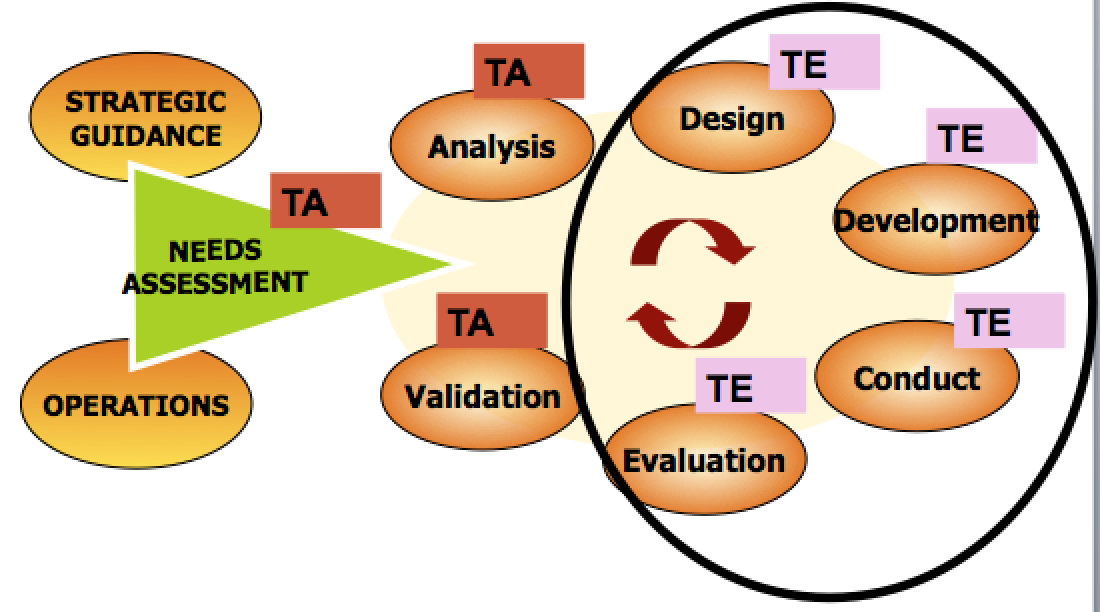
- Six-phase model
- Analysis
- Specify objectives for on-job
performance
- Review needs assessment findings and
related documentation
- Analyze tasks
and
educational
requirements
for IT&E
- Specify performance objectives
and/or education objectives
- Responsibility: Training Authority (TA)
Input: Training Intervention identified
Deliverable: The Qualification Standard
(QS)
- Specify objectives for on-job
performance
- Design
- Select and describe the
IT&E event
- Define learner
characteristics:
knowledge, skills,
attitude
- Perform instructional analysis::
analyze PO's and EO's to
ensure they allow learner to
achieve the objective
- Prepare learning assessment plan:
strategize use of testing to
properly assess learning
objectives
- Select
instructional
strategy
- Specify course content
and lesson guidance
- Responsibility: Training Establishment
Input: Qualification Standard
Deliverable: The Training Plan
- Select and describe the
IT&E event
- Development
- Produce or acquire effective instructional
materials to support the Training Education Plan
- Develop assessment
instruments
- Conduct trials and
revise
- Prepare staff
- Record development
costs
- Responsibility:
Training
Establishment
Input: Training
Plan(TP)
Deliverables:
Master Lesson
Plans, EC and PC
- Produce or acquire effective instructional
materials to support the Training Education Plan
- Conduct
- Implement the training
education plan
- Administer and manage
the learning process
- Deliver instruction
- Monitor
learning
- Responsibility: Training Establishment
Input: Course Content (MLP's, Checklists)
Deliverable: A member who is adequately
trained with the necessary knowledge
- Implement the training
education plan
- Evaluation
- Ensure the optimal
effectiveness and efficiency of
instruction
- Assess learner
achievement
- Assess content
and delivery
- Assess costs
- Revise as necessary
- Responsibility: Training Establishment
Input: Students, Instructors, Course critique
Deliverables: Course/Program Evaluation
- Ensure the optimal
effectiveness and efficiency of
instruction
- Validation
- Verify that the program
has adequately prepared
students to perform tasks
- Scope and plan
- Collect/analyze data
- Interpret findings and
draw conclusions
- Report/ recommend
- Responsibility: Training Authority
(TA) Input: On-the-job Data
*Usually occurs 6-18 Months
after training
- Verify that the program
has adequately prepared
students to perform tasks
- Analysis
- ***Initated by the
recommendations of a
Needs assessment, from
Operations or Strategic
Guidance
- Applies
to the development,
implementation and
maintenance to ensure what
members are learning meets
the requirements of their
duties.
- Needs Assessment
- Aim is to fully examine a
problem or issue before
developing a solution
- Prompted by a
performance deficiency or
if performance can/should
be enhanced
- Aim is to fully examine a
problem or issue before
developing a solution
- Quantity Control Process
- To ensure that IT&E is given to the right
people at the right time for the right cost
- Six Management Fuctions
- Identify Quantitative
Requirement
- Determine basic
qualification
requirements
- Determine non-basic
qualification requirements
- Prioritize
requirements
- Determine basic
qualification
requirements
- Nominate Personnel
- Designate personnel,
or numbers
personnel, to be
qualified
- Designate personnel,
or numbers
personnel, to be
qualified
- Propose Schedule
- Determine potential number and
timing of sessions
- Determine potential number and
timing of sessions
- Match
- Match sessions to
nominations
- Optimize forecast
- Match sessions to
nominations
- Commission
- Apply costs to forecast
- Determine acceptability
of costs
- Prioritize forecast
- Input forecast to
business plan
- Fund sessions
- Apply costs to forecast
- Administer Conduct
- Prepare Nominal roll
- Record results
- Record costs
- Produce reports
- Prepare Nominal roll
- Identify Quantitative
Requirement
- To ensure that IT&E is given to the right
people at the right time for the right cost
- Resource Management Mechanisms
- Operate within the Quality Control Process and
the Quantity Control Process to implement,
maintain and improve resource-effectiveness
- Link IT&E to Business
Planning to Ensure:
- Consideration of resource
requirements at decision points
- Identification, tracking and
monitoring of costs
- Assessment of
resource-effectiveness
- Consideration of resource
requirements at decision points
- Resource Management
Mechanisms and Quality
Control Process
- Identify/ Cost Options
- Ensures all quality
control decisioons
consider resource
implications
- Entails identifying alternate means of
achieving IT&E goals, and estimating costs
for each
- Ensures all quality
control decisioons
consider resource
implications
- Record Costs
- Control expenditures by
identifying and accurately and
comprehensively recording the
resources
- Fundamental process within the
Development phase
- Control expenditures by
identifying and accurately and
comprehensively recording the
resources
- Assess Cost
- Determine the cost-effectiveness of
IT&E programmes by comparing actual
and planned costs and results
- Fundamental process in the Evaluation phase
- Determine the cost-effectiveness of
IT&E programmes by comparing actual
and planned costs and results
- Identify/ Cost Options
- Resource Management
Mechanisms and Quantity
Control Process
- Optimize Forecast
- To minimize the number of sessions
conducted by ensuring optimum
student load
- Underlying process in the
Matching function
- To minimize the number of sessions
conducted by ensuring optimum
student load
- Apply Costs to
forecast
- Costs are applied for
input into the
business pan
- Inherit process in
the Commissioning
Function
- Costs are applied for
input into the
business pan
- Determine
Acceptability of
Costs
- Determine whether
costs meet criteria
established by the
Training Authority
- Essential
process
in
the
Commissioning
Function
- Determine whether
costs meet criteria
established by the
Training Authority
- Prioritize
- Define the link
between IT&E and
operational
requirements
- Define the link
between IT&E and
operational
requirements
- Input forecast to
business plan
- Fund sessions
- Optimize Forecast
- Operate within the Quality Control Process and
the Quantity Control Process to implement,
maintain and improve resource-effectiveness
Medienanhänge
Möchten Sie kostenlos Ihre eigenen Mindmaps mit GoConqr erstellen? Mehr erfahren.