
Mindmap
eLearning Technology & Acme U
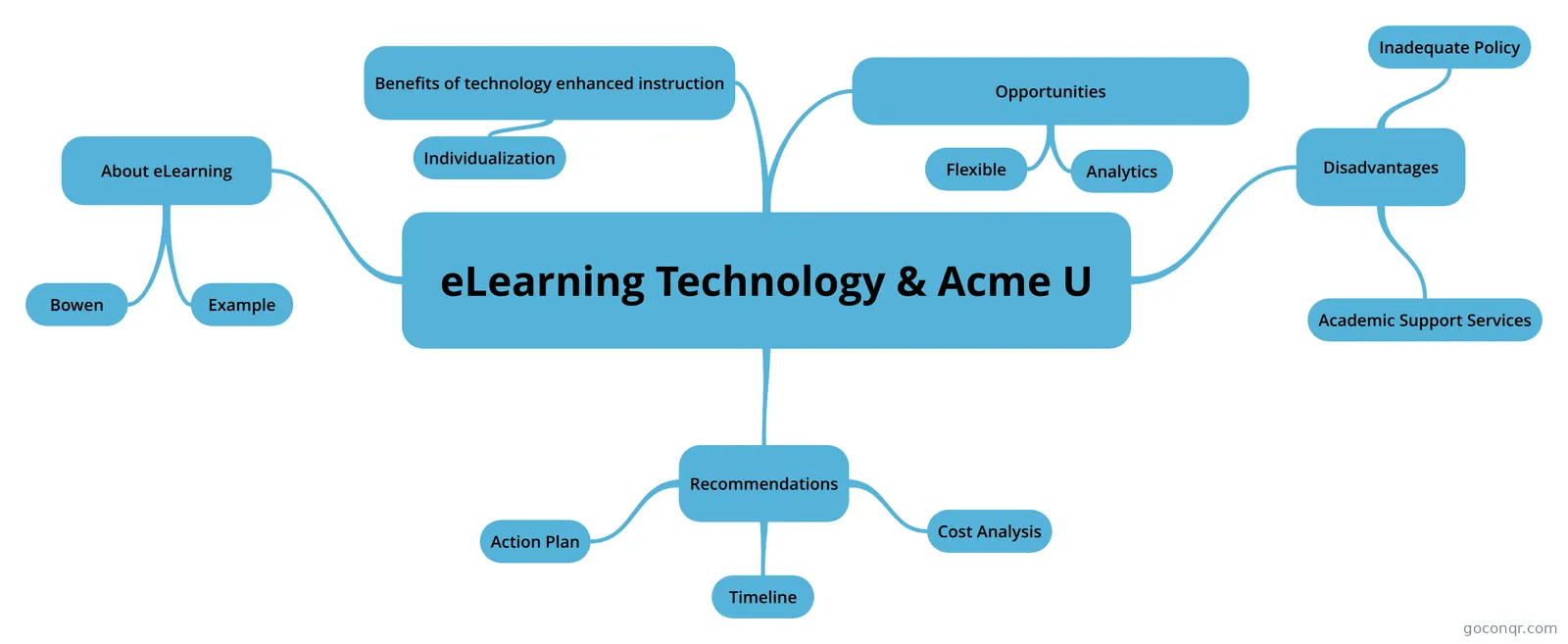
Mind map: eLearning technology & Acme U
Inhalt der Mindmap
eLearning Technology & Acme U
- The purpose of education is to lay the foundation for critical thinking and problem solving. Regardless of the level of ability or aptitude, integrating technology into teaching facilitates the construction of learning opportunities where students of all abilities can succeed. Creating environments where learners are curious and engaged, and enabling students to find answers to their questions are the most central issues to knowledge construction and active engagement (Marlowe & Page, 2010). The application of knowledge for problem solving is the essence of technology. Implementing technological developments into teaching should enable instructors to solve problems linked to facilitating the assimilation of ideas into a framework that allows learners of various cognitive abilities to transform their understanding and transfer learning. Traditional e-Learning attempts to replicateclassroom activities by designing intentional communicative interactions into the course with the use of instructor feedback, peer-to peer online discussion postsand responses, and the occasional group assignment. While the interactions are not an exact replica of conversations and discussions found in classrooms, they docontribute to learning in the communicative domain.
Benefits of technology enhanced instruction
- Technology can significantly affect access to professional development, teaching, and learning. It can enable collaboration that is not reliant on place. Technology can drive instructional design, elevate creativity, and enable personalized instruction that adapts to learners needs. Finally, technology allows for more timely feedback and assessment of learning, which is essential to improving outcomes in the classroom.
- Individualization
About eLearning
- The instrumental and communicative domains of learning give learners an opportunity to predict solutions and take action to solve problems. The practical “how to” of the instrumental domain and the relational/social emphasis of the communicative domain enables students to predict and assess the validity of solutions. Combining domains helps learners confront problematic assumptions while contributing to learner’s transformation as they develop understanding (Mezirow J., 2000). Classroom learning has focused on the instructor-learner-material triad, which allows for shifting between the three components as necessary to facilitate learning; the oscillation between components occurs when the student or the instructor initiates or emphasizes the communicative domain (Kop, 2011, p. 19). Kop (p. 20) suggested that there is a fourth component in the learning paradigm that has been identified as significant for theory and practice – the learning context. Hybrid courses attempt to bridge the gap utilizing the best of the classroom and e-Learning into one course. Students engage with significant amounts of course material online and engage in the communicative domain in the classroom.
- Example
- Westminster College has developed and implemented a hands-on, competency-based approach to online education using an online project-based format that allows learners to concentrate and master skills they need (Westminster College, n.d., para. 2). A skills-based system relies on mastery of the content instead of time spent in the seat. This approach allows students to focus their time and energy on building the skills they need to in the least amount of time. Westminster also offers a flexible time-frame for completion. For example, the online Bachelor of Business Administration degree is projected to take learners 12-18 months (Westminster College, n.d., para. 8). Along with competency-based learning, an accelerated timeline is available for students – who move at their own pace through the curriculum. This is an additional strategy that reduces the time to degree (Hern & Snell, 2014). The least efficient student is the one who completes a lot of courses but does not earn a degree (Belfield, Crosta, & Jenkins, 2014). According to Scalise, “A developmental perspective of learning, a match between instructional goals and assessment, the generation of quality evidence, and providing information to teachers and students that is useful to improve learning outcomes” (2007, p. 2307) support using adaptive technology and mastery based learning in higher education. Brown-Jeffy & Cooper (2011) support a personalized approach to instructional design that applies constructivist principles and cooperative approaches while teaching to, and through, diverse learners’ strengths.
- Bowen
- Bowen (2013) wrote that there is little opportunity to increase productivity in higher education; however, technology can potentially improve the quality of instruction.
Opportunities
- Community college that also offers students the online career coach combined with on campus career services. It is essential that community college students engage in career exploration early in their academic careers to connect learning with potential career pathways. It has been predicted that by 2020, two-thirds of all new jobs created will require education and training beyond high school; those students “who are not able to improve their foundation skills, continue their education and training, and ultimately earn postsecondary certificates or degrees will face increasingly bleak career prospects” (Office of Career, Technical and Adult Education, 2015, p. 26). With so many students attending community colleges to retool or prepare for employment opportunities, with salaries increasingly determined by education, and with growing wage differentials between those with postsecondary education and those who do not have credentials, clearly defined career pathways and career exploration are essential supports that community colleges must provide to both position students for success and sustain the institution (Cahalan, 2013, p. 7).
- Analytics
- Student clicks would provide micro-analytics on every page, quiz, and test, giving researchers the ability to determine what media each student prefers (Waldrop, 2013, para. 5).
- Flexible
- Course design utilizes technology that enables every mouse click to be recorded, an ability that could transform education research by generating data that allows continuous course improvement (Ebben & Murphy, 2014, p. 337).
Disadvantages
- Inadequate Policy
- No guideline exists regarding digital conduct, which has makes it difficult for students, staff, faculty, and administrators to determine acceptable behavior, misconduct, and the appropriate course of disciplinary action (Pomerantz, Hank, & Sugimoto, 2015, p. 2). Acme College is “dedicated to providing collaborative experiences that are free from all forms of harassment, and inclusive of all people. Small actions you can take will help us meet this goal” (Digital Library Federation, 2016, para. 2).
- Acme College encourages digital engagement that elevates reflection and collaboration as well as cultivates professional discourse and civility in the college community that is inclusive, positive, and purposeful, fosters knowledge exchange, and develops social capital (Concordia University - Portland, 2016, p. 7). The Digital Code of Conduct provides the University community with standards for the appropriate use of digital tools, social networking, and an overview of behaviors that will result in sanctions (e.g. cyberbullying and harassment). Acme encourages “self-discipline and respect for the rights of others in the [college] community” (Arizona State University, n.d., para. 2) with social media and all types of communication.
- Academic Support Services
- Academic guidance and counseling, through which students gain information on educational and course planning and graduation requirements; Academic supports, such as tutoring, through which students receive additional help in meeting their academic goals; Personal guidance and counseling, such as mental health counseling or crisis intervention; Career counseling, through which students receive information on careers; and Supplemental services, such as child care or transportation assistance.
- Inadequate Policy
Recommendations
- Action Plan
- Timeline
- Cost Analysis
Informationen
- Beschreibung
- Mindmap am eLearning Technology & Acme U, erstellt von Victoria McWane-Creek am 19/11/2016.
- Erstellt von
- Victoria McWane-Creek
- Aufrufe
- 0
- Bewertung