
Mindmap
Skull = facial skeleton + cranial vault
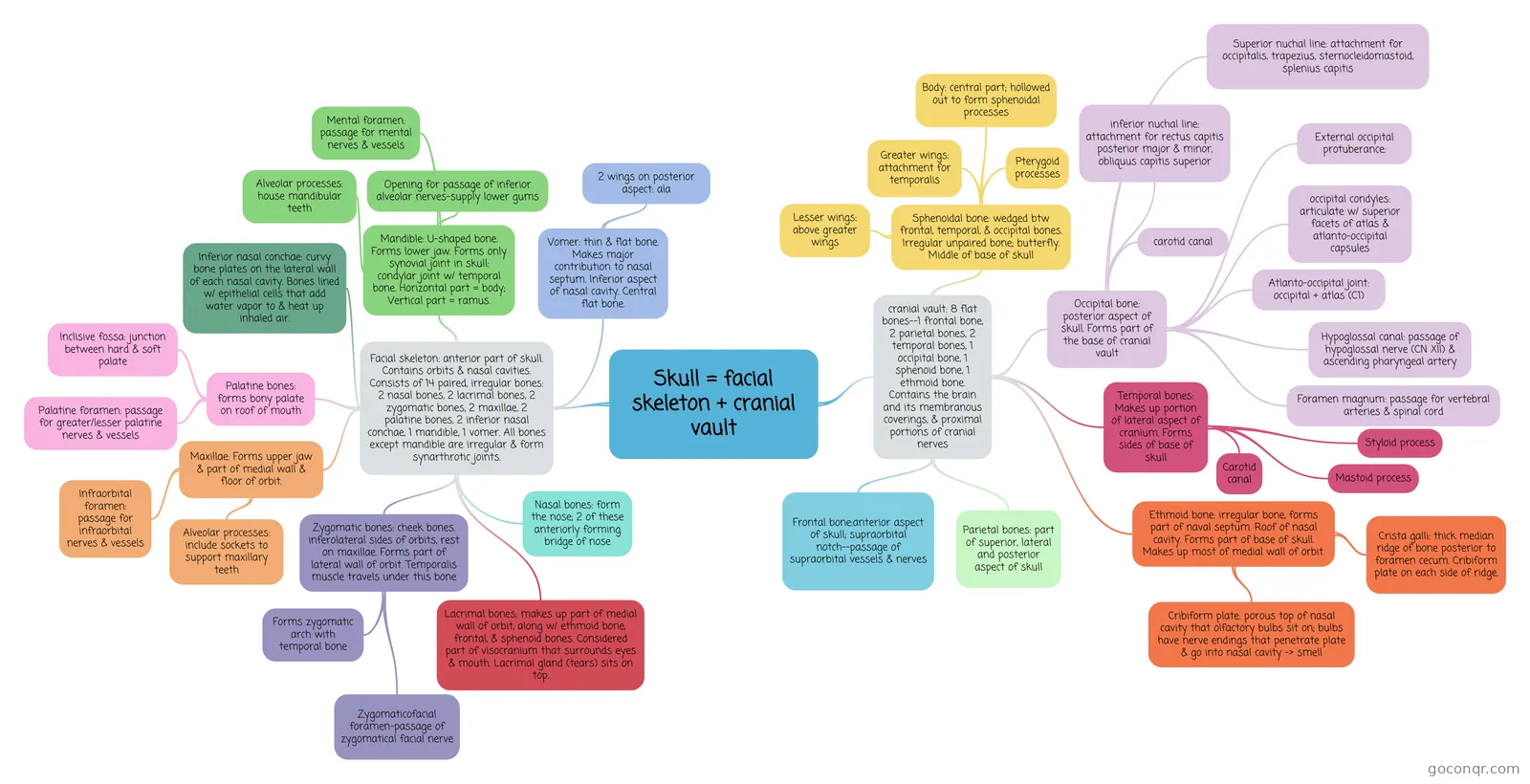
Mind map: Skull facial skeleton and cranial vault
Inhalt der Mindmap
Skull = facial skeleton + cranial vault
cranial vault: 8 flat bones--1 frontal bone, 2 parietal bones, 2 temporal bones, 1 occipital bone, 1 sphenoid bone, 1 ethmoid bone. Contains the brain and its membranous coverings, & proximal portions of cranial nerves
- Frontal bone:anterior aspect of skull; supraorbital notch--passage of supraorbital vessels & nerves
- Parietal bones: part of superior, lateral and posterior aspect of skull
- Temporal bones: Makes up portion of lateral aspect of cranium. Forms sides of base of skull
- Mastoid process
- Styloid process
- Carotid canal
- Occipital bone: posterior aspect of skull. Forms part of the base of cranial vault
- External occipital protuberance:
- occipital condyles: articulate w/ superior facets of atlas & atlanto-occipital capsules
- carotid canal
- Atlanto-occipital joint: occipital + atlas (C1)
- Hypoglossal canal: passage of hypoglossal nerve (CN XII) & ascending pharyngeal artery
- Superior nuchal line: attachment for occipitalis, trapezius, sternocleidomastoid, splenius capitis
- inferior nuchal line: attachment for rectus capitis posterior major & minor, obliquus capitis superior
- Foramen magnum: passage for vertebral arteries & spinal cord
- Sphenoidal bone: wedged btw frontal, temporal, & occipital bones. Irregular unpaired bone; butterfly. Middle of base of skull
- Greater wings: attachment for temporalis
- Lesser wings: above greater wings
- Body: central part; hollowed out to form sphenoidal processes
- Pterygoid processes
- Ethmoid bone: irregular bone, forms part of naval septum. Roof of nasal cavity. Forms part of base of skull. Makes up most of medial wall of orbit.
- Cribiform plate: porous top of nasal cavity that olfactory bulbs sit on; bulbs have nerve endings that penetrate plate & go into nasal cavity -> smell
- Crista galli: thick median ridge of bone posterior to foramen cecum. Cribiform plate on each side of ridge.
Facial skeleton: anterior part of skull. Contains orbits & nasal cavities. Consists of 14 paired, irregular bones: 2 nasal bones, 2 lacrimal bones, 2 zygomatic bones, 2 maxillae, 2 palatine bones, 2 inferior nasal conchae, 1 mandible, 1 vomer. All bones except mandible are irregular & form synarthrotic joints.
- Nasal bones: form the nose; 2 of these anteriorly forming bridge of nose
- Lacrimal bones; makes up part of medial wall of orbit, along w/ ethmoid bone, frontal, & sphenoid bones. Considered part of visocranium that surrounds eyes & mouth. Lacrimal gland (tears) sits on top.
- Zygomatic bones: cheek bones. inferolateral sides of orbits, rest on maxillae. Forms part of lateral wall of orbit. Temporalis muscle travels under this bone
- Zygomaticofacial foramen-passage of zygomatical facial nerve
- Forms zygomatic arch with temporal bone
- Maxillae: Forms upper jaw & part of medial wall & floor of orbit.
- Alveolar processes: include sockets to support maxillary teeth
- Infraorbital foramen: passage for infraorbital nerves & vessels
- Palatine bones: forms bony palate on roof of mouth
- Palatine foramen: passage for greater/lesser palatine nerves & vessels
- Inclisive fossa: junction between hard & soft palate
- Inferior nasal conchae: curvy bone plates on the lateral wall of each nasal cavity. Bones lined w/ epithelial cells that add water vapor to & heat up inhaled air.
- Mandible: U-shaped bone. Forms lower jaw. Forms only synovial joint in skull: condylar joint w/ temporal bone. Horizontal part = body; Vertical part = ramus.
- Alveolar processes: house mandibular teeth
- Mental foramen: passage for mental nerves & vessels
- Opening for passage of inferior alveolar nerves-supply lower gums
- Vomer: thin & flat bone. Makes major contribution to nasal septum. Inferior aspect of nasal cavity. Central flat bone.
- 2 wings on posterior aspect: ala
Informationen
- Beschreibung
- rehab science Mindmap am Skull = facial skeleton + cranial vault, erstellt von Emily Janyszek am 10/12/2016.
- Erstellt von
- Emily Janyszek
- Aufrufe
- 1
- Bewertung
Mehr zu Cranial and facial bones