
Mindmap
Real Analysis
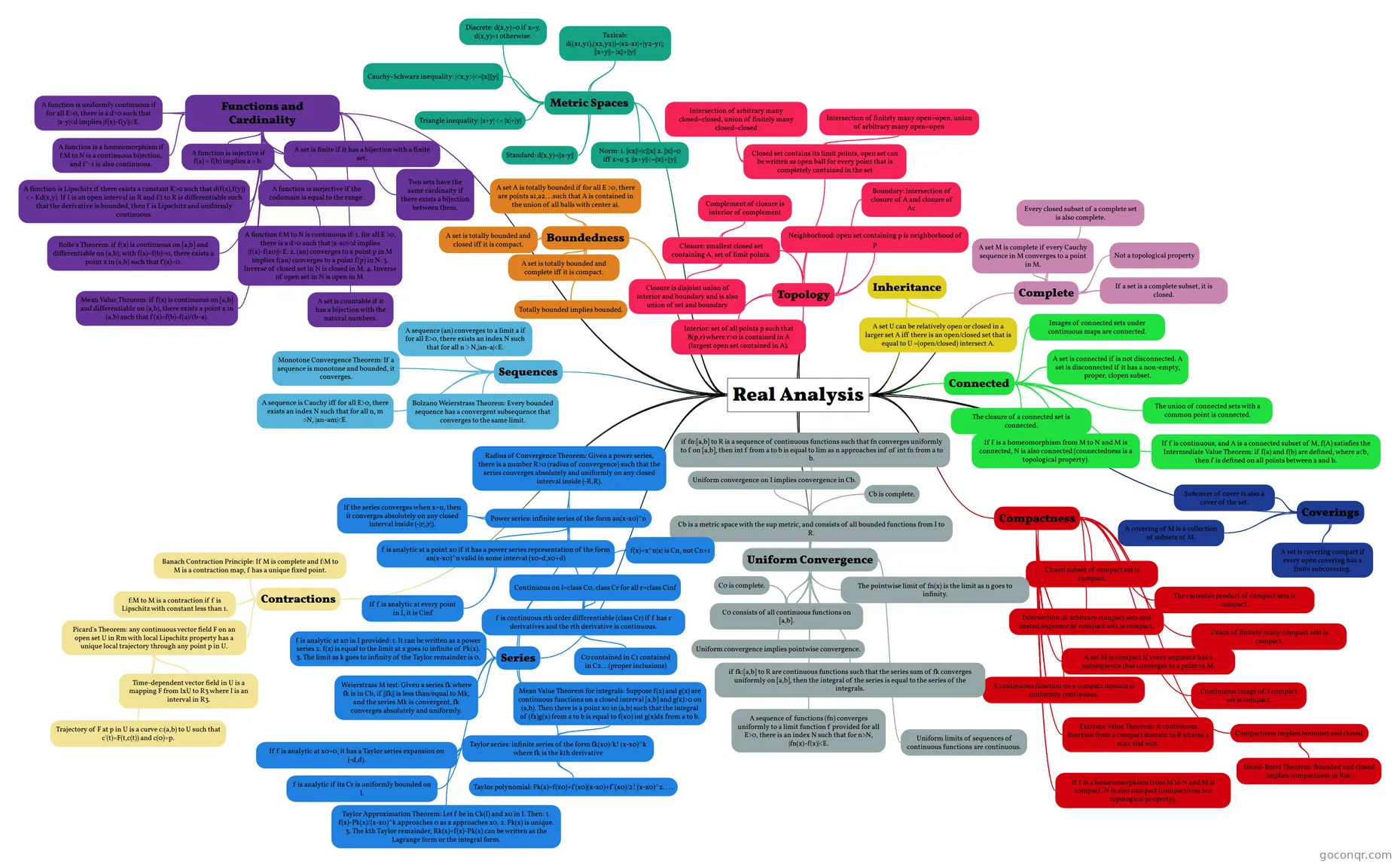
Mind map: Real analysis
Inhalt der Mindmap
Real Analysis
Sequences
- A sequence (an) converges to a limit a if for all E>0, there exists an index N such that for all n > N,|an-a|<E.
- A sequence is Cauchy iff for all E>0, there exists an index N such that for all n, m >N, |an-am|<E.
- Monotone Convergence Theorem: If a sequence is monotone and bounded, it converges.
- Bolzano Weierstrass Theorem: Every bounded sequence has a convergent subsequence that converges to the same limit.
Functions and Cardinality
- A function is injective if f(a) = f(b) implies a = b.
- A function is surjective if the codomain is equal to the range.
- A function is a homeomorphism if f:M to N is a continuous bijection, and f^-1 is also continuous.
- A set is finite if it has a bijection with a finite set.
- A set is countable if it has a bijection with the natural numbers.
- A function f:M to N is continuous if: 1. for all E >0, there is a d>0 such that |x-x0|<d implies |f(x)-f(x0)|<E. 2. (an) converges to a point p in M implies f(an) converges to a point f(p) in N. 3. Inverse of closed set in N is closed in M. 4. Inverse of open set in N is open in M.
- Two sets have the same cardinaity if there exists a bijection between them.
- A function is uniformly continuous if for all E>0, there is a d>0 such that |x-y|<d implies |f(x)-f(y)|<E.
- A function is Lipschitz if there exists a constant K>0 such that d(f(x),f(y)) <= Kd(x,y). If I is an open interval in R and f:I to R is differentiable such that the derivative is bounded, then f is Lipschitz and uniformly continuous.
- Rolle's Theorem: if f(x) is continuous on [a,b] and differentiable on (a,b), with f(a)=f(b)=0, there exists a point x in (a,b) such that f'(x)=0.
- Mean Value Theorem: if f(x) is continuous on [a,b] and differentiable on (a,b), there exists a point x in (a,b) such that f'(x)=f(b)-f(a)/(b-a).
Metric Spaces
- Discrete: d(x,y)=0 if x=y, d(x,y)=1 otherwise.
- Standard: d(x,y)=||x-y||
- Taxicab: d((x1,y1),(x2,y2))=|x2-x1|+|y2-y1|; ||x+y||= |x||+||y||
- Triangle inequality: |x+y| <= |x|+|y|
- Cauchy-Schwarz inequality: |<x,y>|<=||x||||y||
- Norm: 1. ||cx||=|c|||x|| 2. ||x||=0 iff x=o 3. ||x+y||<=||x||+||y||
Topology
- Closure: smallest closed set containing A, set of limit points.
- Complement of closure is interior of complement
- Closure is disjoint union of interior and boundary and is also union of set and boundary
- Boundary: intersection of closure of A and closure of Ac
- Interior: set of all points p such that B(p,r) where r>0 is contained in A (largest open set contained in A).
- Neighborhood: open set containing p is neighborhood of p
- Closed set contains its limit points, open set can be written as open ball for every point that is completely contained in the set
- Intersection of finitely many open=open, union of arbitrary many open=open
- Intersection of arbitrary many closed=closed, union of finitely many closed=closed
- Closure: smallest closed set containing A, set of limit points.
Inheritance
- A set U can be relatively open or closed in a larger set A iff there is an open/closed set that is equal to U =(open/closed) intersect A.
Coverings
- A covering of M is a collection of subsets of M.
- Subcover of cover is also a cover of the set.
- A set is covering compact if every open covering has a finite subcovering.
Boundedness
- A set A is totally bounded if for all E >0, there are points a1,a2...such that A is contained in the union of all balls with center ai.
- Totally bounded implies bounded.
- A set is totally bounded and closed iff it is compact.
- A set is totally bounded and complete iff it is compact.
Complete
- A set M is complete if every Cauchy sequence in M converges to a point in M.
- Every closed subset of a complete set is also complete.
- If a set is a complete subset, it is closed.
- Not a topological property
Connected
- A set is connected if is not disconnected. A set is disconnected if it has a non-empty, proper, clopen subset.
- Images of connected sets under continuous maps are connected.
- The closure of a connected set is connected.
- The union of connected sets with a common point is connected.
- If f is continuous, and A is a connected subset of M, f(A) satisfies the Intermediate Value Theorem: if f(a) and f(b) are defined, where a<b, then f is defined on all points between a and b.
- If f is a homeomorphism from M to N and M is connected, N is also connected (connectedness is a topological property).
Compactness
- A set M is compact if every sequence has a subsequence that converges to a point in M.
- Compactness implies bounded and closed.
- Heine-Borel Theorem: Bounded and closed implies compactness in Rm.
- The cartesian product of compact sets is compact.
- Closed subset of compact set is compact.
- Intersection of arbitrary compact sets and nested sequence of compact sets is compact.
- Union of finitely many compact sets is compact.
- Continuous image of a compact set is compact.
- Extreme Value Theorem: A continuous function from a compact domain to R attains a max and min.
- If f is a homeomorphism from M to N and M is compact, N is also compact (compactness is a topological property).
- A continuous function on a compact domain is uniformly continuous.
Uniform Convergence
- A sequence of functions (fn) converges uniformly to a limit function f provided for all E>0, there is an index N such that for n>N, |fn(x)-f(x)|<E.
- The pointwise limit of fn(x) is the limit as n goes to infinity.
- Uniform limits of sequences of continuous functions are continuous.
- Uniform convergence implies pointwise convergence.
- Cb is a metric space with the sup metric, and consists of all bounded functions from I to R.
- Uniform convergence on I implies convergence in Cb.
- Cb is complete.
- C0 consists of all continuous functions on [a,b].
- C0 is complete.
- if fn:[a,b] to R is a sequence of continuous functions such that fn converges uniformly to f on [a,b], then int f from a to b is equal to lim as n approaches inf of int fn from a to b.
- if fk:[a,b] to R are continuous functions such that the series sum of fk converges uniformly on [a,b], then the integral of the series is equal to the series of the integrals.
Series
- Weierstrass M test: Given a series fk where fk is in Cb, if ||fk|| is less than/equal to Mk, and the series Mk is convergent, fk converges absolutely and uniformly.
- Power series: infinite series of the form an(x-x0)^n
- If the series converges when x=n, then it converges absolutely on any closed interval inside (-|r|,|r|).
- Radius of Convergence Theorem: Given a power series, there is a number R>0 (radius of convergence) such that the series converges absolutely and uniformly on any closed interval inside (-R,R).
- f is continuous rth order differentiable (class Cr) if f has r derivatives and the rth derivative is continuous.
- Continuous on I=class C0, class Cr for all r=class Cinf
- f(x)=x^n|x| is Cn, not Cn+1
- C0 contained in C1 contained in C2...(proper inclusions)
- f is analytic at a point x0 if it has a power series representation of the form an(x-x0)^n valid in some interval (x0-d,x0+d)
- If f is analytic at every point in I, it is Cinf
- Taylor series: infinite series of the form fk(x0)/k! (x-x0)^k where fk is the kth derivative
- If f is analytic at x0=0, it has a Taylor series expansion on (-d,d).
- Mean Value Theorem for integrals: Suppose f(x) and g(x) are continuous functions on a closed interval [a,b] and g(x)>0 on (a,b). Then there is a point x0 in (a,b) such that the integral of (fx)g(x) from a to b is equal to f(x0) int g(x)dx from a to b.
- Taylor polynomial: Pk(x)=f(x0)+f'(x0)(x-x0)+f''(x0)/2! (x-x0)^2....
- Taylor Approximation Theorem: Let f be in Ck(I) and x0 in I. Then: 1. f(x)-Pk(x)/(x-x0)^k approaches 0 as x approaches x0. 2. Pk(x) is unique. 3. The kth Taylor remainder, Rk(x)=f(x)-Pk(x) can be written as the Lagrange form or the integral form.
- f is analytic at x0 in I provided: 1. It can be written as a power series 2. f(x) is equal to the limit at x goes to infinite of Pk(x). 3. The limit as k goes to infinity of the Taylor remainder is 0.
- f is analytic if its Cr is uniformly bounded on I.
Contractions
- f:M to M is a contraction if f is Lipschitz with constant less than 1.
- Banach Contraction Principle: If M is complete and f:M to M is a contraction map, f has a unique fixed point.
- Picard's Theorem: any continuous vector field F on an open set U in Rm with local Lipschitz property has a unique local trajectory through any point p in U.
- Time-dependent vector field in U is a mapping F from IxU to R3 where I is an interval in R3.
- Trajectory of F at p in U is a curve c:(a,b) to U such that c'(t)=F(t,c(t)) and c(0)=p.
Informationen
- Beschreibung
- Mindmap am Real Analysis, erstellt von Arya Mekkat am 13/12/2016.
- Erstellt von
- Arya Mekkat
- Aufrufe
- 8
- Bewertung