
Mindmap
Themes in the colour purple
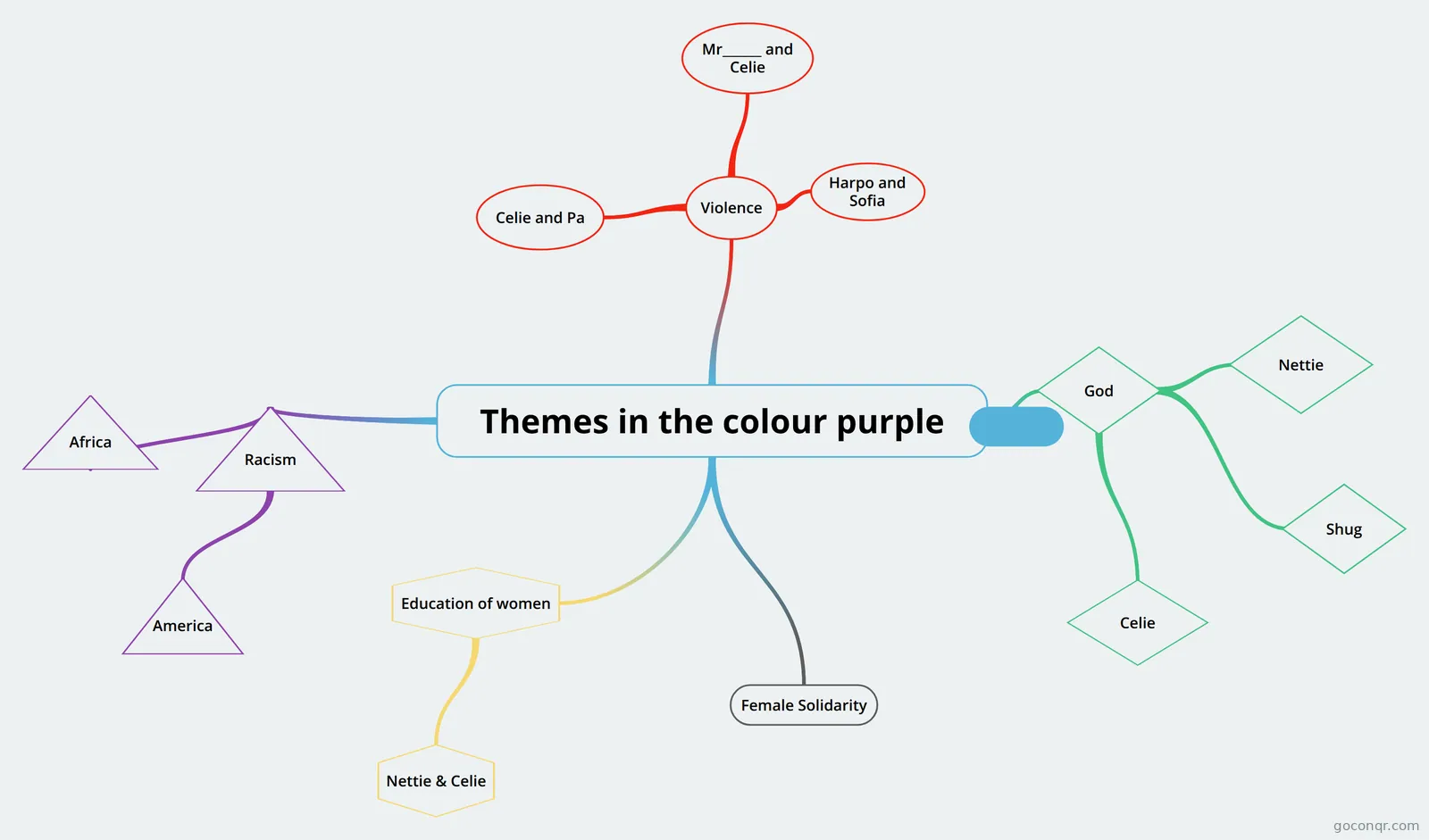
Mind map: Themes in the colour purple
Inhalt der Mindmap
Themes in the colour purple
Violence
- Mr______ and Celie
- "Wives is like children. You have to let 'em know who got the upper hand. Nothing can do that better than a good beating" -Mr_____ pg 35 "Sometimes beat me...whether I do what he say or not." -Celie pg 60 "He beat me like he beat the children...the children be outside the room peeking through the cracks." -Celie Pg 23 "He beat me when you not here...for being me and not you." - Celie pg 71 "I won't leave you... until I know Albert won't even think about beating you." - Shug pg 72
- Celie and Pa
- "He start to choke me, saying you better shut up and git used to it."- Celie pg 3 "He beat me today cause he say I winked at a boy in church" - Celie pg 7 "He beat me for dressing trampy but he do it to me anyway."- Celie pg 9
- Harpo and Sofia
- "Harpo want to know what to do to make Sofia mind." - Celie pg 35 "Beat her. I say"- Celie pg 36 "...Harpo and Sofia...fighting like two mens."- Celie pg 37 "He try to slap her...She...whack him cross the eyes."- Celie pg 37
- Mr______ and Celie
Education of women
- Nettie & Celie
- "The first time I got big Pa took me out of school. He never care that I love it." -Celie pg 11 "Celie smart too. Even Miss Beasley have to say." - Nettie pg11 "Miss Beasley...say as long as she been a teacher she never know nobody want to learn as bas as Nettie and me."- Celie pg 12 "But one thing I do thank [Miss Beasley] for, for teaching me to learn for myself, by reading and studying and writing a clear hand." - Nettie pg 119
- Nettie & Celie
God
- The first words written by Celie, the novel's protagonist, are "Dear God" and the novel ends with a letter, the salutation of whihc reads, "Dear God. Dear stars, dear trees, dear sky, dear people. Dear Everything. Dear God." This encapsulates The Colour Purple's relationship to religion and spirituality: a transition from the belief in a single God, an old white man in a long beard, to a God that exists all around, and is a part of human happiness. Celie begins writing letters to God in order to survive her stepfather's sexual abuse; she later comes to view God as an outgrowth of nature's beauty, after Shug conviences her that God is more than what white people say, and what church teachings confirm. Although Shug is not typically religious, she believes strongly that God wants people to be happy, and that God, too, wants to be loves, just as people do. Nettie serves as a missionary to the Olinka poeple, intending to spread Christianity, but realises like her sister, that God is more pervasive, more bound up in nature than some Christian teachings suggests. Nettie's return to CElie, at the novel's end, confirms that the beauty of family togetherness is one manifestation of God's power on earth. Even Mr____ comes to realise that he behaved evilly as a young man, and his growing belief in the "wonder" of God's creation makes him a bettwe person, and a friend to Celie.
- Celie
- ""And I see they [the children] think that me and Nettie and Shug and Albert and Samuel and Harpo and Sofia and Jack and Odessa real old . . . But I don't think us feel old at all. And us so happy. Matter of fact, I think this the youngest us ever felt." p.261 "I keep hoping he fine somebody to marry. I see him looking at my little sister. She scared. But I say I'll take care of you. With God help." p.5 "Dear God, I am fourteen years old. I am I have always been a good girl. Maybe you can give me a sign letting me know what is happening to me." p.3
- Shug
- "She say, My first step from the old white man was trees. Then air. Then birds. Then other pope. But one day . . it come to me: that feeling of being part of everything, not separate at all. It sort of like you know what, she say, grinning and rubbing high up on my thigh." p.176
- Nettie
- "Corrine and Samuel felt the same. And we kneeled down right on deck and gave thanks to God for letting us see the land for which our mothers and fathers cried—and lived and died—to see again." Letter 58
Racism
- The novel takes place in two distinct settings—rural Georgia and a remote African village—both suffused with problems of race and racism.
- America
- Celie believes herself to be ugly in part because of her very dark skin. Sofia, after fighting back against the genteel racism of the mayor and his wife, ends up serving as maid to that family, and as surrogate mother to Eleanor, who does not initially recognize the sacrifices Sofia has been forced to make. In general, very few career paths are open to the African Americans in the novel: for the men, farming is the main occupation, although Harpo manages to open a bar. For women, it seems only possible to serve as a mother, or to perform for a living, to sing as Squeak and Shug Avery do.
- Africa
- In Africa, the situation Nettie, Samuel, Corrine, Adam, Tashi, and Olivia experience is not that much different. Nettie recalls that the ancestors of the Olinka, with whom she lives, sold her ancestors into slavery in America. The Olinka view African Americans with indifference. Meanwhile the English rubber workers, who build roads through the village and displace the Olinka from their ancient land, have very little concern for that people's history in Africa. The British feel that, because they are developing the land, they "own" it, and the African people who have lived there for centuries are merely "backward" natives. It is only at the very end of the novel, after Samuel, Nettie, and their family have returned from Africa, to Celie's home in Georgia, that Celie and Nettie's entire family is able to come together and dine—a small gift, and something that would be considered completely normal for the white families of that time period, whose lives had not been ripped apart by the legacy of slavery and poverty.
Female Solidarity
- At the start of the novel, the young, black female is presented as about the most vulnerable person in society. Celie epitomizes this female: she is abused and denied a voice by her (supposed) father and then by her husband. Along with the racial prejudice young, black women endure, they also tend to struggle against their black, male counterparts. Sofia always fought her brothers, and we see how she has to fight Harpo to assert her equality. Likewise, the Olinka tribe do not believe in educating their women, and although there are no reports of abuse against women by men in Nettie’s letters, female subservience is unchallenged, and the debasing initiation ceremony continues without contest--except from Nettie and her family. Under such conditions, if they want to change the status quo, these women must stick together against male oppression. In fact, the one time that Celie is too disturbed to sleep is when she betrays Sofia by telling Harpo to beat her; the disloyalty to her fellow female is more than she can bear. Usually, however, there is a strong union of support between one woman and another, and this bonding comes from a need to unbalance the male view of themselves that they have total authority over women in their society.
- The woman who manages to challenge this male dominance the most is Shug, who asserts her independence by living according to her own laws. It is unsurprising, given the circumstances, that Celie and Shug become involved romantically. Shug is a powerful goddess who refuses to be brought down by men, ever vigilant to maintain the upper hand. Celie is a victim of male abuse who has closed herself off from the possibility of trusting men. When she comforts Harpo, who is crying on the porch, she feels nothing more than she would for a dog. Together, these females free each other: Shug teaches Mary Agnes to sing, Albert’s sister takes Celie shopping when no one else does, Sofia’s sisters look after her children while she is in jail, Nettie writes to Celie and looks after her children for thirty years, Doris Baines sends her "wives" to England for their education, Eleanor Jane cooks nourishing food for Henrietta, and Celie nurses Shug back to health and inspires her songwriting. More than all this, Shug and Celie loves each other with a very strong love born from isolation, desire for something better, and acceptance of one another. By the end of the novel, these women are no longer powerless; they have joined forces and are forging their own lives.
Informationen
- Beschreibung
- AS - Level Englilsh Literature Mindmap am Themes in the colour purple, erstellt von Rebecca Hunter am 23/01/2017.
- Erstellt von
- Rebecca Hunter
- Aufrufe
- 27
- Bewertung