
Mindmap
Agencies of social control: Informal
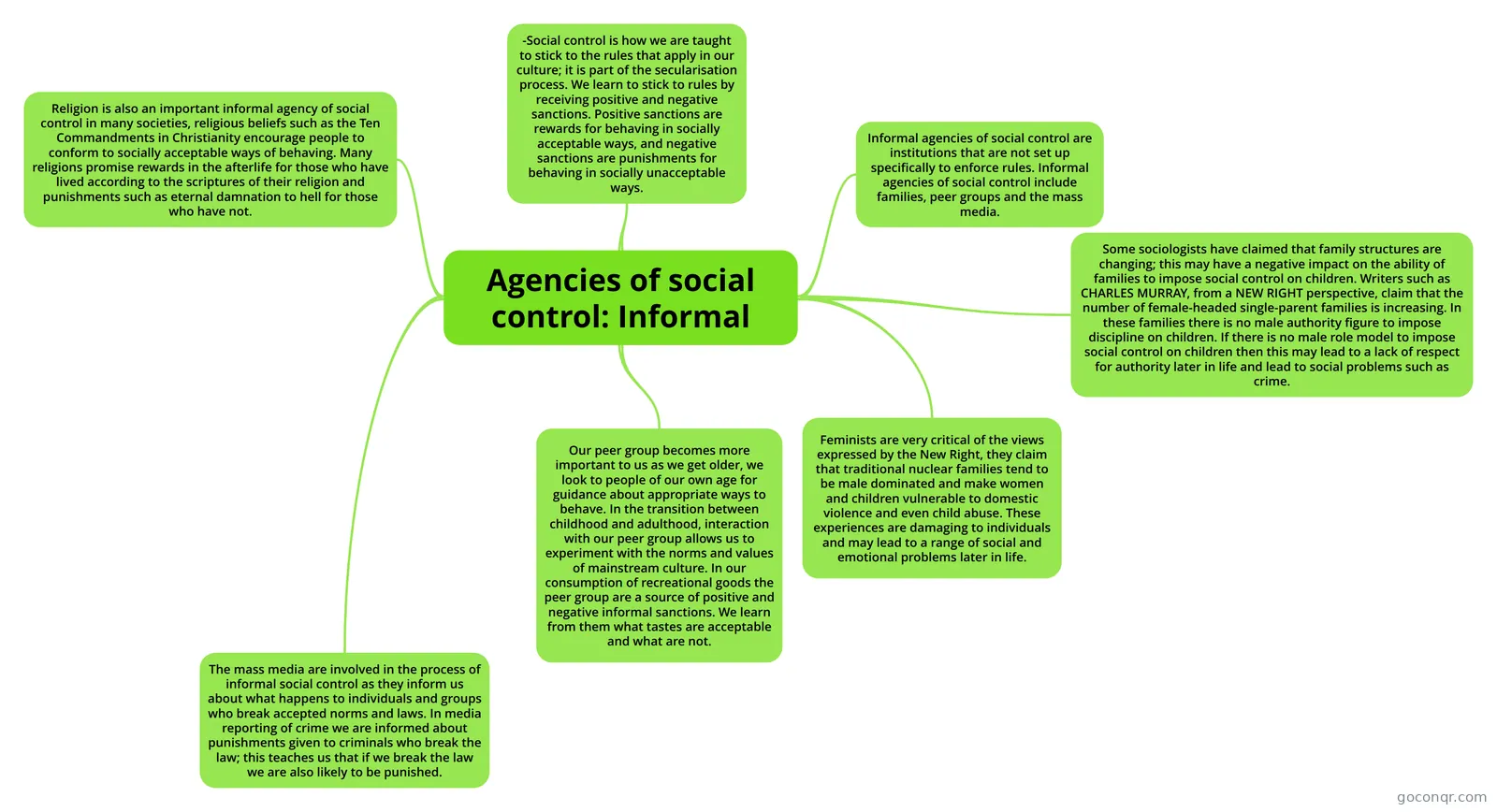
Mind map: informal agencies of social control
Inhalt der Mindmap
Agencies of social control: Informal
-Social control is how we are taught to stick to the rules that apply in our culture; it is part of the secularisation process. We learn to stick to rules by receiving positive and negative sanctions. Positive sanctions are rewards for behaving in socially acceptable ways, and negative sanctions are punishments for behaving in socially unacceptable ways.
Informal agencies of social control are institutions that are not set up specifically to enforce rules. Informal agencies of social control include families, peer groups and the mass media.
Some sociologists have claimed that family structures are changing; this may have a negative impact on the ability of families to impose social control on children. Writers such as CHARLES MURRAY, from a NEW RIGHT perspective, claim that the number of female-headed single-parent families is increasing. In these families there is no male authority figure to impose discipline on children. If there is no male role model to impose social control on children then this may lead to a lack of respect for authority later in life and lead to social problems such as crime.
Feminists are very critical of the views expressed by the New Right, they claim that traditional nuclear families tend to be male dominated and make women and children vulnerable to domestic violence and even child abuse. These experiences are damaging to individuals and may lead to a range of social and emotional problems later in life.
Our peer group becomes more important to us as we get older, we look to people of our own age for guidance about appropriate ways to behave. In the transition between childhood and adulthood, interaction with our peer group allows us to experiment with the norms and values of mainstream culture. In our consumption of recreational goods the peer group are a source of positive and negative informal sanctions. We learn from them what tastes are acceptable and what are not.
The mass media are involved in the process of informal social control as they inform us about what happens to individuals and groups who break accepted norms and laws. In media reporting of crime we are informed about punishments given to criminals who break the law; this teaches us that if we break the law we are also likely to be punished.
Religion is also an important informal agency of social control in many societies, religious beliefs such as the Ten Commandments in Christianity encourage people to conform to socially acceptable ways of behaving. Many religions promise rewards in the afterlife for those who have lived according to the scriptures of their religion and punishments such as eternal damnation to hell for those who have not.
Informationen
- Beschreibung
- Mindmap am Agencies of social control: Informal, erstellt von bryonyelgey am 10/05/2013.
- Erstellt von
- bryonyelgey
- Aufrufe
- 72
- Bewertung