
850564
Beschreibung

Mindmap von Andrew_Ellinas, aktualisiert more than 1 year ago

|
Erstellt von Andrew_Ellinas
vor mehr als 12 Jahre
|
|
Cold Environments: Periglacial
Processes and Landforms
- Periglacial: Environments experiencing long cold winters
and short warm summers, typically with permafrost but not
covered by ice (glacial)
- Permafrost
- Ground that becomes permanently frozen to depths
of over 100 meters.
- Permafrost Table: The upper surface of the permafrost.
- Active Layer: The top few centimetres of soil that may temporarily melt during summer, when temperatures briefly rise above 0 degrees C.
- Ground that becomes permanently frozen to depths
of over 100 meters.
- Periglacial Processes
- Frost Shattering and Frost Heave
- Frost Shattering: Water that expands when turned to ice-breaking apart rocks and sediments and
forming a rock-strewn landscape called a felsenmeer
- Leads to accumulation of scree at base of cliffs.
- Frost Heave: Soils become very bumpy and irregular.
Freezing soil water just below the surface
expands and pushes up the ground above.
- Frost Shattering: Water that expands when turned to ice-breaking apart rocks and sediments and
forming a rock-strewn landscape called a felsenmeer
- Nivation
- Covers a range of processes associated with snow.
- Includes the effects of frost shattering, which operates around the edges of the snow - gradually
causing the underlying rock to disintergrate.
- Meltwater removes any rock debris to reveal an ever enlarging
nivation hollow.
- Covers a range of processes associated with snow.
- Frost Shattering and Frost Heave
- Periglacial Landforms
- Solifluction Lobes
- Downslope movement of rock and soil material in response
to gravity.
- Occur in reasonably think and saturated active layer
- Downslope movement of rock and soil material in response
to gravity.
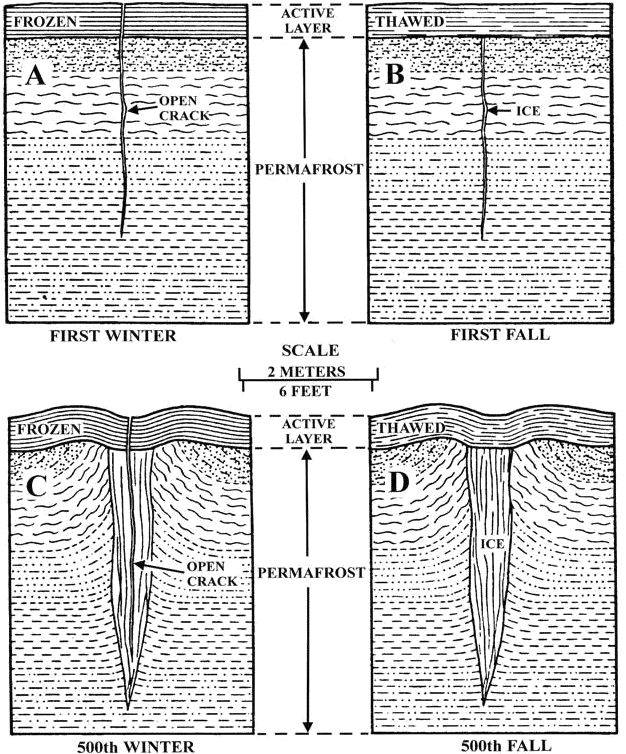
- Ice Wedges
- Meltwater flows into cracks when permafrost contracts. The
Meltwater refreezes in the winter to form ice wedges, which expand
and force the cracks to widen.
- Influence ground surface by forming narrow ridges - due
to frost heave
- Meltwater flows into cracks when permafrost contracts. The
Meltwater refreezes in the winter to form ice wedges, which expand
and force the cracks to widen.
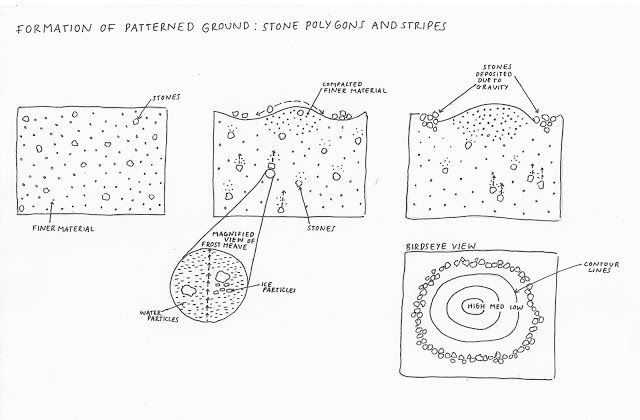
- Patterned Ground
- As ice wedges become more extensive, a polygonal
pattern may be formed on the ground surface-with ice
wedges and their ridges marking the sides of the
polygons
- Stone Polygons
- Stone Polygons tend to form on shallower slopes, and are
directly associated with ice wedges. Frost heave causes
expansions of the ground and lifts soil particles upwards.
- Stone Polygons tend to form on shallower slopes, and are
directly associated with ice wedges. Frost heave causes
expansions of the ground and lifts soil particles upwards.
- As ice wedges become more extensive, a polygonal
pattern may be formed on the ground surface-with ice
wedges and their ridges marking the sides of the
polygons
- Pingos
- Water collects underneath the ground, as the sediment gradually freezes,
the water collected becomes trapped and pressurized freezes as well.
- This expansion causes the land to lift, creating a hill or mound
- In the summer, the ice melts and forces the ground above to collapse inwards
- Can be up to 60 meters high, and 600 meters in diameter.
- Water collects underneath the ground, as the sediment gradually freezes,
the water collected becomes trapped and pressurized freezes as well.
- Solifluction Lobes
Medienanhänge
Möchten Sie kostenlos Ihre eigenen Mindmaps mit GoConqr erstellen? Mehr erfahren.