
Mindmap
HMT Characterisation
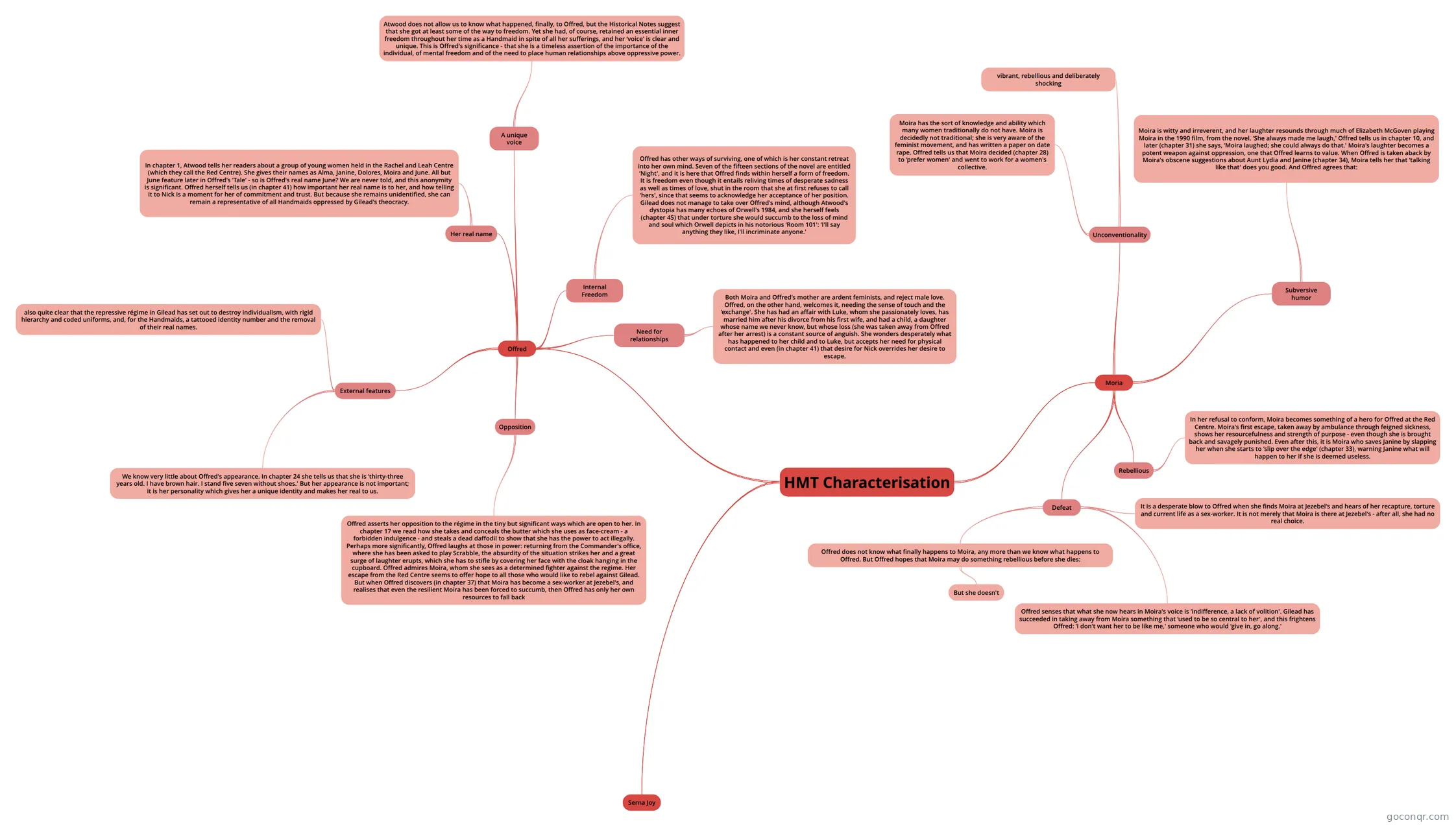
Mind map: HMT Offred characterisation
Inhalt der Mindmap
HMT Characterisation
Offred
- External features
- We know very little about Offred's appearance. In chapter 24 she tells us that she is ‘thirty-three years old. I have brown hair. I stand five seven without shoes.' But her appearance is not important; it is her personality which gives her a unique identity and makes her real to us.
- also quite clear that the repressive régime in Gilead has set out to destroy individualism, with rigid hierarchy and coded uniforms, and, for the Handmaids, a tattooed identity number and the removal of their real names.
- Her real name
- In chapter 1, Atwood tells her readers about a group of young women held in the Rachel and Leah Centre (which they call the Red Centre). She gives their names as Alma, Janine, Dolores, Moira and June. All but June feature later in Offred's ‘Tale' - so is Offred's real name June? We are never told, and this anonymity is significant. Offred herself tells us (in chapter 41) how important her real name is to her, and how telling it to Nick is a moment for her of commitment and trust. But because she remains unidentified, she can remain a representative of all Handmaids oppressed by Gilead's theocracy.
- Internal Freedom
- Offred has other ways of surviving, one of which is her constant retreat into her own mind. Seven of the fifteen sections of the novel are entitled ‘Night', and it is here that Offred finds within herself a form of freedom. It is freedom even though it entails reliving times of desperate sadness as well as times of love, shut in the room that she at first refuses to call ‘hers', since that seems to acknowledge her acceptance of her position. Gilead does not manage to take over Offred's mind, although Atwood's dystopia has many echoes of Orwell's 1984, and she herself feels (chapter 45) that under torture she would succumb to the loss of mind and soul which Orwell depicts in his notorious ‘Room 101': ‘I'll say anything they like, I'll incriminate anyone.'
- Opposition
- Offred asserts her opposition to the régime in the tiny but significant ways which are open to her. In chapter 17 we read how she takes and conceals the butter which she uses as face-cream - a forbidden indulgence - and steals a dead daffodil to show that she has the power to act illegally. Perhaps more significantly, Offred laughs at those in power: returning from the Commander's office, where she has been asked to play Scrabble, the absurdity of the situation strikes her and a great surge of laughter erupts, which she has to stifle by covering her face with the cloak hanging in the cupboard. Offred admires Moira, whom she sees as a determined fighter against the regime. Her escape from the Red Centre seems to offer hope to all those who would like to rebel against Gilead. But when Offred discovers (in chapter 37) that Moira has become a sex-worker at Jezebel's, and realises that even the resilient Moira has been forced to succumb, then Offred has only her own resources to fall back
- Need for relationships
- Both Moira and Offred's mother are ardent feminists, and reject male love. Offred, on the other hand, welcomes it, needing the sense of touch and the ‘exchange'. She has had an affair with Luke, whom she passionately loves, has married him after his divorce from his first wife, and had a child, a daughter whose name we never know, but whose loss (she was taken away from Offred after her arrest) is a constant source of anguish. She wonders desperately what has happened to her child and to Luke, but accepts her need for physical contact and even (in chapter 41) that desire for Nick overrides her desire to escape.
- A unique voice
- Atwood does not allow us to know what happened, finally, to Offred, but the Historical Notes suggest that she got at least some of the way to freedom. Yet she had, of course, retained an essential inner freedom throughout her time as a Handmaid in spite of all her sufferings, and her ‘voice' is clear and unique. This is Offred's significance - that she is a timeless assertion of the importance of the individual, of mental freedom and of the need to place human relationships above oppressive power.
- External features
Moria
- Rebellious
- In her refusal to conform, Moira becomes something of a hero for Offred at the Red Centre. Moira's first escape, taken away by ambulance through feigned sickness, shows her resourcefulness and strength of purpose - even though she is brought back and savagely punished. Even after this, it is Moira who saves Janine by slapping her when she starts to ‘slip over the edge' (chapter 33), warning Janine what will happen to her if she is deemed useless.
- Unconventionality
- vibrant, rebellious and deliberately shocking
- Moira has the sort of knowledge and ability which many women traditionally do not have. Moira is decidedly not traditional; she is very aware of the feminist movement, and has written a paper on date rape. Offred tells us that Moira decided (chapter 28) to ‘prefer women' and went to work for a women's collective.
- Subversive humor
- Moira is witty and irreverent, and her laughter resounds through much of Elizabeth McGoven playing Moira in the 1990 film, from the novel. ‘She always made me laugh,' Offred tells us in chapter 10, and later (chapter 31) she says, ‘Moira laughed; she could always do that.' Moira's laughter becomes a potent weapon against oppression, one that Offred learns to value. When Offred is taken aback by Moira's obscene suggestions about Aunt Lydia and Janine (chapter 34), Moira tells her that ‘talking like that' does you good. And Offred agrees that:
- Defeat
- It is a desperate blow to Offred when she finds Moira at Jezebel's and hears of her recapture, torture and current life as a sex-worker. It is not merely that Moira is there at Jezebel's - after all, she had no real choice.
- Offred senses that what she now hears in Moira's voice is ‘indifference, a lack of volition'. Gilead has succeeded in taking away from Moira something that ‘used to be so central to her', and this frightens Offred: ‘I don't want her to be like me,' someone who would ‘give in, go along.'
- Offred does not know what finally happens to Moira, any more than we know what happens to Offred. But Offred hopes that Moira may do something rebellious before she dies:
- But she doesn't
- Rebellious
Serna Joy
Informationen
- Beschreibung
- English - AO2 Mindmap am HMT Characterisation, erstellt von Alice Vincent am 15/04/2017.
- Erstellt von
- Alice Vincent
- Aufrufe
- 9
- Bewertung
Mehr zu Offred Character Analysis