
Mindmap
Mediators gibbs
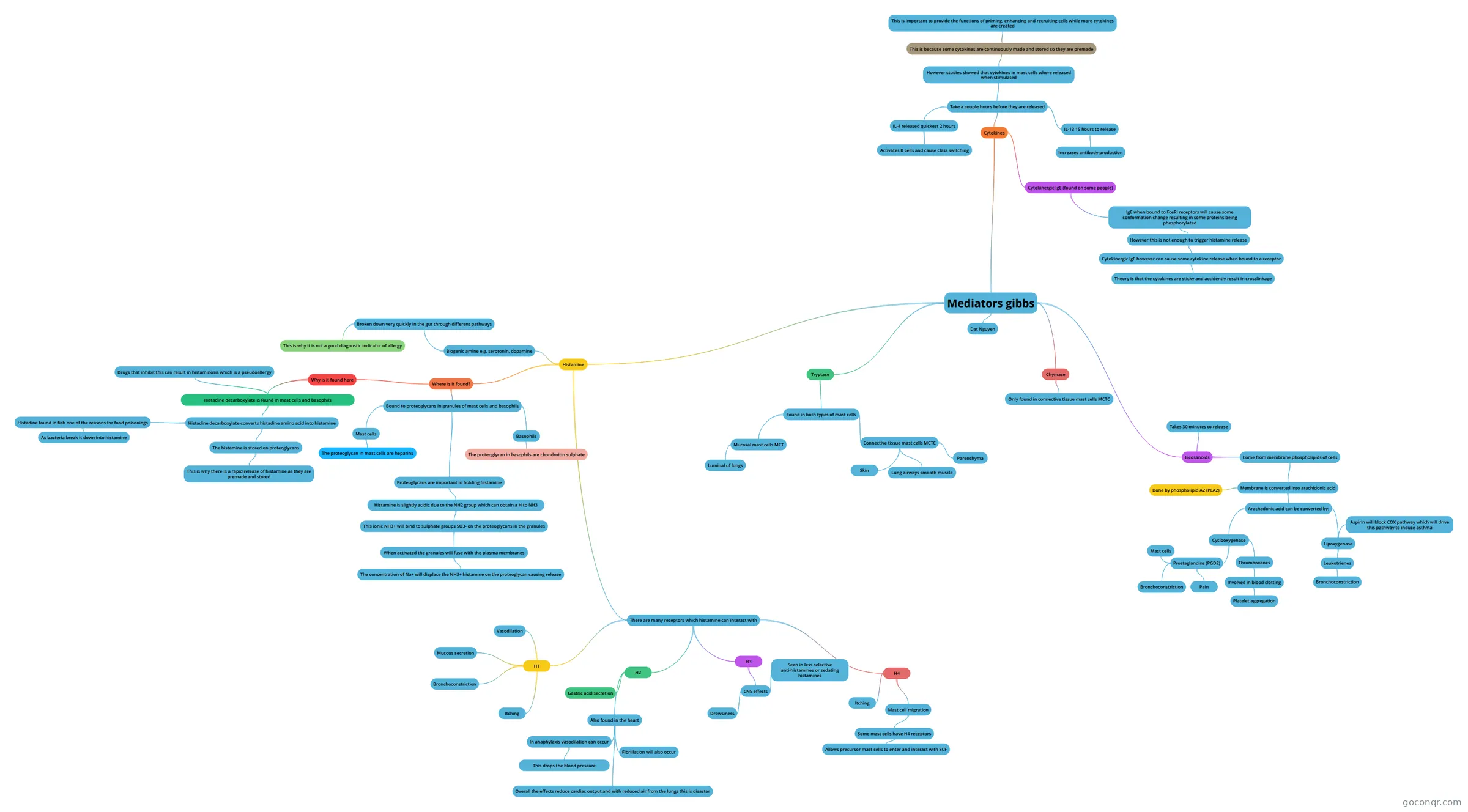
Mind map: Gibbs mediators
Inhalt der Mindmap
Mediators gibbs
Histamine
- Biogenic amine e.g. serotonin, dopamine
- Broken down very quickly in the gut through different pathways
- This is why it is not a good diagnostic indicator of allergy
- Broken down very quickly in the gut through different pathways
- Where is it found?
- Bound to proteoglycans in granules of mast cells and basophils
- Mast cells
- The proteoglycan in mast cells are heparins
- Basophils
- The proteoglycan in basophils are chondroitin sulphate
- Proteoglycans are important in holding histamine
- Histamine is slightly acidic due to the NH2 group which can obtain a H to NH3
- This ionic NH3+ will bind to sulphate groups SO3- on the proteoglycans in the granules
- When activated the granules will fuse with the plasma membranes
- The concentration of Na+ will displace the NH3+ histamine on the proteoglycan causing release
- When activated the granules will fuse with the plasma membranes
- This ionic NH3+ will bind to sulphate groups SO3- on the proteoglycans in the granules
- Histamine is slightly acidic due to the NH2 group which can obtain a H to NH3
- Mast cells
- Why is it found here
- Histadine decarboxylate is found in mast cells and basophils
- Histadine decarboxylate converts histadine amino acid into histamine
- The histamine is stored on proteoglycans
- This is why there is a rapid release of histamine as they are premade and stored
- Histadine found in fish one of the reasons for food poisonings
- As bacteria break it down into histamine
- The histamine is stored on proteoglycans
- Drugs that inhibit this can result in histaminosis which is a pseudoallergy
- Histadine decarboxylate converts histadine amino acid into histamine
- Histadine decarboxylate is found in mast cells and basophils
- Bound to proteoglycans in granules of mast cells and basophils
- There are many receptors which histamine can interact with
- H1
- Mucous secretion
- Bronchoconstriction
- Itching
- Vasodilation
- H2
- Gastric acid secretion
- Also found in the heart
- In anaphylaxis vasodilation can occur
- This drops the blood pressure
- Fibrillation will also occur
- Overall the effects reduce cardiac output and with reduced air from the lungs this is disaster
- In anaphylaxis vasodilation can occur
- H3
- CNS effects
- Drowsiness
- Seen in less selective anti-histamines or sedating histamines
- CNS effects
- H4
- Itching
- Mast cell migration
- Some mast cells have H4 receptors
- Allows precursor mast cells to enter and interact with SCF
- Some mast cells have H4 receptors
- H1
- Biogenic amine e.g. serotonin, dopamine
Dat Nguyen
Eicosanoids
- Come from membrane phospholipids of cells
- Membrane is converted into arachidonic acid
- Done by phospholipid A2 (PLA2)
- Arachadonic acid can be converted by:
- Cyclooxygenase
- Prostaglandins (PGD2)
- Mast cells
- Bronchoconstriction
- Pain
- Thromboxanes
- Involved in blood clotting
- Platelet aggregation
- Involved in blood clotting
- Prostaglandins (PGD2)
- Lipoxygenase
- Leukotrienes
- Bronchoconstriction
- Aspirin will block COX pathway which will drive this pathway to induce asthma
- Leukotrienes
- Cyclooxygenase
- Membrane is converted into arachidonic acid
- Takes 30 minutes to release
- Come from membrane phospholipids of cells
Cytokines
- Take a couple hours before they are released
- IL-4 released quickest 2 hours
- Activates B cells and cause class switching
- IL-13 15 hours to release
- Increases antibody production
- However studies showed that cytokines in mast cells where released when stimulated
- This is because some cytokines are continuously made and stored so they are premade
- This is important to provide the functions of priming, enhancing and recruiting cells while more cytokines are created
- This is because some cytokines are continuously made and stored so they are premade
- IL-4 released quickest 2 hours
- Cytokinergic IgE (found on some people)
- IgE when bound to FceRi receptors will cause some conformation change resulting in some proteins being phosphorylated
- However this is not enough to trigger histamine release
- Cytokinergic IgE however can cause some cytokine release when bound to a receptor
- Theory is that the cytokines are sticky and accidently result in crosslinkage
- Cytokinergic IgE however can cause some cytokine release when bound to a receptor
- However this is not enough to trigger histamine release
- IgE when bound to FceRi receptors will cause some conformation change resulting in some proteins being phosphorylated
- Take a couple hours before they are released
Tryptase
- Found in both types of mast cells
- Mucosal mast cells MCT
- Luminal of lungs
- Connective tissue mast cells MCTC
- Skin
- Lung airways smooth muscle
- Parenchyma
- Mucosal mast cells MCT
- Found in both types of mast cells
Chymase
- Only found in connective tissue mast cells MCTC
Informationen
- Beschreibung
- ACS2 (Gibbs) Mindmap am Mediators gibbs, erstellt von Dat Nguyen am 26/04/2017.
- Erstellt von
- Dat Nguyen
- Aufrufe
- 1
- Bewertung