
8848784
Beschreibung

Mindmap von Florence Papworth, aktualisiert more than 1 year ago

|
Erstellt von Florence Papworth
vor mehr als 9 Jahre
|
|
Hormones of the kidney
- Learning objectives
- Antidiuretic hormone
- Renin-angiotensin-aldosterone system
- Antidiuretic hormone
- Antidiuretic hormone
(ADH/vasopressin)
- released in response to osmolarity
changes in plasma
- plasma osmolarity detected by osmoreceptors
- osmoreceptors - located
in hypothalamus
- osmoreceptors - located
in hypothalamus
- osmoreceptors regulate release
of ADH from neuroendocrine
cells
- ADH released from posterior
pituitary
- released in response to osmolarity
changes in plasma
- ADH function
- excess fluid lowers body fluid
osmolarity
- fluid deprivation increases
fluid osmolarity
- fluid deprivation increases
fluid osmolarity
- changes in osmolarity lead to
appropriate changes in ADH
release
- At normal plasma osmolarity - ADH
present in blood
- At normal plasma osmolarity - ADH
present in blood
- Increase in osmolarity = increases
circulating levels of ADH -> increase
water reabsorption
- Decrease in osmolarity = reduced
circulating levels of ADH -> decreased
water reabsorption
- Acts on collecting duct
- excess fluid lowers body fluid
osmolarity
- ADH and blood
pressure
- ADH release also under
influence of blood pressure
- Negative feedback from
BARORECPETORS via MEDULLA
- pathway = baroreceptor ->
medulla -> hypothalamus ->
posterior pituitary -> ADH!
- pathway = baroreceptor ->
medulla -> hypothalamus ->
posterior pituitary -> ADH!
- Increase in arterial BP ->
reduction of ADH release
- higher water concentration increases the
volume and pressure blood
- higher water concentration increases the
volume and pressure blood
- not as an effective
stimulus as osmolarity
changes
- ADH release also under
influence of blood pressure
- Role of ADH
- normal osmolarity ~ 290 mosmol/L
- excess fluid ingestion
- decreased ECF osmolarity
- HYPOTHALAMIC OSMORECEPTOR
- reduced ADH release
- collecting ducts impermeable to water
- water reabsorption decreased
- water reabsorption decreased
- collecting ducts impermeable to water
- increased ADH release
- collecting ducts permeable to water (using urea)
- water reabsorbtion increased
- water reabsorbtion increased
- collecting ducts permeable to water (using urea)
- reduced ADH release
- HYPOTHALAMIC OSMORECEPTOR
- decreased ECF osmolarity
- water deprivation
- increased ECF osmolarity
- increased ECF osmolarity
- excess fluid ingestion
- normal osmolarity ~ 290 mosmol/L
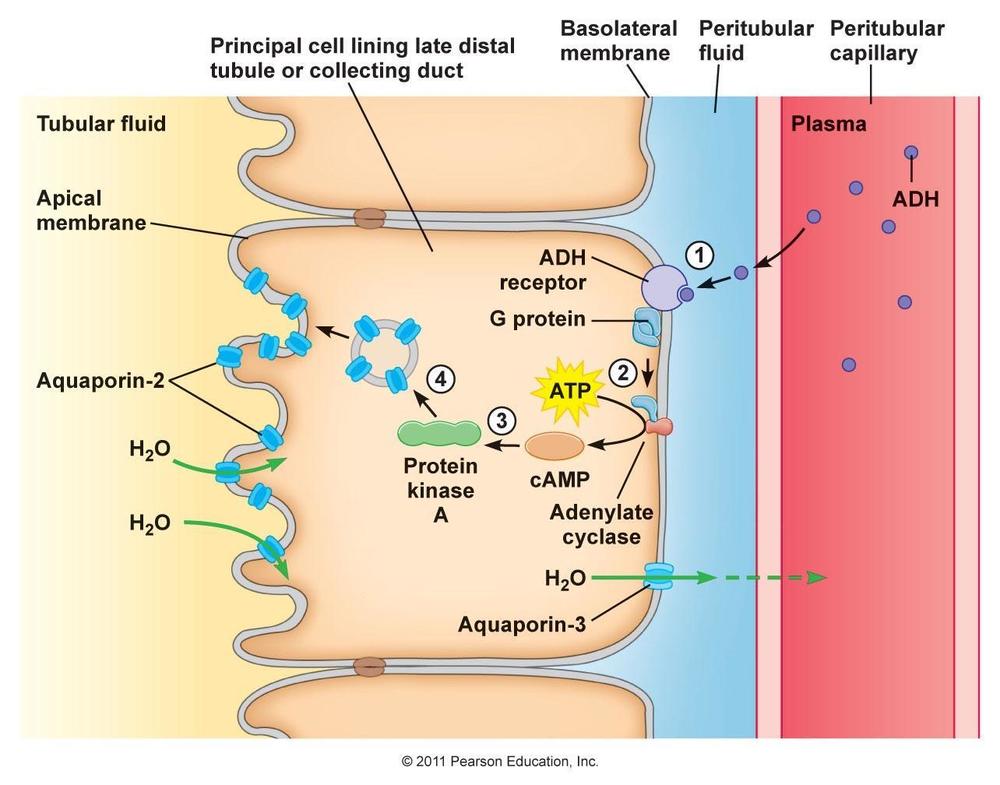
- ADH on
principal cells
- ADH receptor detects ADH in
peritubular fluid/capillary
- ADH channels internalised
- Urea brought into the cell using proteins
- increased aquaporin expression -
increased water reabsorption
- decreased volume of
urine produced
- decreased volume of
urine produced
- increased aquaporin expression -
increased water reabsorption
- ADH channels internalised
- ADH receptor detects ADH in
peritubular fluid/capillary
- Control of circulating ADH
- ADH responds within
minutes to changes in
osmolarity
- For an effective regulatory system
ADH must be rapidly removed from
blood
- Half life of ADH = 15 minutes
- removed by
kidneys or
metabolised
- Half life of ADH = 15 minutes
- Release effected by:
- NICOTINE increases ADH release, as do
barbiturates and morphine
- Alcohol - decrease ADH release?
- DISORDERS:
- diabetes insipidus
- central - production of
ADH affected
- Nephrohrogenic - renal
response to ADH affected
- central - production of
ADH affected
- diabetes insipidus
- NICOTINE increases ADH release, as do
barbiturates and morphine
- ADH responds within
minutes to changes in
osmolarity
- Regulation of body fluid -
Hormonal influences
- Aldosterone
- Renin-angiotensin
- Atrial natriuretic peptide
- Regulation of ECF volume
- levels of sodium must be
regulated (total sodium
determines total body water)
- no good evidence for sodium receptor -
regulation via OSMORECEPTORS and volume of
ECF
- no good evidence for sodium receptor -
regulation via OSMORECEPTORS and volume of
ECF
- levels of sodium must be
regulated (total sodium
determines total body water)
- increased Na+ intake -> increased Na+ in
ECF --> increased osmolarity of ECF
- osmoreceptors
- increased ADH, increased water retention
combined with increased thirst and fluid intake
--> increased volume of ECF
- increased ADH, increased water retention
combined with increased thirst and fluid intake
--> increased volume of ECF
- osmotic withdrawl of
water from cells
- osmoreceptors
- Aldosterone
- Regulation of body
fluid -adolsterone
- body fluid regulated by
renin-angiotensin-aldosterone
system
- ALDOSTERONE- produced in ADRENAL
CORTEX
- stimulates Na+ reabsorption in
distal parts of nephron
- promotes H+ and K+
secretion (via H+K+ATPase)
- promotes Na+ reabsorption
from colon, gastric glands and
sweat glands
- i.e. increases net Na+ reabsorption so
increases body fluid volume via
osmolarity changes and hence osmosis
- stimulates Na+ reabsorption in
distal parts of nephron
- body fluid regulated by
renin-angiotensin-aldosterone
system
- Aldosterone- nephron
and adrenal cortex
- Nephron
- increased Na+ reabsorption in DISTAL
TUBULE and COLLECTING DUCT
- up regulation of : Na channels and
Na/K pump activity
- K+ secretion
- increased Na+ reabsorption in DISTAL
TUBULE and COLLECTING DUCT
- Adrenal cortex
- Acts on distal tubule =
increased K+ secretion in urine
- Allosteric, negative feedback loop -
increased pottassium secretion inhibits
aldosterone release vice versa
- Acts on distal tubule =
increased K+ secretion in urine
- Nephron
- Renin-angiotension system
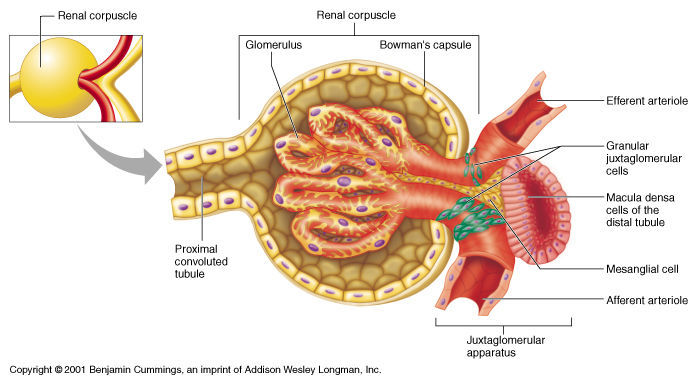
- renin - an enzyme - produced by
JUXTAGLOMERULAR APPARATUS
- Released into plasma when body Na+ is reduced
- Stimulus for release is NOT Na+ itself
- via effective circulating volume ECV - as
Na+ determine this
- via effective circulating volume ECV - as
Na+ determine this
- low Na+ causes
renin release
- increased sympathetic release
causes renin release
- granulosa
cells
produce
renin
- granulosa
cells
produce
renin
- increased sympathetic release
causes renin release
- Decrease in sodium -> decrease in ECF
- sympathetic activity
- afferent arteriolar pressure
- RENIN RELEASE
- RENIN RELEASE
- Na+ at macula densa
- sympathetic activity
- renin - an enzyme - produced by
JUXTAGLOMERULAR APPARATUS
- Activation of R-A-S
- Decrease in Na content ->
Decrease in ECV
- increased
sympathetic
activity
- Lower Na+ at
macula densa
- collection specialised epithelial
cells in distal convoluted tubule,
detect sodium concentration
- collection specialised epithelial
cells in distal convoluted tubule,
detect sodium concentration
- decreased afferent
arteriolar pressure
- increased
sympathetic
activity
- RENIN RELEASE
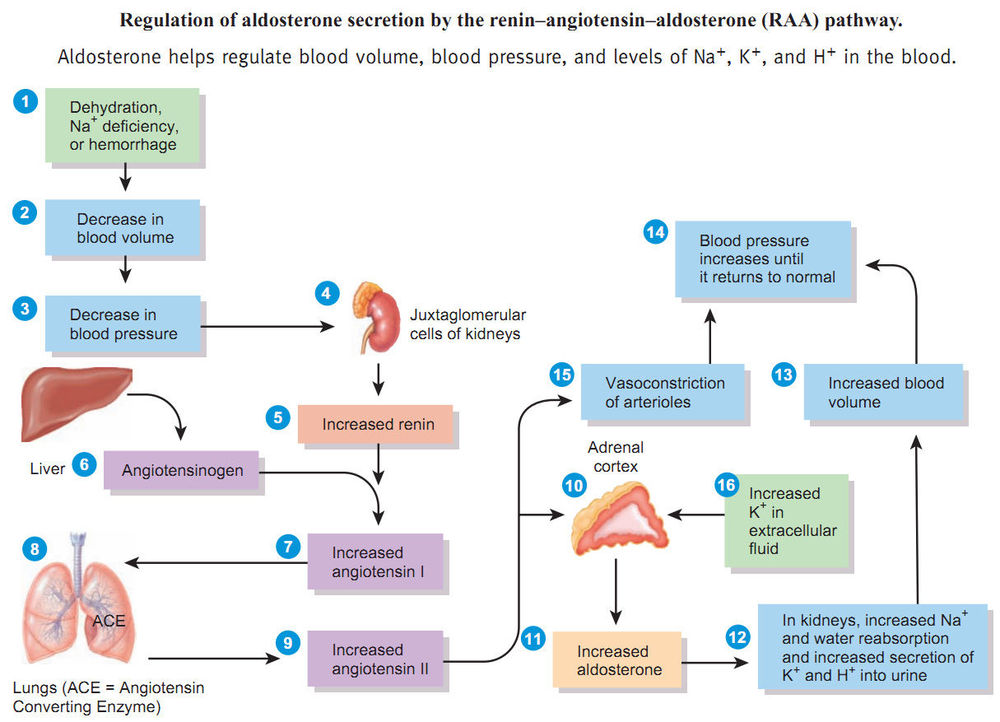
- 1. renin acts on angiotensin acts on
angiotensiongen in blood to split off
angiotensin 1
- 2. ACE enzyme in lungs converts
angiotensin 1 - angiotensin 2
- 3. Angiotensin 2 has many effects
that lead to ECV increase
- 3. Angiotensin 2 has many effects
that lead to ECV increase
- 2. ACE enzyme in lungs converts
angiotensin 1 - angiotensin 2
- 1. renin acts on angiotensin acts on
angiotensiongen in blood to split off
angiotensin 1
- Decrease in Na content ->
Decrease in ECV
- Angiotensinogen
- combines with renin to form
angiotensin 1
- ACE converting enzyme
converts angiotensin 1 -->
angiotensin 2
- ACE converting enzyme
converts angiotensin 1 -->
angiotensin 2
- Angiotensin 2 causes:
- vasoconstriction
- increased adolsterone
- increased ADH = increased thirst
- increased Na+
reabsorption
- decreased GFR
- increase fluid volume - increases
blood pressure till stabilised to
normal levels
- vasoconstriction
- combines with renin to form
angiotensin 1
Medienanhänge
Möchten Sie kostenlos Ihre eigenen Mindmaps mit GoConqr erstellen? Mehr erfahren.