
Mindmap
Major Divisions of the Brain

Inhalt der Mindmap
Major Divisions of the Brain
Telencephalon
- -Largest division -Complex functions (purposeful behaviour, language, perception) -Produces and inhibits emotions
- Cerebral Cortex (Cortical)
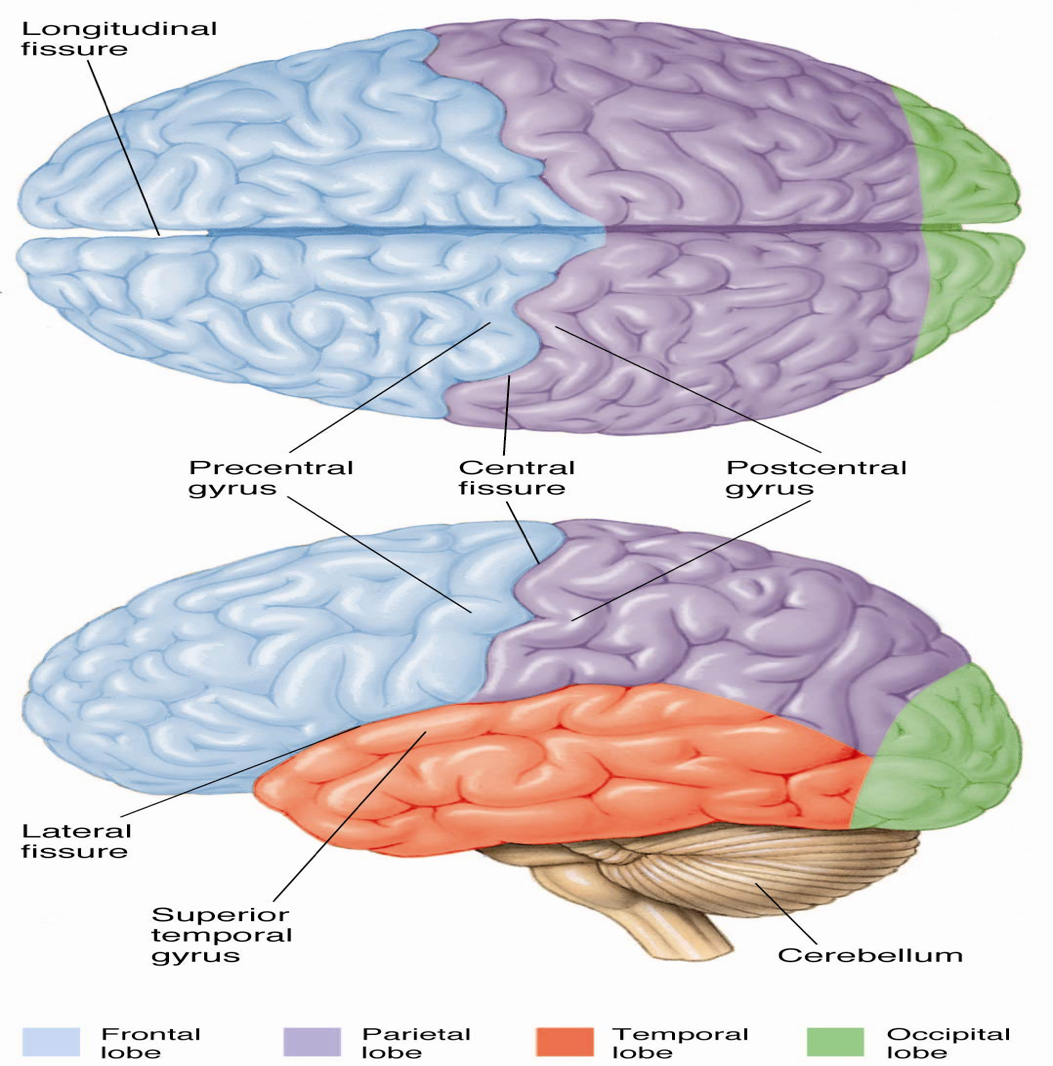
- -Convolutions to +surface area -Longitudinal fissure: separates hemispheres -Corpus callosum: connects hemispheres -Central fissure (horizontal) and Lateral fissure: separate 4 lobes -Gyri: small ridges/protrusions
- Frontal Lobe
- -Executive planning -Complex cognition -Motor control -Emotion inhibition
- Precentral Gyrus (motor strip)
- -Controls motor movements, speech sounds, etc.
- Prefrontal Cortical Regions
- -Complex cognition (planning, evaluating, assessing behav. of others, inhibition of inappropriate behav.) -"Ego" and "Superego" -Damaged by continuous drinking (Korsokoff's syndrome - no inhibition)
- Occipital Lobe
- -Vision
- Visual Cortex
- -Divided by calcerine sulcus -Very back of brain -Processes visual info
- Parietal Lobe
- -Proprioceptive functions (info about position of body relative to environment)
- Post-Central Gyrus
- -Analysing sensations from body
- Temporal Lobe
- -Emotions (fear and aggression) -Epilepsy
- Superior Temporal Gyrus
- -Hearing/auditory perception -Language comprehension
- Inferior Temporal Gyrus
- -Complex visual patterns
- Medial Temporal Gyrus
- -Encoding certain memories
- Limbic System (Subcortical)
- -Motivated behaviours (4 F's)
- Amygdala
- -Anterior temporal lobe -Produces emotions (fear & aggression) -Conditioned fear learning & fear expression (damage = inability to express/detect normal fear)
- Lateral Nuclei
- Basal Nuclei
- Central Nuclei
- Hippocampus
- -Medial temporal lobe -Transfers short-term memories to declarative & explicit long-term memories (ex/ patient HM not forming new explicit memories after hippocampus removal) -Korsakoff's Syndrome: drinking damages hippocampus and leads to memory problems -Contextual fear learning -Spatial cue memory
- Fornix
- Cingulate Cortex
- Septum
- -Midline nucleus near cingulate cortex -Fibres connect it to amygdala, hippocampus, & hypothalamus -Aggression, rage, anxiety, stress, Alzheimer's
- Mammillary Bodies
- Basal Ganglia (Subcortical)
- -Modulates motor output -Fine motor control -Planned & purposeful movements -Cognitive functions (Projects to cortical areas)
- Amygdala
- -Works with nucleus accumbens to produce motivational behav.
- Striatum
- -Caudate + putamen (they appear striped) -Linked to substantia niagra (SN) in a dopamine pathway (deterioration leads to Parkinson's)
- Putamen
- -Centre of caudate (connected by fibre bridges)
- Caudate
- -C-shaped -includes the putamen
- Nucleuss Accumbens
- -Rewarding behaviours (drugs, food, etc) -Receives dopamine input from VTA and amygdala
- Shell
- Core
- Globus Pallidus
- -Medial to putamen -Pale & circular -Linked to SN in dopamine pathway
Mesencephalon
- Midbrain
- Tectum
- -The "roof"
- Inferior Colliculi
- -Receives & processes auditory info
- Superior Colliculi
- -Processes visual info
- Tegmentum
- -Ventral to tectum
- Periaquiductal Gray (PAG)
- -Opioid receptors mediate pain -Where morphine binds to; mediates bain via descending pathways -Emotionality & fear expression (circa-strike attacks & aggression, fear-induced defensive freezing)
- Substantial Niagra (SN)
- -Important in sensorimotor system -Loss of dopamine-producing neurons leads to Parkinson's
- Nigro-Striatal Dopamine Pathway
- Ventral Tegmental Area (VTA)
- -Projects to cortical & limbic regions -Connects with accumbens to produce rewarding effects & addictive behaviours
- Mesocortico-limbic Dopamine Pathway
- -Stress & conditioned stress behavioural responses -Stressor = +dopamine to mPFC = disrupts cognition & planning -Overactive DA pathways may be linked to schizophrenia/paranoid behaviours
- Reticular Formation (anterior aspects)
- Red Nucleus
- -Connects to cerebellum -Descending projections to brain stem & spinal cord -Posture, balance, coordinated movements
Myelencephalon (Medulla)
- -Most posterior division
- Fibre Tracts
- -Carry signals btn rest of brain & body
- Reticular Formation
- -Comprised of 100 sub-nuclei in core of brainstem -Sleep & attention -Movement -Muscle tone -Reflexes (heartbeat, breathing, etc)
Diencephalon
- Thalamus
- -Relays sensory info to cortex, limbic system, & basal ganglia (lik a switchboard)
- Lateral Geniculate Nucleus (LGN)
- -Relays visual info
- Medial Geniculate Nucleus (MGN)
- -Relays auditory info
- Ventral Posterior Nucleus (VPN)
- -Relays somatosensory info (touch, pressure, pain, temp)
- Posterior Intralaminar Nucleus (PIN) and Central Nucleus (CNT)
- -Relay nociceptive (pain) info to amygdala & parietal cortex
- Hypothalamus
- -Regulates motivated behaviours (ex/ brain-stimulation-reward in rats) -Hormone release via pituitary and adrenal glands
- Thalamus
Metencephalon
- Brainstem
- Ascending/Descending Fibre Tracts
- Pons
- -Regulates acoustic startle response to loud noises -Heart activity during fear/arousal
- Cerebellum
- -Balance & coordination (sensorimotor functions)
Bilder und Dateien der Mindmap
Informationen
- Beschreibung
- Mindmap am Major Divisions of the Brain, erstellt von Megan Fairbairn am 19/05/2017.
- Erstellt von
- Megan Fairbairn
- Aufrufe
- 357
- Bewertung