
Notizen
Punishment
Inhalt der Notizen (5)
Seite 1
Goodbye Death Penalty
Throughout history, from the Anglo-Saxons to the early modern period when executions started to decline. The ultimate punishment was always the death penalty. In the 1830s, the only crimes that could be punished under the death penalty were murder and treason; this was due to the Bloody Code being abolished.
From 1840, there were roughly fifteen executions per year. Attempts to abolish the death penalty altogether were made throughout the 1800s and early 1900s. Finally, it was abolished in the mid-20th century.
The Homicide Act 1957 restricted the death penalty for the most severe murder cases - capital murders. Capital murders were:
committing two murders on separate occassions
committing murder while committing theft
murdering someone whilst resisting arrest
killing someone by firing a gun
killing a prison officer or member of the police
This resulted in the number of executions in Britain falling to an average of four per year.
In 1965, the Murder Act was passed and this led to the suspension of the death penalty for murder for five years. In 1969, an amendment to the Murder Act 1965 made this decision permanent and the death penalty was abolished for most crimes. It was not until 1998 that the death penalty ended for all criminal offences.
Seite 2
Changing Attitudes
In government the opinions over the use of the death penalty were divided. The House of Commons passed bills to abolish the death penalty in both 1948 and 1956, but both bills were vetoed by the House of Lords.
Home Secretary, Roy Jenkins, was a key figure in the abolition of the death penalty. Further, as the 20th century progressed, laws regarding children began to change also. People believe that children should be treated alternatively to adults and less severely too. The Young Person's Act 1933 put the age limit for the death penalty at 18, after the 1908 Children's Act set it at 16. In 1963, the age of criminal responsibility was raised from 8 to 10. These developing attitudes in Britain can be seen as the growth of a more liberal agenda in the government during the 20th century.
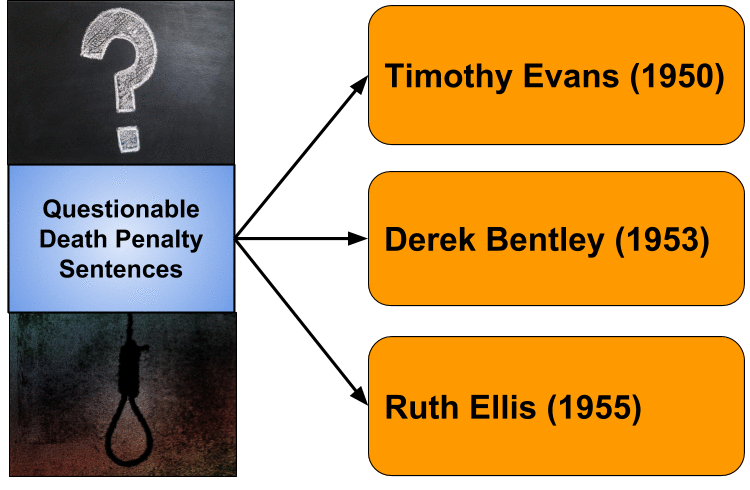
False Accusations -
Timothy Evans: http://www.bbc.co.uk/blogs/wales/entries/cdc56160-91eb-366d-ae0e-5d9c5a676fe2
Derek Bentley: http://news.bbc.co.uk/onthisday/hi/dates/stories/january/28/newsid_3393000/3393807.stm
Ruth Ellis: http://news.bbc.co.uk/onthisday/hi/dates/stories/july/13/newsid_2745000/2745023.stm
Seite 3
The Prison System
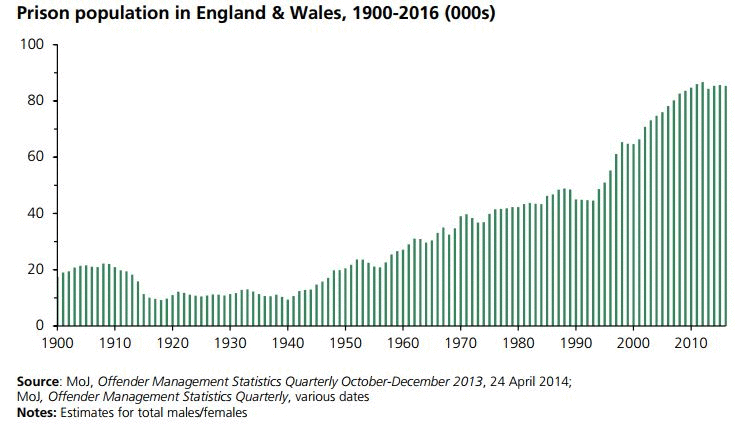
During first half of the 20th century the British government went about developing new penal policies that emphasised a process of reform rather than punishment for individuals. Young criminal offenders were removed from the adult section of the justice system and were offered opportunities of probation in 1907. Probation is where an offender is released early from custody due to a period of good behaviour.
Schools known as Borstal schools were opened up in 1902, the first one in Kent. The aim of these schools was to turn young offenders into upright, respected citizens. Rules were relaxed so that prisoners could attempt to lead normal lives. At this time, unemployment and family problems often led to previous prisoners getting back into a life of crime. They were given meaningful roles of work (including pay) and more frequent family visits.
Even with these new measures, for example, the open prison in New Hall, Wakefield which opened in 1933, crime continued to increase. Young people often found themselves involved in violent crime, including football hooliganism.
Borstals:
These were prisons only for boys, first established in 1902. They were set up as a national system under the 1908 Prevention of Crime Act. Borstals emphasised education in the process of reform. Reoffending rates were estimated at around 30% in the 1930s, but 60% today. The borstal system was abandoned under the Criminal Justice Act of 1982.
Reform:
Moving into the 1940s, the Labour government was more fixated on ideas of reform rather than punishment. They improved the system and opportunities for probation. They amended the Criminal Justice Act in 1948: graduated prison system (dependent on the severity of a crime), detention centres to deter young criminals and attendance centres where young people would go for rehabilitation on the weekends.
More government reforms in the 1960s, favoured the treatment of young offenders by probation officers and social workers. The Children and Young Persons Act 1963 and 1969 altered the means of treatment for young criminals. The government wanted more of a focus on protecting and caring for these young children and understanding why they would get involved in a life of crime.
Seite 4
The Prison System
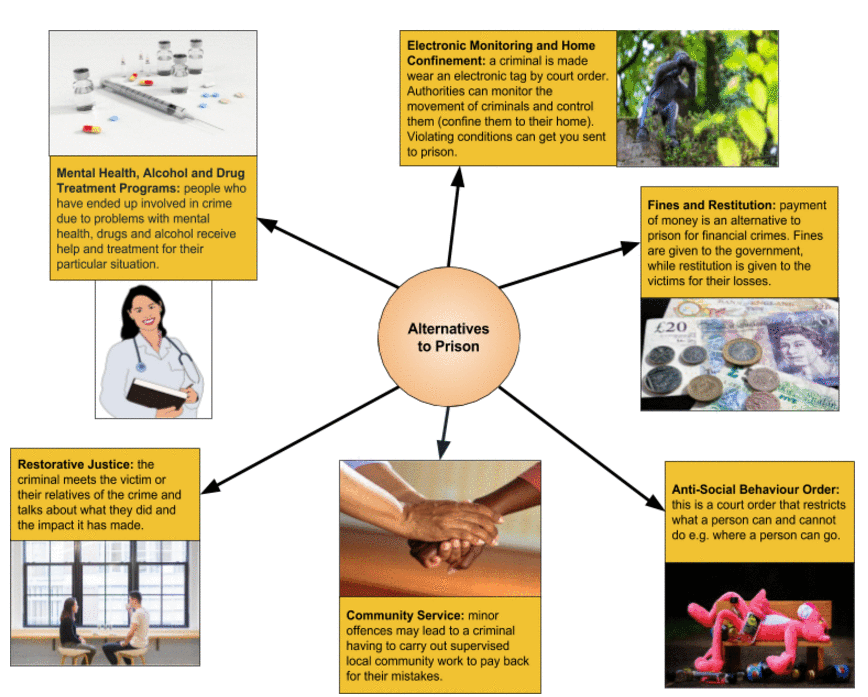
The alternative ideas to prison was a system meant to give a chance to criminal offenders to change their ways and go through reform and rehabilitation. These are preferred means of treatment in a lot of cases for prisoners with minor offences.
Seite 5
The Courts
Juvenile Courts:
These courts deal with offenders under the age of 18, who are deemed over the age of criminal responsibility (10). These offenders are either held in a Secure Children's Home (SCH), a Secure Training Centre (STC) or a Young Offender Institution (YOI) before standing trial. The principal aim of the system is to prevent children and young persons from committing criminal offences.
These courts are less formal than adult courts as members of the public are not allowed be present and the young offender must be accompanied by a parent or guardian. Most common crimes amongst youth are:
theft and burglary
drug offences
anti-social behaviour
The range of sentences of the court varies from community sentences to detention and training orders. Moreover, moving into the 20th century the local courts system came to an end. A more centralised system was established.
Crown Prosecution Service (CPS):
This system was formed in 1986 and acts as the principal public body for prosecuting criminals in England and Wales. The main role of the CPS is to provide legal advice to police and other investigative bodies during criminal investigations. This leads to a decision being made on whether a suspects should face criminal charges following an investigation.
According to http://www.cps.gov.uk/about/:
The CPS:
decides which cases should be prosecuted – keeping them all under continuous review;
determines the appropriate charges in more serious or complex cases – advising the police during the early stages of investigations;
prepares cases and presents them at court - using a range of in-house advocates, self-employed advocates or agents in court; and
provides information, assistance and support to victims and prosecution witnesses.
Juries:
Trial by a jury has evolved over the centuries from when it was first established. The Administration of Justice Act 1933 guaranteed the right of trial by jury for a number of crimes. The number of jurors varies within the Crown Court, High Court, County Court and Coroner's Court

Informationen
- Beschreibung
- Der Nutzer hat seine Fachbereichs-Information gelöscht. Notiz am Punishment , erstellt von Gelöschter Nutzer am 18/08/2017.
- Erstellt von
- Gelöschter Nutzer
- Aufrufe
- 23
- Verlauf
-
- Erstellt von Andrew Burke · 16 Aug 2017
- Kopiert von Andrew Burke · 18 Aug 2017
- Bewertung