
Notizen
chapter 16 Essay Complements
Inhalt der Notizen (1)
Seite 1
Complement System
The complement system consists of a group of serum proteins that activate one another to destroy invading microorganisms. Serum is the remaining liquid remaining after blood plasma is clotted.
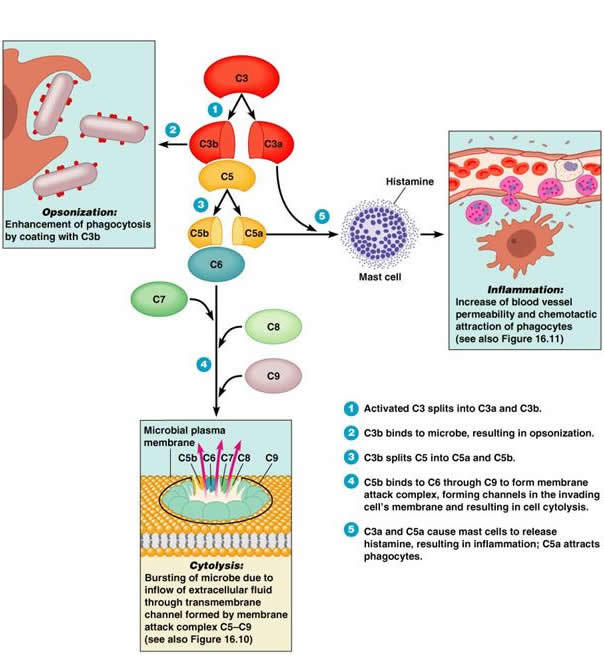
There are three pathways to complement activation but they all end up forming a C3 convertase complex which activates C3 and results in three things:
inflammation
opsonization
cell lysis.
C3 is cleaved to C3a and C3b
C3a stimulates inflammation
C3b opsonizes and cleaves C5 to produce C5a and C5b
C5a stimulates inflammation
C6,C7,C7, and C9 associatet o form the MAC, which causes cell lysis
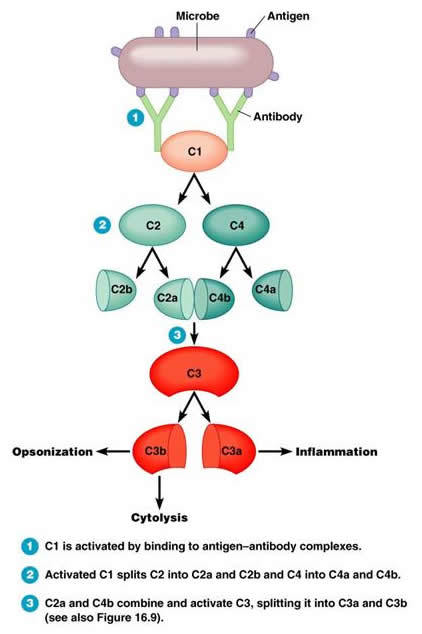
Classical Pathway:
C1 binds to antigen---antibody complexes (antibody binding to antigen is called antigen fixation; when an antigen-antibody complex binds C1 this is called complement fixation)
C2 and C4 associate and this acts as C3 convertase
Alternative Pathway
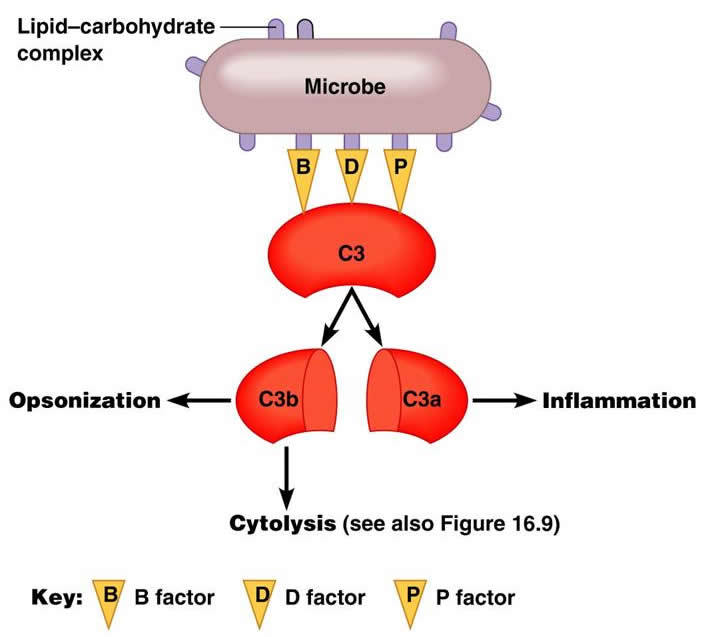
Factor B, factor D, factor P, and C3b bind to certain cell wall polysaccharides (i.e. peptidoglycan) to activate C3b
C3 undergoes autolysis to provide C3b, which is very unstable and has a short half-life
Factor B stabilizes C3b
Factor D cleaves factor B to produce a C3b-factor Bb molecule; this acts as C3b convertase
Properdin, Factor P, stabilizes the C3b-factor Bb C3 convertase
The Lectin Pathway
Phagocytosis by macrophages induces release of chemicals that stimulate the liver to produce carbohydrate binding proteins (lectins)
One such lectin, mannose-binding lectin (MBL) binds to mannose on bacterial cell walls and on some cell walls
MBL opsonizes and activates C2 and C4 to activate C3
New Page
Informationen
- Beschreibung
- Notiz am chapter 16 Essay Complements, erstellt von newsha am 10/11/2014.
- Erstellt von
- newsha
- Aufrufe
- 15
- Bewertung