
Notizen
Methanogens
Inhalt der Notizen (2)
Seite 1
Methanogens in humans
Like bacteria, archaea are prokaryotes but many of their characteristic features are distinct from those of bacteria and eukaryota. Many archaea are best known for their ability to thrive in extreme environments.
Methanogens are a group of archaea that produce methane (CH4) mainly from H2 and CO2 and can be found in various anoxic (there is not oxygen) habitats. They can be found in extreme environments such as hydrothermal vents or saline lakes. From a saline lake in Egypt the halophilic methanogen But, methanogens also colonize non-extreme environments. They can be isolated from anoxic soil sediments such as rice fields, marshland or wet lands.
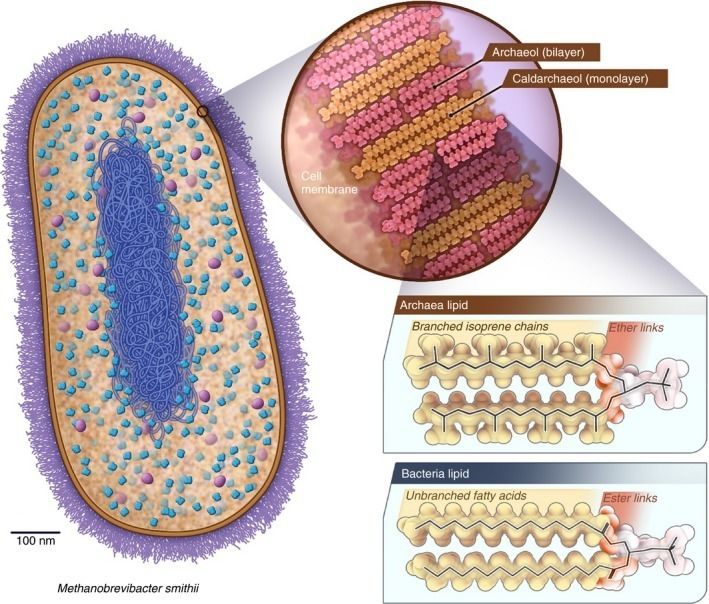
Some methanogens can also associate with plants. and animals, like the rumen of herbivorous mammals (ruminants). Methanogenic archaea are also present in the human body. The majority of the so far detected methanogens in humans, particularly from the gut and mouth, represent members of the family Methanobacteriaceae. The dominant methanogen in the human intestine is Methanobrevibacter smithii
https://www.ncbi.nlm.nih.gov/pmc/articles/PMC5754280/
https://www.ncbi.nlm.nih.gov/pmc/articles/PMC4737270/
Seite 2
Methane and Greenhouse effect
Methane is the most important greenhouse gas after carbon dioxide, and the atmospheric methane concentration has more than doubled since the start of the industrial era. This increase is responsible for ∼ 20% of the current global warming trend. Currently, global methane emissions are about 500 – 600 Tg per year, about 70% of which is due to methanogenesis from a wide variety of habitats. Greenhouse gas (GHG) emissions from enteric fermentation consist of methane gas produced in digestive systems of ruminants and to a lesser extent of non-ruminants. Enteric methane emissions from ruminant animals raised for their meat and milk account for an important increase of methane in the atmosphere.
https://www.cell.com/current-biology/comments/S0960-9822(18)30623-7
https://ec.europa.eu/knowledge4policy/dataset/beofao-fao-emissionsentericfermentation_en
Informationen
- Beschreibung
- 1º de ESO Biology and Geology Notiz am Methanogens, erstellt von Raquel Riquelme Galiana am 15/05/2020.
- Erstellt von
- Raquel Riquelme Galiana
- Aufrufe
- 0
- Bewertung