
Notizen
Partial Differentiation - created from Mind Map
Inhalt der Notizen (1)
Seite 1
Total differentials
Chain rule
Maximum & Minimum
Total Differentials for Two Variables for a function z = f(x, y).
Total Differentials for Three Variables for function w = f(x, y, z).
Approximation
Definition: the total differential for f is dz = df = fx(x, y)dx + fy(x, y)dy
Definition: the total differential for f is dw = df = fx(x, y, z)dx +fy(x, y, z)dy +fz(x, y, z)dz
Approximations: given small values for ∆x and ∆y, ∆z = ∆f = fx(x, y)∆x + fy(x, y)∆y, and f(x+∆x, y+∆y) ≈ f(x, y)+fx(x, y)∆x +fy(x, y)∆y.
Suppose that we have two functions f(x) and g(x) and they are both differentiable. If we define F(x) = (f∘g)(x) then the derivative of F(x) is, F′(x) = f′(g(x))g′(x) If we have y = f(u) and u = g(x) then the derivative of y is, dy/dx = (dy/du)(du/dx)
Elimination
Implicit differentiation
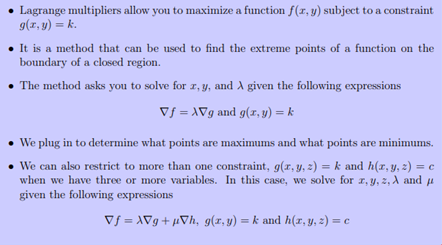
Lagrange multipliers
let f'(x)=0 and find critical numbers then find second derivative f''(x). Apply critical numbers in the second derivative. The function f(x) is maxima when f''(x)<0 and the function f(x) is minima when f''(x)>0. To find the maximum and minimum value we need to apply those x values in the given function
Eliminate y
solve for y and substitute
provides another way to find these extreme values
Informationen
- Beschreibung
- Notiz am Partial Differentiation - created from Mind Map, erstellt von anoetics 00 am 11/07/2021.
- Erstellt von
- anoetics 00
- Aufrufe
- 0
- Verlauf
-
- Erstellt von anoetics 00 · 11 Jul 2021
- Zu Notiz kopiert von anoetics 00 · 11 Jul 2021
- Bewertung