
Notizen
Pre/During War Germany
Inhalt der Notizen (1)
Seite 1
Pre/During War Germany
People:
The Kaiser Wilhelm II - Was King of Prussia, head of state, had to most power and was royalty and position was hereditary not elected. Abdicated in November 1918, after armistice.
Otto Von Bismarck - (1815–1898), Prussian statesman who dominated German and European affairs. Main leader in German unification in battle for ownership of the German Confederation. Hitler saw as great leader. For Hitler, trying to attract a mass movement, Bismarck would have been the obvious figure to claim as the architect of a successful and growing empire as opposed to the humiliated and unstable Weimar Republic.
Organisation of Kaiser Reich:
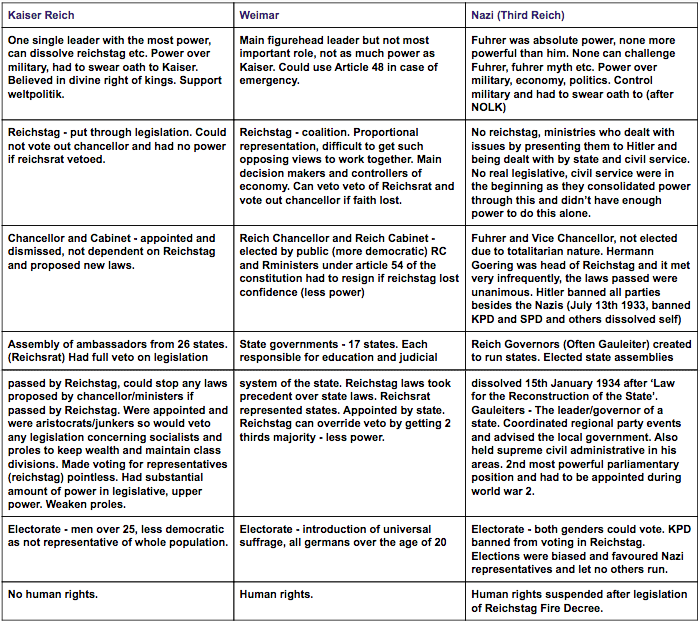
Kaiser - could dissolve Reichstag, appoint and dismiss governments, control foreign policy and military, intense power made all other parts weak
Reichstag - Elected deputies by male suffrage (25+), agree or reject law proposed by Kaiser or government. Can NOT remove chancellor or government - had parties e.g. Centre, Conservatives, SPD etc.
Government (Chancellor and Ministers): Appointed by Kaiser, propose new laws to Reichstag, not dependent on support of Reichstag
Reichsrat - had veto on legislation passed by Reichstag, had power! Were more typically elite men so had interest of Junkers and upper/middle prioritised
Electorate - Vote in 3 year elections, vote for state assemblies (Lander), constitution but no civil rights
(Not a parliamentary government, Reichstag not in control of government and could not remove chancellor and other ministers appointed by Wilhelm. Government had to cooperate with Reichstag or legislation not passed - Semi Absolutist Regime)
Economic and Political Tension:
As Germany grew as a central power in Europe, as did it’s economy in the 19th century. The proletariat grew as a result of this and they supported the socialist party in the Reichstag. The SPD wanted political reforms, Bismarck saw this as a threat to his power and tried to repress the socialists and then introduced welfare schemes as a concession to the workers to pull the working class away from socialism, but to no avail. Support for the SPD grew.
Conservative elite built the second reich, but split. Real power laid in Kaiser and the Junkers. Junkers held the key positions in government thus dominating state e.g. army officers, top civil servants and senior judges. (Anti Communist!) Junkers scorned politics (Right Wing) and resented the reichstag members who voiced view of reformers. Feared possibility of socialist revolution.
Foreign Policy:
During 1880s the idea of social darwinism became apparent.
‘Application of Darwin’s idea of survival of the fittest (evolution) to society and states.’
Some concerned with biological degeneration (decline) of nation. Lead to anti semitism sweeping across population - elites (Wilhelm included), middle and lower class. This stemmed from emigration of Russian Jews fleeing Tsarist persecution,
Germans felt threatened by alien culture and religion, lead to increase in nationalism. Increase in nationalism lead to imperialism. Ruling class saw aggressive foreign policy as way to win working class support and stop revolution.
From 1890 - Weltpolitik pursued by Kaiser and Ministers - take foreign land
Key Dates:
Second Reich - 1871-1918
1980 - Weltpolitik introduced - similar imperialistic ideas to Hitler and his dreams of expansion.
During War Germany:
Parties in reichstag made political truce to support Kaiser Wilhelm II and his military command
Kaiser not a capable war strategist - Military command Ludendorff and Hindenburg ran Germany as a military dictatorship
The Reichstag still met but high command ignored it
Took Germany to point of military and economic collapse - social and political discontent
When USA entered war 1917 Ludendorff suggested to Kaiser that new government would calm unrest
Revolution from Above - new government that Wilhelm and high command introduced in 1917 to stop a revolution from below -> led by Prince Max Von Baden -> was formed from the majority parties in the Reichstag
Country had large economic difficulties and loss of war was iminent yet only the high command were aware -> still had a kaiser even though claimed to be democratic
Informationen
- Beschreibung
- A level History (Modern) Notiz am Pre/During War Germany, erstellt von Katie King am 30/03/2016.
- Erstellt von
- Katie King
- Aufrufe
- 1
- Bewertung