
Notizen
Ohne Titel
Inhalt der Notizen (3)
Seite 1
Creation of the Republic and the Constitution
3rd October 1918 - Prince Max asked Allies for an armistice
Allies discussed and German politics continued - 1918-1919 Weimar Republic created
Communist Revolution Threat:
Prince Max government made constitutional reforms
Extended vote to all men
Both ministers and army responsible to government not kaiser - although talk of revolution continued
28th October 1918 -> gov's inaugeration day navy refused to sail against the British fleet -> strikes and mutinies
Prince's reforms seen as cynical and fake whilst others focused on other unchanged problems
Sparticists wanted revolution like that in Russia
Worker's and soldiers councils set up - shared ideals of Russian soviets (others less radical) but all wanted change
Prince Max advised Kaiser to abdicate - 8th November Bavaria broke from Germany declared a republic -> final straw for Kaiser and he abdicated
Prince Max's government were then forced to resign - lasted less than a month
10th November 1918 - New Government Set up - Council of People's Representatives led by socialist groups that held power in the Reichstag (Most significant being SPD and USPD, led by Ebert and Haase respectively)
Ebert became chancellor with cabinet of SPD and USPD members
Problems with new Gov. and how overcame:
Ebert Groener Pact - army would support government as long as government opposed left wing parties in Reichstag, SPD and USPD could not agree
Stinnes Legien Pact - Set 8 hour working day, allowed independent trade unions, helped ex soldiers find work, widen health and unemployment benefit
Ebert - wanted to arrange new elections and let National Assembly make largest changes
Haase - wanted social and political reforms and nothing to do with army unless reformed
First action of Government:
11th November - Matthias Erzberger (Jewish, Socialist - stab in the back!) signed armistice
Germans told by allies could not take part in treaty discussions
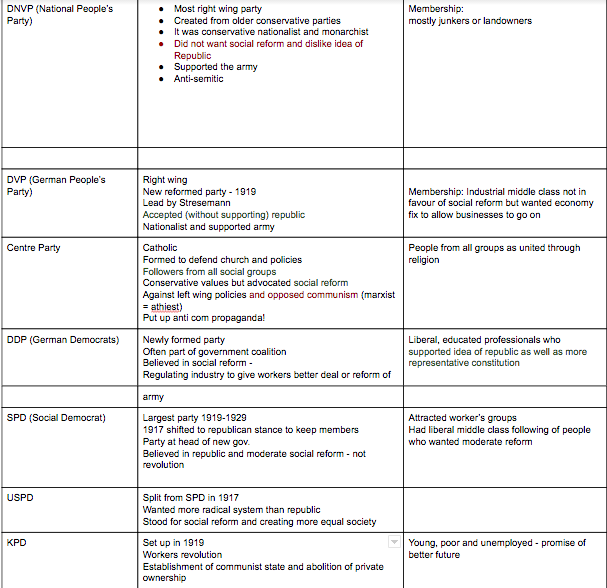
Partys began to form and reform and get votes to have a say in the Reichstag
Gov. made social reforms to try and dismiss idea of left wing revolution (Stinnes Legien Pact) - Set 8 hour working day, allowed independent trade unions, helped ex soldiers find work, widen health and unemployment benefit
First elections fixed for 1919 Jan
Unrest -> USPD and SPD fought over how radical policies should be and many USPD members joined KPD
The Spartacist revolt:
KPD - party set up in December 1918
many Germans petrified of the red Plague of communism spreading from Russia
Freikorps had units specially recruited to fight in the east against possible communist invasion - extent of fear!
Kpd political meetings came under attack from the private armies of other political parties (freikorps)
Political atmosphere so violent that when the Spartacist uprising broke out in January 1919 Berlin Ebert move the government to Weimar the safety
The freikorps were asked to deal with the sparticist leaders and results brutal - Liebknicht and Luxembourg were captured beaten and murdered
Note: Many political parties in 1919 have their own private armies
Returning soldiers unemployed and bitter about the signing of the armistice refused to return military equipment - they set up private armies the biggest of which were the freikorps - the SPD had it’s own group the Sozi
Between 1919 and 1922 there were 376 political murders in Germany 356 by right wing extremists
The biggest and most significant murders were:
Rathenau (Jewish) - whose death caused concern and anti-antisemitism - killed by org. consul
Erzberger (signer of armistice) - killed by org. Consul
Haase - (leader of USPD) Shot outside Reichstag
Creation of the Constitution:
Government was still in Weimar for the 19th January election
the election was a success 82.7% of electors voted - shows public interest in politics/democracy
SPD did not get majority and hopeful and could only governed by forming Coalition
form a coalition with Z party and the German democratic party (DDP) - other parties had seats in the Reichstag and a vote but were not part of the government
Seite 2
Overcoming Challenges of Constitution
28th June 1919 - German Delegation from Weimar gov. signed treaty of versailles - was a diktat
Made republic and democracy unpopular - many still believed war could have been won
Clauses hated by all - war guilt, reparations and fact was a diktat
Government had to battle own unpopularity and internal challenges from groups and weakness of constitution
Throughout 1920s-1930s political opposition shown by voting, debates and violence
End of war released numbers of trained soldiers - joined private armies
Right wingers who wanted imperial government, supported republic in lukewarm way rather than risk opposing it and it become more left wing
Challenges:
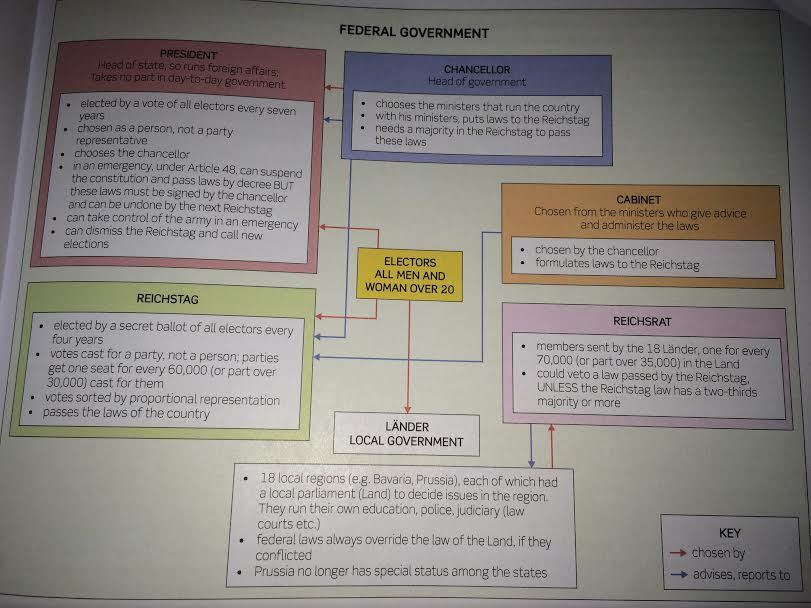
Allowed for Reichstag with too many political parties - took only 60,000 votes to gain seat - too many parties meant formation of weak coalitions and difficult for reichstag to work effectively - 29 parties throughout 1920s
Shift of parties and membership (ie USPD and SPD) confuses voters and loses them valuable votes
PR meant people voted for party rather than individual (as had been done before the war) - felt like a lot of politicians but none interested specifically in them
PR meant majority hard to form (especially with so many parties) so weak quaralling coalitions of opposing parties form eg. quarall over flag caused collapse of one government! - 1919-1923 nine different short lived coalitions - government argued before laws were even presented to the reichstag
Parties not interested in working together in coalitions
Coalitions broke down and article 48 had to be used by Ebert to rule by degree - use of emergency powers lead people to believe in state of emergency
Power of article 48 could be abused in wrong hands as granted president unlimited emergency powers and never specified an emergency
Overcoming Challenges:
1924-1929 - reichstag
Seite 3
Constitution Structure:
7th of February 1919 Ebert gave speech to new assembly proclaiming victory for democracy
11th of February elected first president of Republic by 277 votes to 51
Government still meeting in Weimar as felt returning to Berlin was dangerous
Weimar Constitution finally passed by national assembly on 31st of July 1919
Informationen
- Beschreibung
- Notiz am Ohne Titel, erstellt von Katie King am 30/03/2016.
- Erstellt von
- Katie King
- Aufrufe
- 0
- Bewertung