
Notizen
Part I
Inhalt der Notizen (5)
Seite 1
Economic growth in a country refers to a rise in national or per capita income.
Economic development on the other hand is related to "human development". Improvements in: health ,education, and other aspects of human welfare.
(economic growth does not necessarily lead to development)
Higher national or per capita income may not lead to higher level of health, education or life expectancy
- However, economic growth along with highly equal income distribution can potentially raise the levels of health and education.
(Income distribution is an important issue in achieving economic development)
GDP is the market value of all output produced within the border of a country. It includes output produced by foreign citizens living in the country.
GNP is the sum of market values of all good and services produced in an economy during a year,GDP + earnings of home country citizens abroad - income earned by foreigners in the home country.
Measuring economic growth
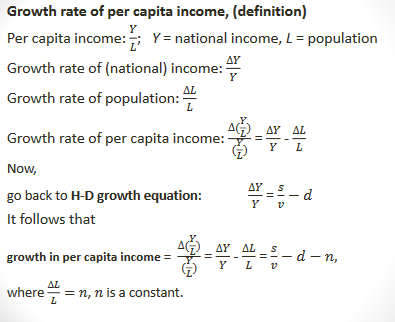
(GDP / population) gives per capita income
Real GDP is GDP adjusted for domestic price inflation
Economic growth is the changes (increases) in GNP of an economy over time
Problems concerning the measuring of GDP.
GDP only include officially recorded transactions. This means that transactions that are unrecorded are excluded from the GDP. This could give a uncorrect picture of the value of goods and services produced.
This is a concern especially in poor countries since a lot of production takes place for self consumtion , which does not enter the GDP.
In richer countries there is little home production and almost all production is transacted in the market place and gets included in the GDP.
Standard measure of GDP will usually underestimate total income generation in poor countries.
GPD: comparisen
PPP-adjustment: Each countrys GDP is usually measured in its own currency. If one wants to compare per capita GDP between countries, it is not a good idea to use official exchange rates to convert income measures from one currency to another.
The official exchange rate will always underestimate the purchasing power in poor countries, since prices of local (non-traded) goods are much lower compared to the prices in rich countries.
Economic development indicates a better life for all!
Core/basic:
Sucstenance (ability to meet basic needs)
Self-esteem (have self-respect and worth)
Freedom to choose (freedom from oppressive institutions)
A society is in a developed state if all citizens can live a worthy and good life
Must have access to certain basic goods and services: clean water, adequate shelter, health care and security
Freedom of choice: Must be free to make own decisions
Economic growth is neccessary but not a sufficient condition for improving living syandards in a poor country.
It is neccessary because a poor country with few rich and many poor, there is little potential for improving living standards for the poor just though redistribution.
Economic growth is not sufficient because if the entire increase in national income comes only to the rich then the poor will not enjoy any improvement in living standards. OR the increase in income may be confiscated by the government to purchase military hardware.
Amartya Sen
Development is the goal that we want to achieve, economic growth provide the means to achieve it.
one's capability is defined as a set of alternative combinations of functionings that one can achieve.
The goal of development is to expand the capabilities of people to live the lives they choose to lead.
Seite 2
Human development index (HDI)
Published by the UN once a year. The index varies from 0 to 1. 0 being lowest and 1 being the highest level of development. The index is used to compare countries and measure progress over time.
3 determinants
To live a long and health life - measured by life expectancy years
Aquire knowledge - measured by years of schooling
Hace the resources/income required for a decent standard of living - measured by money income.
HDI is the geometric average of these three determinants
Why are some countries rich and others poor?
High and sustained economic growth is a relatively recent phenomenon. Few countries have experienced sustained economic growth since 1900. More recently a number of Asian countries have had very high economic growth. This has led to widening income inequality in the world.
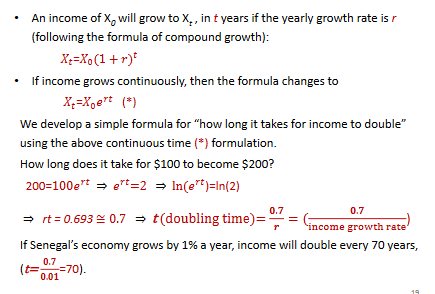
Calculating doubling times:
Seite 3
Chapter 3 Factor accumulation, productivity and economic growth
Production function: A country's total product (output) is determined by two basic factors of production- capital and labour
Production function: Y = F(K,L)
K: Capital - includes machines, tools, buildings
L: Labour - labour force
- there is a functional relationship between total output and the fators of production
What leads to rise or growth in the total output?
1. Factor accumulation leads to growth, more of K and L leads to more Y.
2. Productivity growth of the factors will also generate economic growth.
marginal productivity of capital: How much will output increase if you add one more "machine" in production
Average productivity of capital: The amount of output that each unit of machine produces.
Productivity growth: A rise in marginal productivity or average productivity.
Productivity growth of factors can be achieved in two ways:
Improved efficincy in factor use
technological change
How to improve efficiency
- Better utilization of the factors of production
- Innovation in management practice
- Presence of better "social institutions" - good law enforcement, good governance...
This can give higher production
Technological change - New or improved technology
Y = F(K,A,L,H)
A = a measure of technilogical know how
Better technology means A rises and output rises as a result
H = knowledge level of the labour force, and also health level of labour force.
Increase in H gives higher output
Diagram:
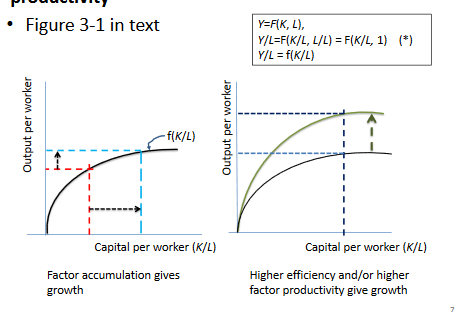
Using historical data, economists have been able to measure how much of economic growth is generated by factor accumulation and how much by growth in total factor production (TFP)
- Poor countries: Economic growth is largely explained by factor accumulation. Contribution of TFP in economic growth is msall.
- Rich countries: TFP growth is more important than factor accumulation
- For recent fast growing countries like China, contribution of both factor accumulation and TFP - growth are important.
Characteristics of rapidly growing countries (P. 75 - 87)
Macroeconomic and political stability
Investments in health and education
Effective governance and institutions
Favourable environment for private enterprise
Trade, openness and growth
Favourable geography
Chapter 4 Theories of economic growth
Two important models:
The Harrod-Domar model, and the Solow model
Economic growth requires industrialazation, modern capital based production.
Growth in industrial production requires continuous addition to the stock of capital, like new buildings and machine, which is capital accumulation
Addition to the existing capital stock is called investment
¨Low growth is a result of low levels of investment
Capital stock, Depreciation and investment :
Aggregate capital stock (K) is the total quantity of capital used in the production of goods and services including buildings, equipment, tools and machines
Changes in capital stock (d'K) is the difference between investment expenditures (I) and capital depreciation.
- Depreciation = loss due to wear and tear
We assume (in the models) that a fixed proportion (d) of capital stock is lost every period due to depreciation.
d'K = I - dK
- If investment in new capital exceeds the depreciation of existing capital (dK), then the capital stock expands. if depreciation exceeds investment, then the capital stock contracts.
- Recall that economic growth requires a growing capital stock, like, investment.
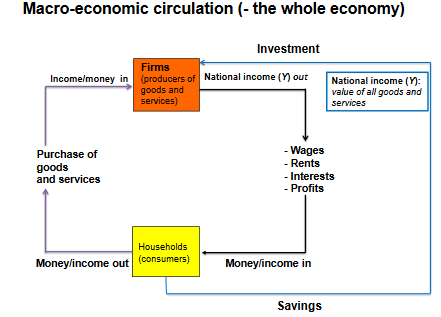
- Where do investment come from?
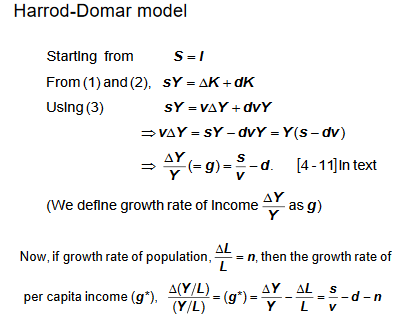
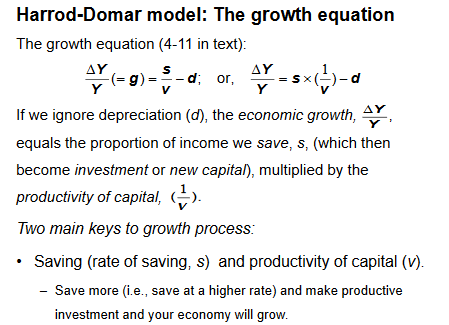
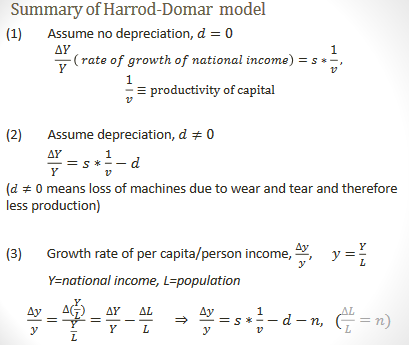
Harrod Domar Model
Assumption: Everything we save will automatically be turned into investment
(1) s (total saving) = I (total investment)
S = sY; S = Y = national income, s = proportion of income that is saved (s is assumed a constant)
(2) Change in capital stock (definition): d'K = I - dK; d (a constant) is the rate at which capital stock depreciates
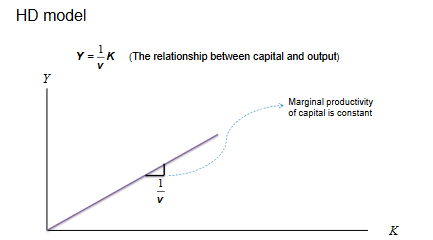
(3) Capital-output ratio: (K/Y) = v: or Y = (1/v)K, v is a constant
From (3) we have d'Y = (1/v) d'K, ot d'K = vd'Y
Seite 4
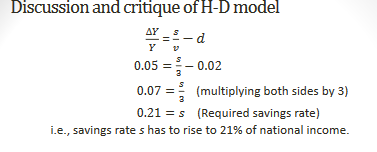
Critique of the Harrod - Domar model:
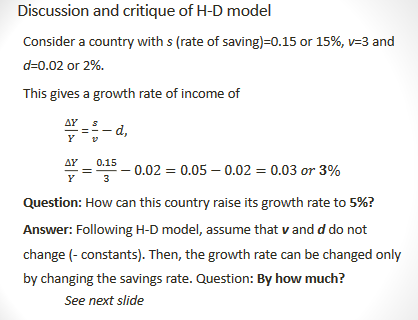
- Accoring to the H-D model all a country needs to do to achieve higher growth is to increase the rate of saving
- But higher growth can only be attained if savings are turned into productive investment
- If savings are used on poor / unproductive (- often government sponsored) investment projects then little or no growth will materialize.
The assumption of fixed capital-output ratio can not hold when we consider the economy over a long period of time (long run)
- Poor countries will typically have a low capital-output ratio
- As countries develop, production will become more capital-intensive, i.e. capital-output ratio will increase. But this is not allowed by the assumption in the model.
- The H-D modle does not fit the long run growth patterns of countries in the real world.
The H-D model does not allow for growth in factor productivity. (Note that productivity of capital (K) is fixed at 1/v)
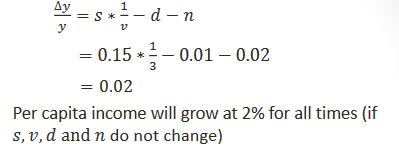
The Solow model
The solow model drops the fixed-coefficient function in the H-D model and replace it with a neoclassical production function, that allows more flexibility and subtitution between the factors of production.
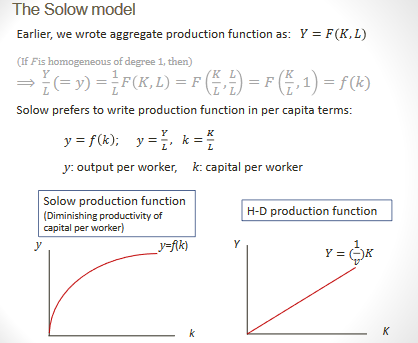
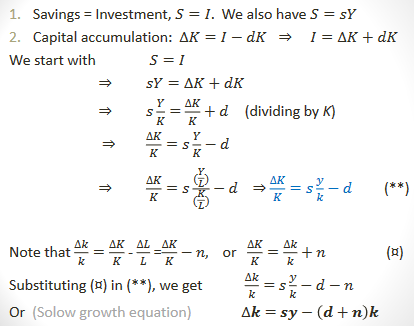
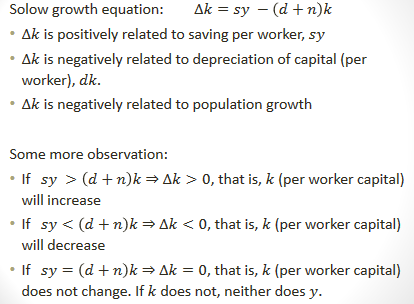
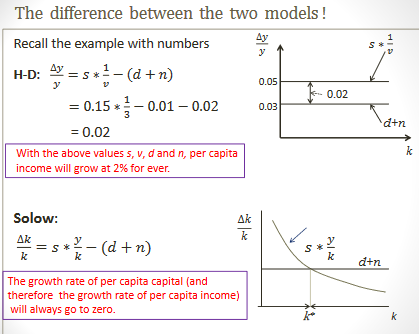
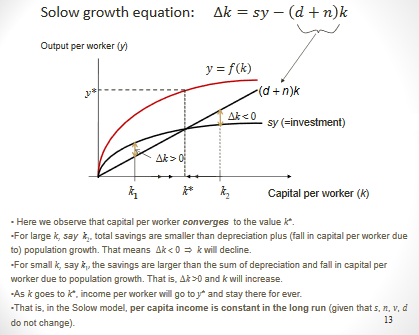
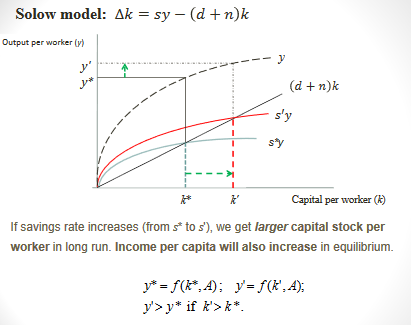
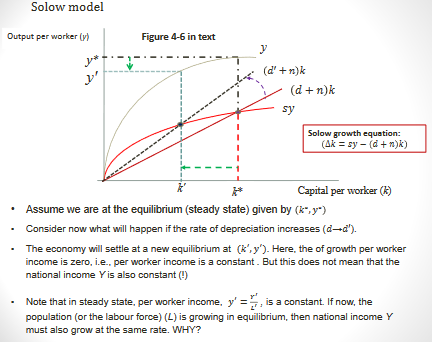
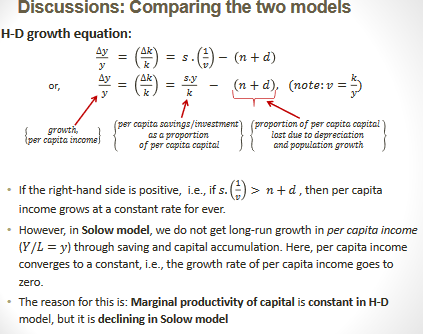
The Solow model predicts that all countries will achieve the same per capita (or per woker) income (or, standard of living) in the long run, if all countries have same savings rate (s), production function, depreciation rate (d) and population growth rate (n).
The Solow model can explain differences in income between countries in theory.
- Country B will have a higher per capita income than country C ig savings rate (s) is higher (and population growth rate (n) and depreciation rate (d) are lower) in country B than in country C (repectively).
The growth rate of per capita income can be positive in the long run in the Solow model, but it will require continuous technological progress.
- Recall the discussion earlier on how to achieve economic growth. The anser was that there were two ways:
1. Factor accumulation
2. increase in factor productivity (f.ex. through technological progress)
- If the production function shifts upward continually due to continuous technological progress, then per capita income will also rise continuously.
Seite 5
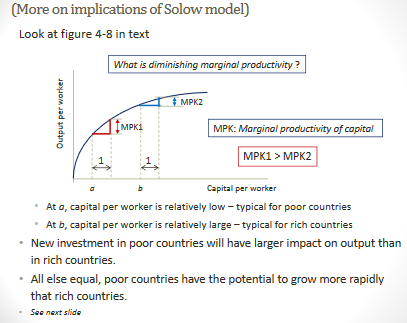
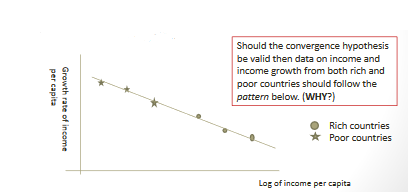
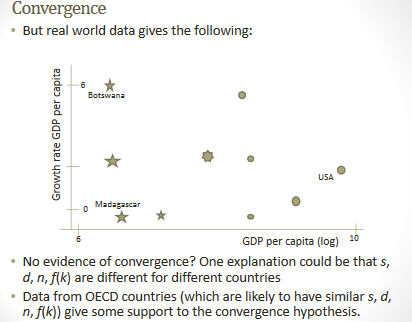
As countries become richer, growth rate tend to slow down.
Because poor countries can potentially grow faster than rich countries, they can catch up and close the gap in relative income.
(Unconditional) Convergence (An implication of the Solow model)
Given all else being equal, (i.e. s,d,n and the production function f(k) are the same for all countries), all countries will converge to the same per capita income in the long run.
New (endogenous) growth theory: Motivation
- The Solow model says that rich countries with high per capita capital will have slow growth in per capita income and eventually reach a long run equlibium where per capita income remains constant.
- Why do then the standard of living ( or per capita income) in rich countries continue to increase without signs of slowing down?
- One answer: consisten with the Solow model - is that rich countries experience a continuous rise in factor productivity due technological progress. But who/what is behind the continuous technological progess?
- We assume that it is the private entrepreneurs who spend on research and development (R&D) in order to increase their profits and in turn gives technological progress.
- But R&D expenditure should sooner or later cease to grow as profits from more R&D will eventually decline to a zero because of diminishing productivity of R&D.
- But for some reason, R&D expenditures in rich countries continue to grow and technological progress continue. Why?
A key concept: Positve external effects
External effects are also called "spill over" effects
Recall that in the Solow model, the growth rate of per capita income goes to zero because capital exhibits diminishing marginal productivity. This assumption remains valid in new growth theory.
Assume that producer C faces diminishing marginal productivity on her own R&D expenditure
- But C also enjoys positive benefits from the R&D undertaken by all other producers.
Then it is possible that the declining productivity from C's own R&D investment is offset by productivity gains due to R&D investment of all other firms. This will also be the case for all other firms in the economy (assuming producers behave the same)
This can generate sustained positive growth in per capita income (similar to that in H-D model), and continued rise in R&D investment (per capita).
it is often the case that mutual external effects of investment between firms are much stronger in an industrialized country than in a developing country. (Synergy effect)
A developing country may get access to modern technology, but often lacks complementary investment in higher education, infrastructure, etc. This can limit the size and scope of these spill-over effects.
- The above can be a possible explanation for why the differance between rich and poor countries has grown steadily.
Informationen
- Beschreibung
- Business/Economics (Development economics) Notiz am Part I, erstellt von Linda Solsvik am 04/11/2016.
- Erstellt von
- Linda Solsvik
- Aufrufe
- 2
- Bewertung