
HACCP Introduction
Folien in diesem Satz (7)
-
- When working in certain industries it is important for staff to have thorough health and food safety training. This allows employees to be aware of the dangers present in working with food and the surrounding environment. This course is designed to guide employees through training of the in relation to the HACCP system.
- Moreover, most industries from hotels to restaurants are legally required to maintain certain standards of food safety and work environment cleanliness in order to reduce the risk of hazards that may occur.
-
- Hazard Analysis and Critical Control Point (HACCP) is a systematic approach to identifying and controlling hazards, whether they be microbiological, chemical or physical, that may be a danger in the food preparation process. In simple terms, HACCP works to identify what may go wrong and how measures can be put in place to prevent it.
- Since 1998, all food businesses have been required to have food safety management practices in place based on the principles of HACCP.

-
- HACCP, in its simplest terms, is a food safety programme. It was first developed in the 1960s as a collaboration between NASA and the Pillsbury Company who were attempting to provide safe food for astronauts who were on space missions.
- Before the existence of HACCP, people used to measure food safety on the basis of the number of complaints received from their customer base. This highlighted food borne illnesses and the quality of end products in places serving food. The implementation of HACCP was a huge step from the old system.

-
Why commit to HACCP standards?
- The HACCP system is designed to control and keep food safe in the production, storage and distribution process and ultimately profit the business you work in. There are a number of benefits to HACCP:
- Increases your customer base and develops a sense of trust with the customer
- Protects customers from the dangers of eating contaminated or poorly prepared food
- Allows your business to serve safe food at all times
- Saves money in the long term
- Makes sure you are compliant with international food and health safety regulations
- Offers up defence in a court of law
- Provides a consistent high quality product to the customer
- Illustrates conformity to regulations for the food and health safety sector and the customer's well-being
-
- Food safety management is based on these seven principles of HACCP which help you to identify and control hazards before the safety of food or customer is threatened:
- Recognise the hazards - identify each step in the food handling process - purchasing, delivery, storage, preparation, cooking etc. - and what could go wrong e.g. piece of plastic in a salad
- Determine the critical control points (CCPs) - establish how you can control a hazard e.g. cooking meat to internal temperature of 75 degrees celsius in order to kill potential pathogens
- Establish critical limit(s) - setting limits which enable you to recognise when a CCP is out of control
- Establish a system to monitor control of the CCP - once CCPS and critical limits are established you need to develop a system to monitor and record what is happening during each CCP
- 5. Establish the corrective action to be taken when assessing a certain CCP indicates it is not under control - e.g. the fridge breaks down and all the milk turns sour; the fridge needs to be repaired in order to maintain the milk at the correct temperature
- 6. Create procedures to verify the HACCP system is functioning effectively - whenever changes are made to the operation of the business make sure to review and correct the system e.g. installation of new fridge
- 7. Generate documentation and records relating to these principles and their application - to allow successful and effective implementation of HACCP standards employers should have appropriate documentation and records readily available e.g. cleaning records, cooking temperatures, delivery
-
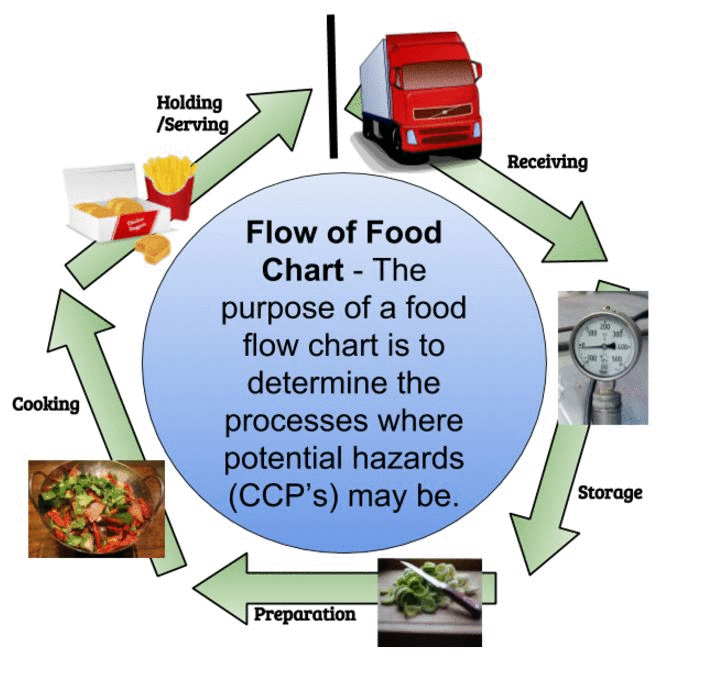
- Bildunterschrift: The Food Flow Chart
-
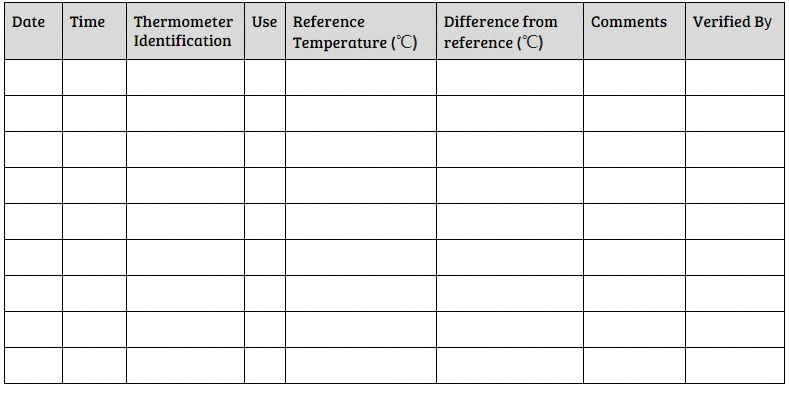
- Bildunterschrift: An example table for calibrating record for a thermometer (helps to ensure it works properly when measuring temperature of hot food)
Informationen
- Beschreibung
- Der Nutzer hat seine Fachbereichs-Information gelöscht. Folienset am HACCP Introduction, erstellt von Gelöschter Nutzer am 01/09/2017.
- Erstellt von
- Gelöschter Nutzer · Sep 2017
- Aktualisiert
- 1 Sep 2017
- Aufrufe
- 78
- Tags
- Verlauf
-
- Erstellt von Andrew Burke · 25 Jul 2017
- Kopiert von Andrew Burke · 31 Aug 2017
- Kopiert von Jacob Lee · 1 Sep 2017
- Kopiert von Jacob Lee · 1 Sep 2017
- Bewertung