
Quiz
Immunology/Microbiology Physiology :)
Dieses Quiz enthält Fragetypen, die sich im gewohnten Player öffnen.
Fragen in diesem Quiz (32)
1What is MHC III presented on?
- Aall nucleated cells
- Bcytokines
- Ccomplement proteins
- Denzymes
- Eleukocytes
- Fmonocytes
- Gmicroglia
2[blank_start]B[blank_end][blank_start]7[blank_end]-[blank_start]C[blank_end][blank_start]2[blank_end][blank_start]8[blank_end] is known as the co-stimulatory response. It is an interaction between T Helper cell and the [blank_start]dendritic[blank_end] cell that assists with T4 helper cell [blank_start]maturation[blank_end].
- AB
- BC
- C7
- D8
- E2
- Fdendritic
- Gmaturation
3The classical complement cascade is only triggered during bacterial infections.
- ARichtig
- BFalsch
4[blank_start]C[blank_end] [blank_start]reactive[blank_end] [blank_start]protein[blank_end] is a PAMP raised only in bacteria that helps with complement binding.
- Areactive
- Bprotein
- CC
5Complement encourages platelet agglutination.
- ARichtig
- BFalsch
6Unmethylated DNA can be considered a PAMP.
- ARichtig
- BFalsch
7What are the hematopoietic organs of the body?
- ALiver
- BThymus
- CBone Marrow
- DSpleen
- ESALT
- FMALT
- GLymph node
8Hypersensitivity is a form of immunodeficiency.
- ARichtig
- BFalsch
9Which of these are central lymphoid organs?
- Abone marrow
- Bthymus
- Cspleen
- DMALT
- ESALT
- Flymph node
10Thymus increases in size as one grows from childhood to adulthood.
- ARichtig
- BFalsch
11What are secondary lymphoid organs?
- Alymph node
- BMALT
- Cspleen
- Dthymus
- Ebone marrow
- FAdipose tissue
12The spleen is found anatomically in the [blank_start]upper[blank_end] [blank_start]left[blank_end] [blank_start]quadrant[blank_end], between ribs [blank_start]9[blank_end]-[blank_start]11[blank_end]. spleen filters out blood cells every [blank_start]120[blank_end] days. In the case of anemia, red blood cells are [blank_start]stored[blank_end].
- Aupper
- Bleft
- Cquadrant
- D9
- E11
- F120
- Gstored
13The spleen is at danger of
- Ahemorhaging from blunt trauma
- Bhypercoagulation and rupturing
- Cinflammation and rupturing
- Dautoimmune disorders and rupturing
14The splenic artery comes from the [blank_start]celiac[blank_end] [blank_start]trunk[blank_end].
- Aceliac
- Btrunk
15[blank_start]Metazoa[blank_end] are multicellular parasites. [blank_start]Protozoa[blank_end] are unicellular parasites. [blank_start]Helminths[blank_end] are specifically worms, a type of parasite.
- AMetazoa
- BProtozoa
- CHelminths
16Viruses are metabolically active.
- ARichtig
- BFalsch
17Label the parts of a virus?
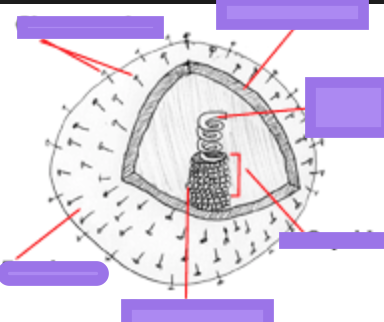
- AVirus genome
- Bbilipid layer
- Ccapsid
- Dglycoproteins
- Eenvelope
18What is often a therapeutic target for drugs?
- Avirus' genome
- Bvirus' capsid
- Cvirus' glycoproteins
- Dvirus' enzymes
19Viral testing:
If you want to know whether one has had a viral action before or is currently having one:
[blank_start]PCR[blank_end] ([blank_start]polymerase[blank_end] [blank_start]chain[blank_end] [blank_start]reaction[blank_end]) and [blank_start]Antibody[blank_end] tests. An example of such a test is a [blank_start]COOMB's[blank_end] test, which checks whether something is due to an autoimmune reason or a virus reason.
An [blank_start]oxidative[blank_end] [blank_start]burst[blank_end] test checks for neutrophil functionality.- APCR
- Bpolymerase
- Cchain
- Dreaction
- EAntibody
- FCOOMB's
- Goxidative
- Hburst
20Ebola is a [blank_start]hemmavirus[blank_end] and hence, causes a [blank_start]hemmorhagic[blank_end] [blank_start]fever[blank_end] and which will lead to the patient bleeding out.
- Ahemmavirus
- Bhemmorhagic
- Cfever
21Parts of a bacteria?
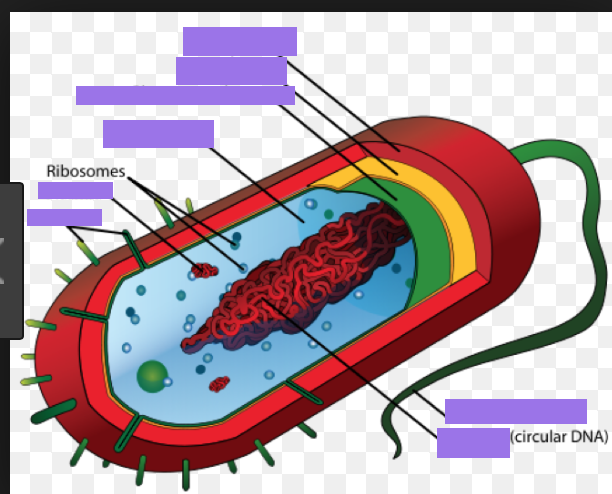
- Acapsule
- Bcell wall
- Cplasma membrane
- Dcytoplasm
- Eplasmids
- Fpilli
- Gnucleoid
- Hflagellum
22What are the types of bacteria?
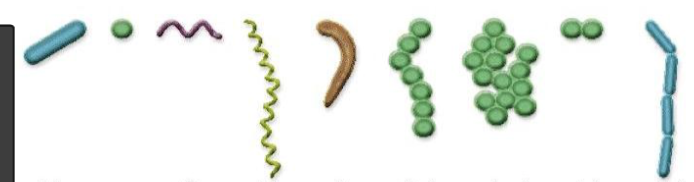
- Abacilli
- BSpirochete
- CVibrio
- DStaphylacocci
- ECoccus
- FDiplococci
- GStreptococci
- Hstreptobacillus
23Bacteria are classified according to their response to antibodies.
- ARichtig
- BFalsch
24Gram staining: staining of the [blank_start]bacteria[blank_end], specifically of the [blank_start]cell[blank_end] [blank_start]wall[blank_end].
Process:
1. Wash bacteria with [blank_start]purple[blank_end] dye
2. Wash dye out
3. Wash bacteria with [blank_start]pink[blank_end] dye
4. Wash dye out- Abacteria
- Bcell
- Cwall
- Dpurple
- Epink
25Gram staining can result in:
Gram [blank_start]negative[blank_end]
LPS ([blank_start]lipopolysaccharide[blank_end])
color [blank_start]Pink[blank_end]/Red
[blank_start]Thin[blank_end] outer wall
[blank_start]Outer[blank_end] and [blank_start]inner[blank_end] membranes
these bacteria generally live in dry places
Atypical, or aka [blank_start]Acid[blank_end] [blank_start]Fast[blank_end]
Gram [blank_start]positive[blank_end]
[blank_start]Lipoteichoic[blank_end] [blank_start]Acid[blank_end] (LTS)
Color [blank_start]Purple[blank_end]/Blue
[blank_start]Thick[blank_end] outer wall
[blank_start]Inner[blank_end] membrane
these bacteria live in wet places- Anegative
- Blipopolysaccharide
- CThin
- DOuter
- Einner
- FAcid
- GFast
- Hpositive
- ILipoteichoic
- JAcid
- KThick
- LInner
- MPurple
- NPink
26[blank_start]Bacteriophages[blank_end] are viruses that only infect bacteria.
- ABacteriophages
27[blank_start]Fungi[blank_end] are important opportunistic infections and indeed, the [blank_start]immunosuppressed[blank_end] often get these type of infections.
- AFungi
- Bimmunosuppressed
28Parasites are very [blank_start]metabolically[blank_end] similar to humans.
- Ametabolically
29[blank_start]Anti[blank_end]-[blank_start]D[blank_end] [blank_start]immunoglobulin[blank_end] [blank_start]treatments[blank_end] (ex: Rhogam) are given to women at risk of Rhesus disease.
- AAnti
- BD
- Cimmunoglobulin
- Dtreatments
30[blank_start]Molecular[blank_end] [blank_start]mimicry[blank_end] is the body's antibody response once it is exposed to an antigen.
- Amimicry
- BMolecular
31Packed Blood still contains some plasma.
- ARichtig
- BFalsch
32The possibility of creating antibodies is seen with...
- Abone marrow transplant
- Bblood transfusion
- Ckidney transplant
- Dlymph transplant
Informationen
- Beschreibung
- Der Nutzer hat seine Fachbereichs-Information gelöscht. Quiz am Immunology/Microbiology Physiology :) , erstellt von Gelöschter Nutzer am 29/01/2018.
- Autor
- Gelöschter Nutzer
- Sprache
- English
- Aufrufe
- 13
- Verlauf
- Erstellt am 29 Jan 2018 · aktualisiert am 29 Jan 2018
- Schlagwörter
- Bewertung
- Noch keine Bewertungen Bewerte dieses Quiz