
Karteikarten
The Pancreas and Blood Glucose Concentration
Karten in diesem Stapel (19)
- 1Where is the pancreas found?Below the stomach
- 2TRUE OR FALSE: The pancreas has both endocrine and exocrine functionsTRUE
- 3The areas of the pancreas that contain endocrine tissue are called...The islets of Langerhans
- 4Describe the structure and function of the islets of LangerhansSTRUCTURE
Found in clusters around blood capillaries
Made up of alpha (α) and beta (β) cells
FUNCTION
Secretes hormones directly into the blood
α cells secrete glucagon
β cells secrete insulin
Glucagon and insulin help to control the blood glucose concentration - 5Complete the sentences: Most cells in the pancreas synthesise and release ____________ enzymes. The exocrine cells are in small groups (_________) surrounding tiny __________.Most cells in the pancreas synthesise and release DIGESTIVE enzymes. The exocrine cells are in small groups (ACINI) surrounding tiny TUBULES.
- 6Describe the structure and function of the aciniSTRUCTURE
The acini are grouped together into small lobules separated by connective tissue.
The tubules from the acini join to form intralobular ducts that eventually combine to make up the pancreatic duct.
FUNCTION
The cells of the acini secrete the enzymes they synthesise into the tubule at the centre of the group.
The pancreatic duct carries the fluid containing the enzymes into the first part of the small intestine (duodenum). - 7What does the fluid from the pancreatic duct contain?Pancreatic amylase
Trypsinogen
Lipase
Sodium hydrogencarbonate - 8What is the role of pancreatic amylase?A carbohydrase which digests amylose to maltose
- 9What is the role of trypsinogen?An inactive protease which will be converted to the active form trypsin when it enters the duodenum
- 10What is the role of lipase?Digests lipid molecules
- 11What is the role of sodium hydrogencarbonate in the fluid from the pancreatic duct?Makes the fluid alkaline, helping to neutralise the contents of the digestive system that have just left the acid environment of the stomach
- 12Outline the process by which insulin is secreted by the islets of Langerhans1. K⁺ channels in the β-cell membrane are open and K⁺ diffuse out of the cell creating a p.d. of -70mV
2. If blood glucose levels are high, glucose passes into the cell by facilitated diffusion
3. Glucose is phosphorylated by glucokinase
4. phosphorylated glucose is used in respiration to produce ATP
5. K⁺ channels are ATP-sensitive and close due to the increased levels
6. K⁺ levels increase within the cell
7. This lowers the p.d. across the membrane to -30mV
8. Change in p.d. causes voltage-gated Ca²⁺ channels to open and Ca²⁺ floods into the cell
9. Ca²⁺ cause vesicles containing insulin to fuse with the β-cell membrane
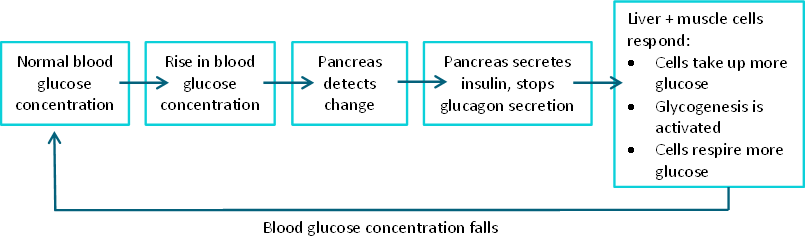
10. Insulin is released into the capillaries of the islet of Langerhans via exocytosis - 13Outline what happens when blood glucose levels are too high1. Detected by β-cells in the Islets of Langerhans
2. β-cells secrete insulin into the blood
3. Insulin binds to receptors on hepatocytes (liver cells), muscle and brain cells
4. Tyrosine kinase is activated, causing the phosphorylation of inactive enzymes in the cell
5. Vesicles containing transporter proteins fuse with the membrane to create glucose channels so glucose enters the cell
6. Glycogenesis occurs and glucose is converted to fats
7. More glucose is used for respiration
8. Decrease in blood glucose concentration
9. Normal blood glucose levels (90mg 100cm⁻³) - 14What is glycogenesis?The process whereby glucose is converted to glycogen for storage
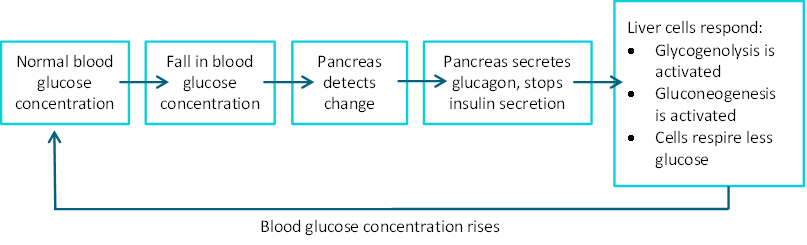
- 15Outline what happens when blood glucose levels are too low1. Detected by α-cells in the Islets of Langerhans
2. α-cells secrete glucagon into the blood
3. Glucagon binds to receptors on hepatocytes
4. G-protein is stimulated inside of the membrane
5. Adenylyl cyclase is activated
6. ATP is converted into cAMP
7. Glycogenolysis and gluconeogenesis occur
8. More fatty acids are used in respiration
9. Increase in blood glucose concentration
10. Normal blood glucose levels (90mg 100cm⁻³) - 16What is glycogenolysis?The process whereby glycogen is converted to glucose by phosphorylase A
- 17What is gluconeogenesis?The production of glucose from non-carbohydrate substances, such as amino acids or lipids
- 18Describe the negative feedback mechanism that occurs when there is a rise in blood glucose concentration
- 19Describe the negative feedback mechanism that occurs when there is a fall in blood glucose concentration
Informationen
- Beschreibung
- Der Nutzer hat seine Fachbereichs-Information gelöscht. Karteikarten am The Pancreas and Blood Glucose Concentration, erstellt von Gelöschter Nutzer am 05/03/2018.
- Erstellt von
- Gelöschter Nutzer · Mär 2018
- Aktualisiert
- 5 Mär 2018
- Aufrufe
- 13
- Verlauf
-
- Erstellt von Yinka F · 17 Feb 2018
- Kopiert von Yinka F · 5 Mär 2018
- Bewertung