
Quiz
Common AMK pathologies :)
Dieses Quiz enthält Fragetypen, die sich im gewohnten Player öffnen.
Fragen in diesem Quiz (60)
138-year-old male fell whilst horse riding earlier in the day. He was unconscious briefly after his fall but was able to continue horse riding. He now complains of disorientation and a severe headache. His GCS is 13. He feels nauseous. Examination reveals a bruise on his temple. His blood pressure is 160/105, HR 55bpm, RR 20, temperature 37.1. What vessel may have been ruptured?
- AAnterior cerebral artery
- BMiddle meningeal artery
- CSagital sinus
- DSubdural vein
- EVertebral artery
2A 42 year old male, of no fixed abode, presents with increased forgetfulness over the past month. He complains of a mild headache which does not improve with paracetamol. Initial blood tests show ALT 392 (0-55), AST 228 (0-60), ALP 160 (40-150), bilirubin 45 (3-21). He has a 20 pack year smoking history and his alcohol intake is 80u/week.
What is the most likely diagnosis?- AVascular dementia
- BExtradural haemorrhage
- CSubarachnoid haemorrhage
- DSubdural haemorrhage
- EVenous sinus thrombosis
3An elderly female presents to ED with subacute worsening of back pain which is 5/10 in severity. She has had longstanding lower back pain. She does not report any recent changes in urinary or bowel symptoms. Examination reveals local, central tenderness on lower palpation. There is normal lower limb sensation and power. Renal function and FBC are normal. Spinal XR is ordered.
What is the next step in management?- AAdequate analgesia, discharge
- BAlendronic acid
- CSpinal CT scan
- DSurgical referral
- EUrinary electrophoresis
4An elderly male attends his GP complaining of left-sided hip pain. The pain has been worsening slowly over the past few weeks and has not responded to naproxen. On further questioning, he admits he has been feeling tired and has stopped gardening. Examination reveals full range of hip motion, non-tender to palpation and left hip feels slightly warm.
Hb 120 (130-180)
Plt 110 (150-400)
WCC total 12.5 (4-11)
CRP 27 (<10)
Ca 2.3 (2.1-2.6)
eGFR 59 (>90)
Cr 190 (70-150)
Urea 9.1 (2.5-6.7)
What is the diagnosis?- AMyeloma
- BOsteopenia
- COsteoporosis
- DPaget’s disease of bone
- ERheumatoid Arthritis
5Diagnosis of multiple myeloma has been made. What do you expect to see on urinary electrophoresis?
- AMonoclonal kappa light chain IgG
- BMonoclonal kappa light chain IgM
- CMonoclonal lambda light chain IgG
- DMulticlonal kappa light chain IgM
- EMulticlonal lambda light chain IgM
6Ig[blank_start]A[blank_end] is present in breast milk.
Ig[blank_start]G[blank_end] is transplacental and is a specific antibody
Ig[blank_start]M[blank_end] is a general antibody
Ig[blank_start]E[blank_end] is allergy related
Ig[blank_start]D[blank_end] is a BCR- AA
- BG
- CM
- DD
- EE
775 year old male was found unconscious at home and initial assessment has revealed a neck of femur fracture. He was previously able to walk 4 miles without stopping and performed all activities of daily living.
What is the most appropriate definitive management plan?- ADynamic hip screw
- BHemiarthroplasty
- CLeg cast and strong analgesia
- DOpen reduction, internal fixation
- ETotal hip arthroplasty
875 year old male was found unconscious at home and initial assessment has revealed a neck of femur fracture. He was previously able to walk 4 miles without stopping and performed all activities of daily living. In ED, he suddenly becomes tachypnoeic, and complains of pleuritic chest pain. His O2 sats drop to 88% (10L O2), HR is 120 and BP is 90/50.
What is the most likely diagnosis?- AAcute haemorrhage
- BMyocardial infarction
- CPulmonary Embolism due to fat embolus
- DPulmonary Embolism due to Venous Thrombosis
- ESeptic Shock
955 year old male presents to his GP with a lump on DIP on his left hand. The lump is hard, non-mobile and adherent to overlying and underlying tissue. The lump does not give him any issues. He does not want surgical intervention.
He has a history of multiple episodes of acute finger joint pain. His regular medication is naproxen, ramipril and bendroflumathiazide.
What is the most appropriate management plan?- AAdvise lumpectomy
- BAllopurinol
- CBiopsy lump
- DColchicine
- EIncreased NSAID dose
10You are a GP and are called out to see a known IVDU who complains of a painful right knee. She is walking with a limp. On examination, her right knee is erythematous, tender and warm on palpation and there is reduced knee flexion. She is tachypnoeic and sweating.
What is the next most appropriate step?- AEmergency admission to ED
- BFlucloxacillin 500mg TDS PO
- CHigh dose NSAIDs
- DOral steroids
11You are a FY1 and you aspirate the swollen knee of a 55 year old female patient. She presented with a red, hot, swollen knee. She is otherwise well. The fluid is turbid and straw coloured.
What is the most likely diagnosis:- AOsteoarthritis
- BRheumatoid arthritis
- CSeptic arthritis
- DReactive arthritis
12On a normal healthy patient, bridging veins should be visible.
- ARichtig
- BFalsch
13Calcification of the choroid plexus is common in elderly patients and can be seen in CTs as surrounding the ventricles
- ARichtig
- BFalsch
14What's this pattern indicative of?
Trauma--> Lucid phase--> Headache- AEpidural hemorrhage
- BSubdural hemorrhage
- CSubarachnoid hemorrhage
- DIntercerebral hemorrhage
15Because the complications of epidural hemorrhages include [blank_start]herniation[blank_end], the management is a urgent [blank_start]non[blank_end]-[blank_start]contrast[blank_end] [blank_start]CT[blank_end] of the head and urgent [blank_start]neurosurgeon[blank_end] [blank_start]referral[blank_end].
- Aherniation
- Bcontrast
- Cnon
- DCT
- Eneurosurgeon
- Freferral
16Because subdural hemorrhages are [blank_start]venous[blank_end] and slower, even [blank_start]acute[blank_end] subdural hemorrhages take place over many [blank_start]days[blank_end]/weeks. They're usually due to [blank_start]minor[blank_end] trauma and are more common in children, elderly, and [blank_start]alcoholics[blank_end]. Symptoms include [blank_start]pseudo[blank_end]-[blank_start]dementia[blank_end] and [blank_start]confusion[blank_end].
- Avenous
- Bacute
- Cminor
- Ddays
- Ealcoholics
- Fpseudo
- Gdementia
- Hconfusion
17Acute subdural hematoma requires urgent referral to the neurosurgeon.
- ARichtig
- BFalsch
18What are the different types of subdural hemorrhages?
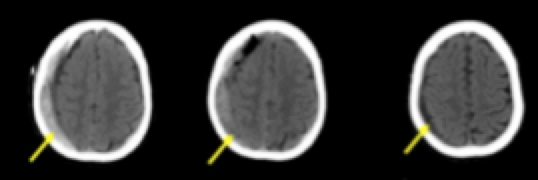
- Aacute
- Bsubacute
- Cchronic
19What is true regarding subarachnoid hemorrhages?
- AWorst 10/10, sudden headache
- Binvestigate: check for protein and urea
- Cmost common in middle aged women
- Dblood between sulci and in sub-arachnoid space
- Edue to berry aneurysm bursting
- Finvestigate: positive Kerniq's sign
- Gmanage: urgent non-contrast CT scan and neurosurgeon referral
- Hinvestigate: spinal tap after 12 hours
- Isymptom: neck stiffness and backpain
- Jinvestigate: reduced GCS
20Which of these is not a Liver Function Test?
- AALT
- BAST
- CALP
- DGGT
- EBilirubin
- FERCP
21Raised ALP alone can be helpful in differential diagnosis.
- ARichtig
- BFalsch
22If ALP and AST are more raised than ALP and Bilirubin, this is indicative of
- AAlcoholic liver disease
- BGilbert's syndrome
- CJaundice
- DCirrohosis
23Isolated raised bilirubin levels are indicative of [blank_start]Gilbert's[blank_end] [blank_start]Syndrome[blank_end].
- AGilbert's
- BSyndrome
24Types of Hip Fractures:
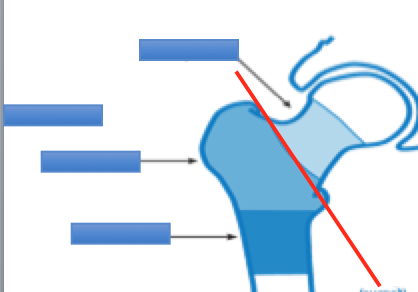
- Aintracapsular
- Bextracapsular
- Ctrochanteric
- Dsub
25The joint capsule is made up of a femur [blank_start]head[blank_end] and [blank_start]neck[blank_end].
- Ahead
- Bneck
26Only intracapsular fractures can be either displaced or nondisplaced.
- ARichtig
- BFalsch
27Which of these can you manage via internal fixation with a dynamic hip screw (DHS)?
- Aundisplaced intracapsular
- Bdisplaced intracapsular
- Cundisplaced extracapsular
- Ddisplaced extracapsular
28The management for an intracapsular displaced fracture is hip arthroplasty within 24 hrs (total hip replacement or hemiarthroplasty)
- ARichtig
- BFalsch
29Paget's disease is very much visible in an x-ray of a spinal vertebrae.
- ARichtig
- BFalsch
30In Paget's disease, serum calcium and phosphate levels would be increased drastically.
- ARichtig
- BFalsch
31Osteopenia may present with a history of excessive steroid usage or fraility fractures.
- ARichtig
- BFalsch
32Osteoporosis will have normal calcium serum levels but a raised ALP
- ARichtig
- BFalsch
33Alendronic acid is a treatment for osteoporosis.
- ARichtig
- BFalsch
34some bone conditions and pathologies involve DEXA scans for diagnostic purposes.
- ARichtig
- BFalsch
35What is true regarding multiple myeloma?
- Ait is due to cloning of a plasma cell
- Bthere is overproduction of an antibody IgG (light chain)
- Cinvestigation: urinalysis (with ++ protein)
- Dhypocalcemia
- Erenal failure
- Fanemia
- Gbone pain
- Hpresent: back pain
- Iinvestigation: skeletal survey and head and vertebrae x-ray
- Jpepper pot appearance
36For Multiple Myeloma:
Monoclonal band urine electrophoresis known as Bence [blank_start]Jones[blank_end] proteins aka monoclonal [blank_start]kappa[blank_end] [blank_start]light[blank_end] chains
Also:
[blank_start]low[blank_end] RBC,
Calcium [blank_start]high[blank_end]
ALP [blank_start]normal[blank_end],
PTH [blank_start]normal[blank_end]- Alow
- Bhigh
- Cnormal
- Dnormal
- EJones
- Fkappa
- Glight
37If IgM is found in urine electrophoresis, the condition is Waldenstrom’s macroglobinaemia.
- ARichtig
- BFalsch
38What would you prescribe for a 40 year old with a painful red toe?
- Aaciclovir
- Ballopurinol
- CNSAIDs
- Dparacetamol
- Eurgent referral
39Hemarthrosis is due to factor 11 deficiency.
- ARichtig
- BFalsch
40Septic arthritis is usually seen in one really red, hot, and tender joint (large.)
- ARichtig
- BFalsch
41In any really red and hot joint, always aspirate to investigate.
- ARichtig
- BFalsch
42What is true regarding septic arthritis?
- Acause: staphylococcal
- Bcause: viral
- Ctreatment: IV penicillin
- Dtreatment: analgesia
- Ecommon with trauma
- Fcommon with joint prosthetics
- Gcommon in the homeless
- Hcommon in IV drug users
43[blank_start]Gout[blank_end] in common in middle aged males. There is a history of poor diet, such as too much [blank_start]meat[blank_end], alcohol, and too high of a [blank_start]BMI[blank_end]. There is high serum levels of [blank_start]urate[blank_end], which may be due to renal failure.
Usually, there is [blank_start]monoarthropathy[blank_end] because the problem is in only one joint. It presents acutely, and the patient may suddenly wake in the middle of night from the pain.- AGout
- Bmeat
- CBMI
- Durate
- Emonoarthropathy
44Osteoarthritis/rheumatoid arthritis is better at night .
- ARichtig
- BFalsch
45Aspirate:
Septic arthritis: [blank_start]opaque[blank_end] (clarity) and [blank_start]red[blank_end] (color)
Rheumatoid arthritis: [blank_start]straw[blank_end] colored
Osteoarthritis: [blank_start]clear[blank_end] colored- Aopaque
- Bred
- Cstraw
- Dclear
46Acute Gout:
1st treatment: [blank_start]NSAIDS[blank_end] such as [blank_start]naproxen[blank_end], diclofenac
Contraindications to NSAIDS include: [blank_start]peptic[blank_end] [blank_start]ulcer[blank_end] disease, [blank_start]Asthma[blank_end], [blank_start]renal[blank_end] [blank_start]failure[blank_end]
2nd line medication is then: [blank_start]colchicine[blank_end]- Anaproxen
- BNSAIDS
- Cpeptic
- Dulcer
- EAsthma
- Frenal
- Gfailure
- Hcolchicine
47[blank_start]Allopurinol[blank_end] (xanthene oxidase inhibitor) if there are [blank_start]two[blank_end] or more attacks per year
It will increase uric acid initially
so give [blank_start]NSAIDs[blank_end] short course.- AAllopurinol
- Btwo
- CNSAIDs
48What is true regarding pseudogout?
- Ausually affects larger joints in women
- Bpresents sub-acutely
- Cinvestigation: positive needle crystals (befringement)
- Dinvestigation: negative needle crystals (befringement)
- Emanage: NSAIDS (1st line)
- Fmanage: intra-articular steroid injection (2nd line)
- Gmanage: NSAIDS (2nd line)
- Hmanage: intra-articular steroid injection (1st line)
49Reactive athritis can have diarrhea as well
- ARichtig
- BFalsch
50Drugs to stop before surgery:
Aspirin
[blank_start]7[blank_end] [blank_start]days[blank_end]
Clopidrogrel
[blank_start]7[blank_end] [blank_start]days[blank_end]
Metformin
[blank_start]morning[blank_end] [blank_start]of[blank_end]- A7
- B7
- Cdays
- Ddays
- Emorning
- Fof
51adrenaline in anaphylaxis is 1 in 1000
- ARichtig
- BFalsch
52Adrenaline in advanced life support is less than the amount in an anaphylactic treatment.
- ARichtig
- BFalsch
53Metformin can cause hyperglycemia.
- ARichtig
- BFalsch
54Veraparil can be given as hypertension medication. (calcium channel blocker)
- ARichtig
- BFalsch
55Calcium channel blockers (should be given at [blank_start]night[blank_end]) and can cause [blank_start]pulmonary[blank_end] [blank_start]edema[blank_end].
EX: [blank_start]Valpromide[blank_end]- Apulmonary
- Bedema
- Cnight
- DValpromide
56Hyperkalemia can cause heart arrhythmias.
- ARichtig
- BFalsch
57A potential side effect of ACE inhibitors: renal failure
- ARichtig
- BFalsch
58Break through morphine dosage calculation for acute pain:
([blank_start]total[blank_end] [blank_start]morphine[blank_end] dose for the day) divided by ([blank_start]6[blank_end])- Amorphine
- Btotal
- C6
59INFR deals with thrombopoietin
- ARichtig
- BFalsch
60if INFR is [blank_start]8[blank_end]< (major bleeding) then give [blank_start]Vitamin[blank_end] [blank_start]K[blank_end] or [blank_start]fresh[blank_end] [blank_start]plasma[blank_end] if needed.
if INFR is [blank_start]8[blank_end]> (minor to no bleeding) then just [blank_start]vitamin[blank_end] [blank_start]K[blank_end] if needed at all- AVitamin
- BK
- Cfresh
- Dplasma
- E8
- F8
- Gvitamin
- HK
Informationen
- Beschreibung
- Content credits to Ali Bakhsh
- Autor
- Gelöschter Nutzer
- Sprache
- English
- Aufrufe
- 25
- Verlauf
- Erstellt am 11 Mär 2018 · aktualisiert am 13 Mär 2018
- Schlagwörter
- Bewertung
- Noch keine Bewertungen Bewerte dieses Quiz