
28. Some Types of Mental Processing are More Challenging than Others
Folien in diesem Satz (3)
-
Three Different Types of Loads
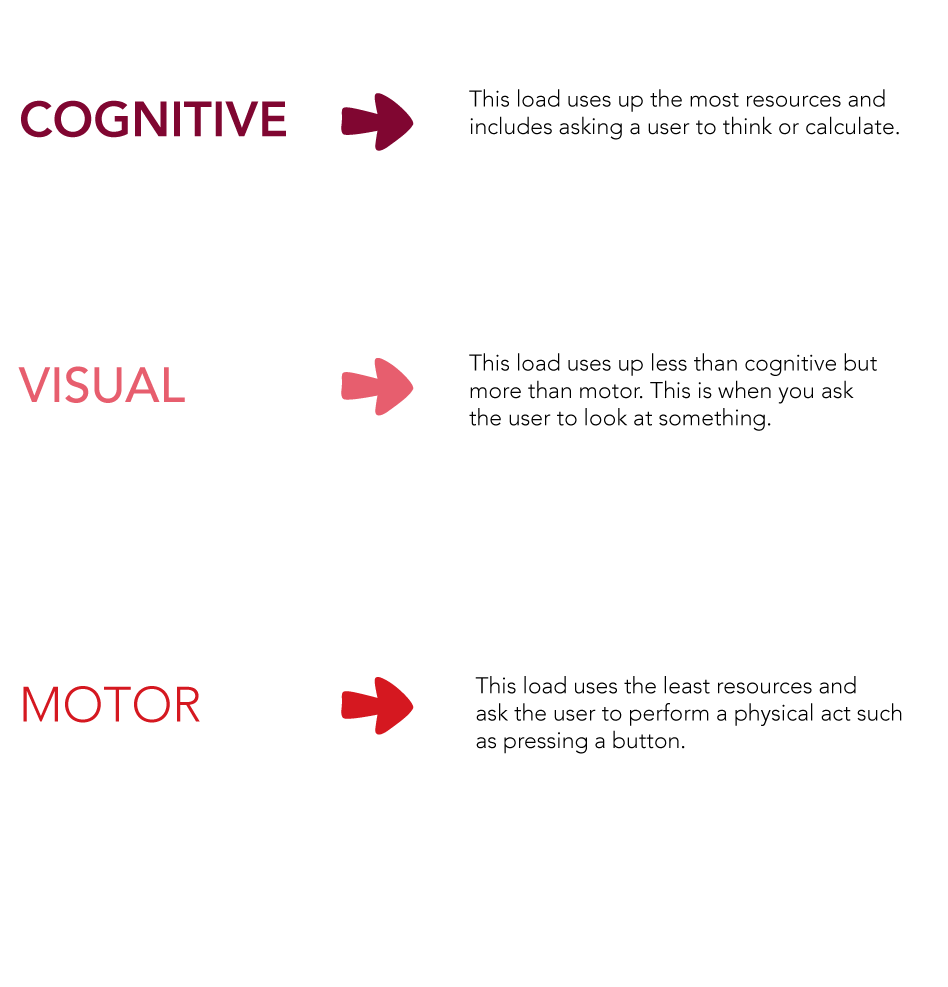
- Bildunterschrift: Loads represent the amount of mental resources used for each task you ask the user to complete.
-
Designing in the Correct Amount of Load
- Sometimes swapping one load for another can help improve the design. For example, a user would probably have an easier time understanding your design with more clicks (motor) and less thinking (cognitive) because the overall load is less.
- It never hurts to try and reduce the overall load of the product to make usability easier. Look for areas where you can remove a load without affecting the overall design and functionality.
- Always remember that using a cognitive load requires the most mental energy to complete. Too much cognitive load and you risk losing users.
- Most designs do better with overall lower loads. One of the exceptions to this rule is video games. In this format, load is purposely increased so that a person has to work more in order to solve the problem or advance to the next level
-
Science explains button size & placement
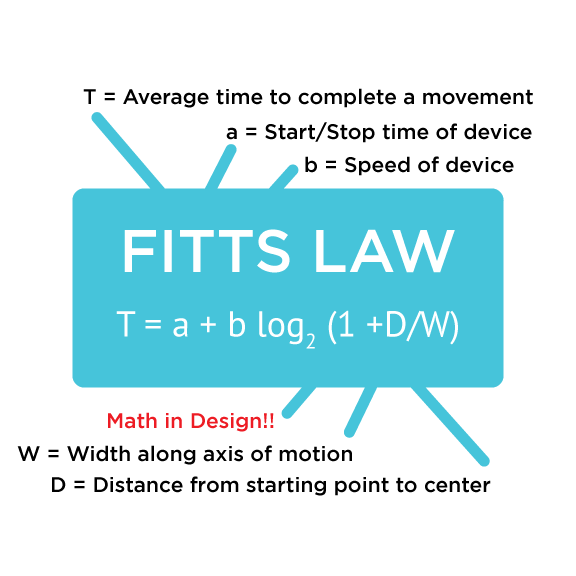
- No need to memorize this crazy equation!
- Simply understand that when placing items within an interactive design that there is a connection between time, speed, and distance.
- Making a button or arrow too small can make it more difficult for an end user to find and use it.
- The goal of good design is to work on lessening the loads put on a user. In other words, don't make them work so hard that they don't want to continue interacting with your website, design, etc.
- Bildunterschrift: FITTS Law is a scientific principle that helps to determine how big an interactive element such as a button should be.
Informationen
- Beschreibung
- Learning about different loads
- Erstellt von
- Gelöschter Nutzer · Mär 2018
- Aktualisiert
- 28 Mär 2018
- Aufrufe
- 24
- Tags
- Verlauf
-
- Erstellt von Julie Mastbrook · 28 Mär 2018
- Kopiert von Julie Mastbrook · 28 Mär 2018
- Bewertung